
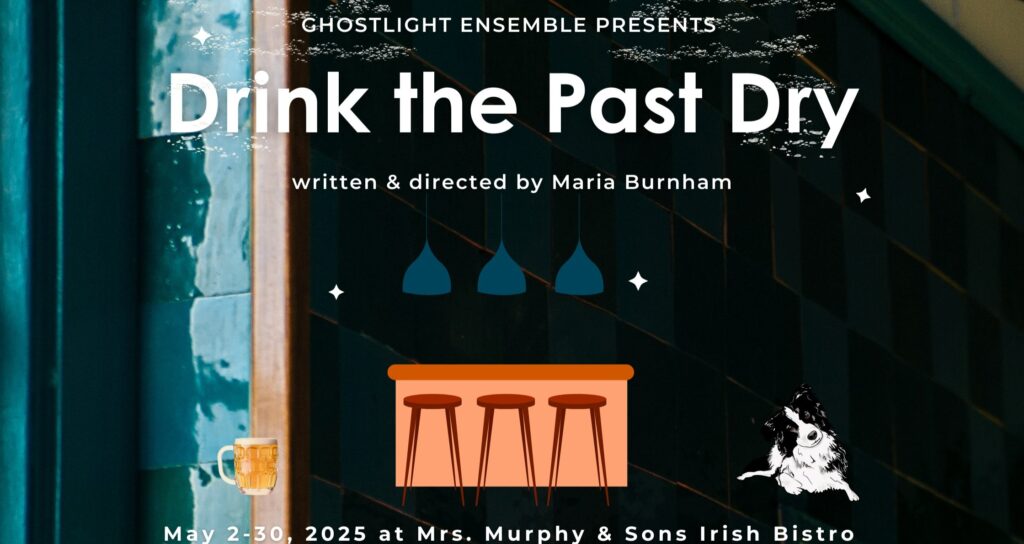
 **** The world premiere of “Drink the Past Dry” is a very touching presentation, currently playing in the upstairs bar at Mrs. Murphy & Sons Irish Bistro, in Chicago. Playwright Maria Burnham has created and directed the four vignettes which make up the play, all of which are loosely related to each other and based the same motif, namely, time travel. The story has somewhat of an affinity with “Ground Hog Day”, in its fantastical nature and constant repetition. While every vignette starts out similarly—with banter between the bartender (Khnemu Menu-Ra) and the regular Sidney (Alex Albrecht)—a different main character emerges in each instance, who has a unique reason for wanting to go backwards or forwards through time.
The premise behind the entire show is simple. For the low price of $5.25, the bartender serves each prospective time traveler a pint of some type of mystical beverage, which they must drink “in an average amount of time.” But first, he explains the rules: The customer must wish for the exact date they wish to visit the past or future. Then, whoever they want to see must have visited this particular bar at some point in their lives. The time traveler can only go back in time once and cannot change history or historical events. They are also not allowed to reveal that they are time travelers to anyone whom they meet. In fact, during the first two vignettes, the main character makes all sorts of excuses about who they are, why they are present in that locale, and why they seem to know so much about the situation which they find themselves in. Finally, once each customer has finished their pint, they will return back to the bar in the current era. Despite initial skepticism, the customers come to realize that their wishes can and do come true and that the bar is indeed magical.
The four vignettes are called:
1) “Kiss My Grits”: Jamie (Catherine Councell) wants to see her Memaw* (Dianne Wawrzyniak) once again. Not only does she miss her grandmother but she also wants to get her recipe for cheese grits, which has been totally lost after Memaw passed away. When Jamie goes back in time, she can’t let on that she is actually the woman’s granddaughter, all grown-up, so she pretends to be a cousin and refers to her as Aunt Arlene. But does she get the recipe? The title is taken from the phrase uttered by Florence Jean Castleberry (Flo) on the TV sitcom “Alice.”
2) “Mad Forest”: Chris (Valerie Cambron) wants to see her pet dog again. When she time-travels, she meets Bethany (Abbie Brenner), who “now” owns the dog. In the process, Chris learns something important about herself and her life that she didn’t already know. (Perhaps it’s my failing, but I couldn’t figure out the reason for the title.)
3) “Missing”: Mica (Katharine Jordan) wants to see her father before he got dementia so that they could have a meaningful conversation and could reminisce about the fact that he was once such a wonderful cook, restaurant owner, and dad. In a seeming violation of the rules, Mica is allowed to tell her dad (Stephen Dunn) that she is from another time period, because he’s “going to forget about it anyway.” Their dialogue is truly heartrending because her father is approaching his death. We meet Mica earlier in the performance when picking up food for takeout.
4) “The Past Will Catch You”: This vignette breaks the mold and is the most creative and poignant of the saga. (And it is the reason why this show is getting a four-star review.) Super-timely, relevant, and smart, it represents a cynical view of the future, and it is clearly the segment that was possibly revised as recently as last week. It is. As compared to philosophical speculations about whether one’s past is tomorrow’s future and so forth, here we gain a fascinating perspective which radically contrasts with the first three vignettes, which are ahistorical and family-focused and could have been written in any era.
In the prior segments, Sidney, the regular, has been keeping a journalistic record of all the time travelers and their adventures in a little book that he always keeps with him. Armed with these notes, Sidney not only knows all about time travel but now wants to experience it for himself. He wants to go back to the year 1975; but rather than returning home to 2025, he plans to permanently live out the next fifty years of his life from that point forward. To accomplish this, he figures out how to violate the rules of time travel which were previously set down by the bartender and followed by all the other travelers. As a consequence of this change in premise, this vignette has the most problems structurally. What makes things muddy is its multiple layered and sometimes mismatched timelines with its different incarnations of Sidney. Then too, we witness the past bartender (Catherine Councell) who once supervised the time travel. Despite the fact that the playwright has created a nexus of significantly implausible situations, this nevertheless provides the setting for the larger story’s most interesting and perceptive monologues.
Without revealing any great secrets (or perhaps I am!), Sidney believes the 1970s to be a much more copasetic time period than today. Not only does he consider the songs from back then to be some of the best, but for him, Watergate and its aftermath represented a sense of optimism about the United States’ collective future. It signaled a time when the rule of law had primacy, when great journalism was extolled, and when truth-telling was important. Above all, those in politics and government could be called out on the carpet for criminal activity. Americans lived with the knowledge that no one person (like President Nixon) was above the law and that those who violate human rights and civil rights can and do go to jail. The era thus gave rise to a hopeful generation of young people who were anxiously waiting for “the places you’ll go” rather than entertaining the thought of living lives of cautious uncertainty. Spoiler alert: Sidney does succeed in going back in time. But the underlying question remains: Is it good idea to escape today’s realities by retreating into the past, or is it better to look to the future with sanguinity?
Although this is a site-specific play relating to a bar, this is not immersive theatre. While the audience is indeed sitting in a real public house (and a lovely one at that), the fourth wall is never really broken. In other words, the audience is not involved in any of the vignettes nor do we interact with the actors. All throughout, we hear recordings on the sound system in the background: Pink Floyd, Led Zeppelin, Johnny Cash, etc. This only adds to the realism. The music is being played at the correct volume so that it doesn’t detract from the words being spoken. Casual costume design by Rin Menge works well for this production.
In the course of the 2-1/2-hour performance (with several breaks between acts), we learn that the bartender has “inherited” the power to send people back and forth in time, but he never changes in appearance; he is timeless. The bar is also meant to be timeless: that is specifically, Mrs. Murphy & Sons Irish Bistro. In advance of the show, I treated myself to a delicious dinner on the first-floor and also did some time traveling. I found myself transported to Ireland when I last went there in 1995. How wonderful is that?
“Drink the Past Dry” runs through June 1, 2025, and takes place in the upstairs bar at Mrs. Murphy & Sons Irish Bistro, 3905 N. Lincoln Avenue, Chicago.
Tickets are on sale now and are pay-what-you-will, with an average donation of $25.
Those audience members who are financially able to donate more than the average can help offset the cost for those who can’t afford to give.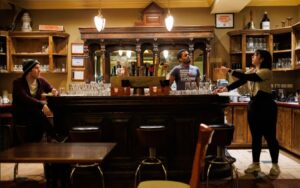
Performance schedule:
Fridays: 7:30 p.m.
Sundays: 3:00 p.m.
Additional performances: Saturday, May 3rd at 7:30 p.m., Saturday, May 24th at 7:30 p.m., and Thursday, May 29th at 7:30 p.m.
For more information about the show, go to: https://www.ghostlightensemble.com/drink-the-past-dry.
To purchase tickets, see: https://www.eventbrite.com/e/drink-the-past-dry-tickets-1299913679809.
For general information and to learn about Ghostlight Ensemble’s other offerings, please visit: https://www.ghostlightensemble.com/.
To see what others are saying, visit www.theatreinchicago.com, go to Review Round-Up and click at “Drink the Past Dry”
*Note that Memaw is an affectionate term for grandmother in Southern American English.



More Stories
“In Pursuit Of”
“The Brief Wonderous Life of Oscar Wao” reviewed by Paul Lisnek, Curtain Call Chicago
“The Play That Goes Wrong”