
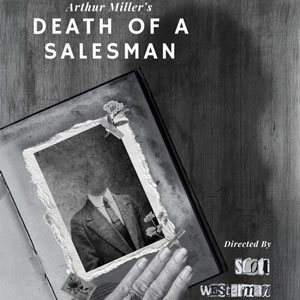
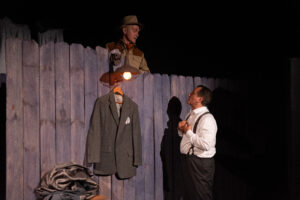
****One of the most memorable books I read in American Literature class was Death of a Salesman. On the surface, it’s the story of a hardworking, likable, easygoing salesman — Willy Loman — brought brilliantly to life here by Rick Yaconis. He’s a man chasing the postwar American Dream: marriage, family, a home, a steady job, and the sense of dignity that comes with it.
Behind Willy stands the true backbone of the family — his wife, Linda. Played with heartfelt realism by Annie Slivinski, Linda’s love and quiet strength make her the emotional center of this production. At times, you feel as if you’re seeing the story through her eyes.
When I studied the play years ago, our professor emphasized themes of capitalism and its failures. I saw it differently — as the story of a man whose mind is deteriorating, struggling with what we now recognize as dementia or early Alzheimer’s. Willy achieved his dream — a family, a home, and a career — but loses his grasp on reality as time passes.
His two sons represent two sides of that dream. Jimmy Piraino is strong as Biff, the eldest — once a high school football star, now a drifter haunted by his father’s expectations. Grayson Kennedy gives an equally strong performance as Happy, the younger son who chases success and pleasure but remains deeply unfulfilled. Kennedy embodies the restless energy of a man who wants more but doesn’t know what “more” means.
R. Slavick’s Charley, the neighbor and true friend, provides the calm voice of reason and compassion Willy desperately needs. Though the role isn’t fully fleshed out until the second act, Slavick grounds his scenes with quiet dignity. Terrence Mayfield shines as Charley’s son Bernard, whose success serves as a stark contrast to Biff’s failures — a reminder that hard work and education can pay off, even if the Lomans can’t see it.
Cat Hermes makes a memorable appearance as “The Woman,” Willy’s mistress. Her laugh — sharp and grating — perfectly captures the guilt and distraction that tear at Willy’s conscience and family.
To put things in perspective, Willy wasn’t as much of a failure as he thought. Earning between $1 and $2 an hour in the 1940s — when the minimum wage was just 45 cents — meant he was relatively successful. But numbers can’t measure happiness, and that’s the tragedy Arthur Miller captured so well.
This Gwydion Theatre Company production, directed by Scott Westerman and stage-managed by Catalina Nino, is one of the best I’ve seen. For a company only three years old in Chicago — originally from California — Gwydion proves it knows how to blend top-notch acting with Chicago’s trademark authenticity. The intimate upstairs space at the Greenhouse Theater Center (2257 N. Lincoln Ave.) suits the story perfectly, drawing you right into the Lomans’ world.
At 2 hours and 50 minutes (with one intermission), the show moves swiftly thanks to Westerman’s tight pacing and the cast’s emotional honesty. Tickets are just $34 at greenhousetheatre.org, and there’s plenty of parking nearby on Lincoln Avenue.
This Death of a Salesman is one play you shouldn’t miss — deeply human, powerfully acted, and heartbreakingly relevant.
” Death of a Salesman” will continue Thru – Oct 26th with performances as follows:
 Thursdays:7:30pm
Show Type: Drama
Box Office: 773-404-7336





More Stories
“The Brief Wonderous Life of Oscar Wao” reviewed by Paul Lisnek, Curtain Call Chicago
“The Play That Goes Wrong”
“Carmen” reviewed by Frank Meccia