

 *** Skokie Theatre currently presents Stephen Sondheim’s classic 1970 play “Company”, directed by Steve Scott and music directed by Jeremy Ramey.
The story’s protagonist is Bobby, a/k/a Robert, Bob, or Robbie (Graham Todd). For his 35th birthday, all of his friends decide to throw him a surprise party, complete with a large cake full of candles. On this milestone occasion, Bobby suddenly realizes that, of all his friends, he’s the only one who’s still single. As yet unsure, if not confused, about his need or desire for constant companionship, he feels compelled to figure out whether something is missing at this very moment in his life. So he chooses to look to his married friends to determine whether marriage might be suitable for him or not.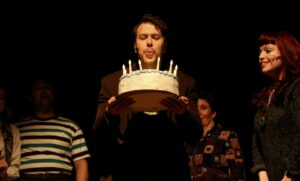
Most of the show is devoted to how Bobby and the audience evaluate the quality of his friends’ relationships. We witness personal flaws and mismatches among the various couples; yet despite their seeming unhappiness, all of them believe (each in their own way) that it’s important to form a loving partnership. When some of his friends see Bobby as remaining single, they assume that he must be lonely, and when they confuse being alone with being lonely, they feel that this is a tragic situation for such a good friend—and would prefer to see him being married.
One of the most telling lines is uttered at the end of the first act when Bobby’s girlfriend at the time says that she’s afraid to get married, whereas Bobby says he’s afraid not to be married. But it’s in the second act when Bobby pulls together his thoughts about his friends’ marriages: Not only does he observe their personality quirks and incompatibilities, but also their contempt for each other or their smothering each other with too much affection. He also notices their cheating on their spouses and their divorces, not to mention that one of them even wants a homosexual relationship in addition to their marriage (or possibly instead of it). And all of these things put together turn him away from wanting to be like them. Of course, Bobby realizes that not all marriages are the same and that being in a bad marriage doesn’t necessarily mean that the institution of marriage is a bad thing. He is also awakened to the possibility of what would happen if he were married and realizes that it might actually be what he wants and perfectly right for him. Yet he eventually figures out what bachelorhood means to him and decides for himself the advantages of remaining single—or at least for the time being as he comes to grips with the idea that he is free to do what he wants with his life.
The friends who have organized Bobby’s surprise party are made up of several couples: Sarah and Harry (Sarah Sapperstein and Conner H. Schroeder), Susan and Peter (Fatima Zahara and Aidan Sternberg), Jenny and David (Jenna Smith and Elijah Warfield), Amy and Paul (Jamie Todd and Gabriel Reitemeier), Joanne and Larry (Rena Ahmed and Aaron J. Godwin). The girlfriends whom he has been dating include Marta (Anna Seibert), Kathy (Kelly Killorin), and April (Natalie Pearl Evans). And I liked the ending where Bobby can finally blow out all the birthday candles on his cake, because his wish has finally come true! (But now you have to see the show to see what that wish is!)
Now having said this, the script is entirely too long and dull in spots. While the music may be iconic and while it captures Sondheim’s brilliance and humanity, it is much too repetitive. How many times do we need to hear songs about Bobby? To my mind, a good adaptation of George Furth’s book is necessary to shorten and sharpen the play and turn it into one act. This would be more consistent with modern tastes; plus, while a story about relationships is good, Bobby is not all that interesting of a character to follow (at least not in this production). Except for recognizing that he is in the crux of a dilemma, we know little more about him. We only know that his friends like having him around, because he is personable and always available to help out.
More to the point, the underlying story feels too dated and old-fashioned, because times have changed over the past 60 years. Timeless, however, are issues about how couples get along (or not) within the parameters of their marriage. But being married by a certain age is not as important socially and careerwise for a man as it might have been in the early 1960s when this play is set. With the changing in norms, being single in America today is more of an option than ever before. Plus, it is no longer revolutionary to be a committed couple without “benefit of clergy.” Finally, various ways of exploring sexuality, sexual orientation, and gender identity have become more normative in our current culture, and none of this is reflected in this play. Thus, the show is somewhat historical in the way that relationships are portrayed.
As for this particular production at the Skokie Theatre, the best part is the music and the live orchestra, made up of Jeremy Ramey (conductor/keyboard), Jeff Smith (bass), Adam Nigh (reed doubler), and Healy Hurst (drums). The singing and dancing are generally good. Sound design is excellent (if not a bit too loud), thanks to Elijah McTiernan in conjunction with Concert Sound Systems. I particularly liked the canned music at the top of the performance, like Frank Sinatra’s “I’ve Got You Under My Skin” (1956) and Elvis’s “Can’t Help Falling in Love” (1961), which grounds the performance and tells us something about the time period. Costume design by Kasey Wolfgang is appropriate for the era. Bobbie’s sweater with the horizontal stripe works well, and I especially liked April’s costume of red, which makes her stand out among the characters.
I realize that set design was intentionally minimalistic and innovative when “Company” was originally staged on Broadway: the point of which was to emphasize Bobby’s isolation. Unfortunately, at the Skokie Theatre, the set is so minimalist to the point of looking very amateurish. Although the scenes shift from being on a terrace to being inside an apartment to being outdoors, etc., it gets tired fast when all we see are blue curtained panels and a floor consisting of several raised wooden platforms of various heights. To put this another way, the set looks so cheesy so as to be laughable. On opening night, for example, there was one moment when Bobby’s girlfriend states that his apartment is beautiful with all of his masculine-looking furniture—and there was a bit of a snicker coming from the audience, considering that (with the exception of one bookcase) there is no furniture on stage. Also mildly comical was when the curtains parted at the Entr’acte to reveal the orchestra, followed by the conductor drawing them back together again. Even having a black scrim with the orchestra behind it would have worked better, because it would have given the audience something to look at and remark upon. The only thing that distinguishes the performance is a silhouette directly above the stage with an image of the New York City skyline. Even that could have been done better, as my guest thought it looked like a ship in a harbor rather than a series of buildings. While lighting helps to demarcate scenes, this becomes insufficient over time as the same barren set keeps getting reused. Missing from this production is a much wider stage so that actors could comfortably move from one (sparse) room to the next, thus allowing the audience to better distinguish among locales.
The story raises an important question: Who do you want for company throughout the course of your life? While many people are anxious to be married or to live together, this may not be the panacea for all. While one person might perceive marriage to be a suitable and appropriate way of life—if not a perfectly lovely sexual and romantic arrangement—another person might view wedded bliss as a sea of troubles. Today there are more alternatives in lifestyle and culture than when Bobby was examining his options regarding bachelorhood and marriage. Even when you have a loving partner and a solid relationship, sometimes you have to know when to take out time just for yourself. And the ending is hopeful: You have to be alive! And you are your own best company!
 “Company” is playing through March 1, 2026, at the Skokie Theatre, 7924 Lincoln Avenue, in Skokie.
General admission tickets – $48
Seniors/Students – $42
Performance schedule:
Fridays and Saturdays at 7:30 p.m.
No performance: Friday, Feb 27th
Sundays at 2:00 p.m.
Extra performances:
Wednesday matinee on February 25th at 1:30 p.m.
Saturday matinee on Feb 28th at 2:00 p.m.
For more information about this and other shows, please visit: https://gopher-halibut-ga77.squarespace.com/.
To purchase tickets, go to: https://gopher-halibut-ga77.squarespace.com/company or phone the box office at 847-677-7761 or visit in person 90 minutes before each performance.
To see what others are saying, visit www.theatreinchicago.com, go to Review Round-Up and click at “Company”.




More Stories
“The Drowsy Chaperone”
“White Rooster” Reviews by Al Bresloff and a second by Paul Lisnek Curtain Call Chicago
“Fully Committed” reviewed by Frank Meccia