
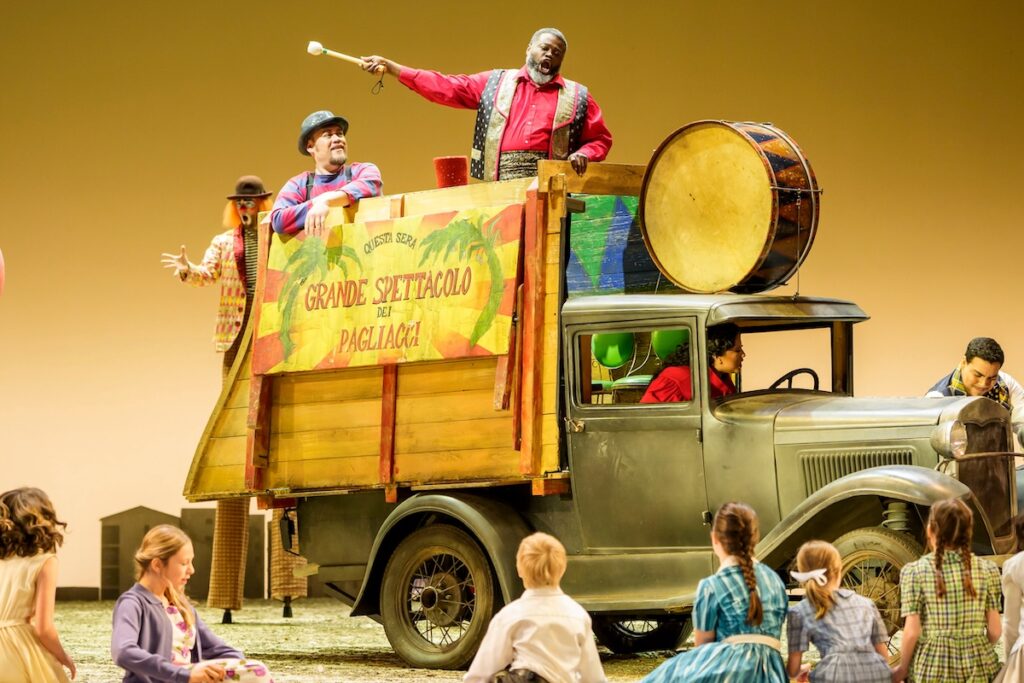
Thursday, Oct. 30, 2025 in Chicago. Lyric Opera Chicago Pagliacci Enrique Mazzola, conductor Tonio, Quinn Kelsey•• Canio, Russell Thomas Beppe, Daniel Luis Espinal• Villagers, Christopher Filipowicz, Hoss Brock Nedda, Gabriella Reyes Silvio, Luke Sutliff+ (©Todd Rosenberg 2025)
(©Todd Rosenberg 2025)
***** Cavalleria rusticana and Pagliacci: two Italian operas from the 1890s eternally united by being only a little over an hour long, one-hit wonders for their composers, and the only commonly performed entries in the verismo genre not written by Puccini. This double-header production originally directed by Elijah Moshinsky, with revival direction by Peter McClintock and conducted by Lyric Music Director Enrique Mazzola, returns to the Lyric Opera of Chicago this November. Pagliacci is particularly famous, and the image of the crying clown is recognizable even to people who have never been to an opera. Having been inspired by naturalism, the relatively recent and controversial nineteenth century literary movement that posited that characters should be represented as influenced by and as products of their social environment, they provide a lot of meat for analysis. But if you’re just interested in whether the performance is enjoyable, rest assured that the cast, pacing, design, and music itself all make for top-rate theatre that is accessible to people with any amount of classical music experience.Both operas are about fatal love triangles in the southern Italian countryside. First is Cavalleria rusticana, (Rustic Chivalry), composed by Pietro Mascagni, which takes place on Easter in Calabria. A young woman named Santuzza (mezzo Yulia Matochkina) is searching for her ex-boyfriend, Turiddu (tenor SeokJong Baek), at a tavern owned by his mother, Lucia (contralto Lauren Decker). Santuzza explains that Turiddu has abandoned her to return to his former girlfriend from before his military service, Lola (mezzo Camille Robles), even though Lola is now married to the rich and powerful Alfio (baritone Quinn Kelsey), who in this production is implied to be a mafioso. Santuzza is the only person in this love triangle to have been excommunicated, presumably because, being pregnant, she is the only one who confessed, and she wishes for Turiddu to return to her. However, when Turiddu enters and Santuzza confronts him, he points out that she is endangering him by spreading accusations, and that Santuzza should have known she would never have his heart. She cannot accept this and takes the obvious means of getting revenge.
In the play’s social context, it is almost certain that Turiddu was conscripted, that Lola married Alfio out of financial desperation, and that if Santuzza were not the viewpoint character, their situation could have been depicted much more sympathetically. But without that context being explicitly stated, the characters’ plight appears to be caused by their own immaturity. SeokJong Baek is a youthful and powerful Turiddu; he rolls in like a thunderstorm and clashes mightily with Kelsy’s older, more self-assured Alfio. Matochkina’s Santuzza is a sweet, contemplative, but naive girl, who despite her anger at Lola and Turiddu, is able to describe their situation in a straightforward manner and attempts to win back Turiddu’s passion with reasoned arguments. Moshinsky/McClintock’s direction has her meandering about the stage yearning for most of the run-time, her isolation standing in contrast with the very communal chorus, who are all quite busy hanging up decorations and celebrating Easter. Decker’s Lucia is a delight, always huffing and fretting, giving orders and carrying out her duties as a hostess. Framed by Michael Yeargan’s set and costumes, she truly seems a vision from another place and time.
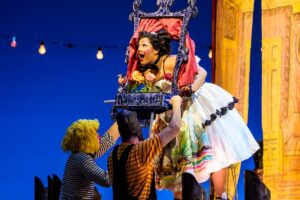
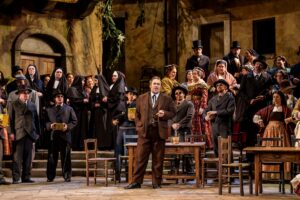
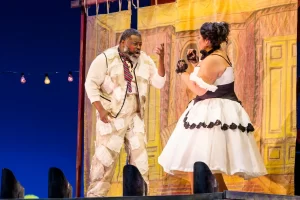
This production’s Pagliacci is set right after the end of World War II, when it really has been a long time since the comedia troupe last was in town. The ultimate play about actors who got too wrapped up in their roles, it depicts a group of clowns led by Canio (tenor Russell Thomas) who perform skits in which Canio’s wife, Nedda (soprano Gabriella Reyes), cheats on him with Beppe (tenor Daniel Luis Espinal), while rejecting the advances of Tonio (also played by Quinn Kelsey). In truth Nedda really is having an affair with a local man, Silvio (baritone Luke Sutliff), despite, or perhaps because of, Canio’s obsessive jealousy and hair-trigger temper. One might wonder why Canio chooses this as his troupe’s subject matter if he is that insecure, yet, when a man jokes to Canio that Nedda might betray him for real, Russell Thomas’s sardonic smirk before Canio violently intimidates the man into apologizing suggests that having an excuse to threaten people who laugh at him is Canio’s reason for playing the clown.
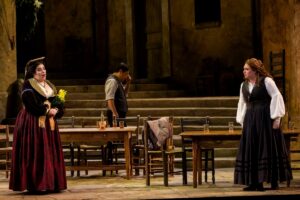
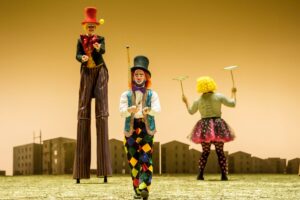
Pagliacci has a lot more action than Cavalleria, and this production adds non-speaking clowns to provide circus-style spectacle. It also depicts love and violence onstage instead of just describing it. Sutliff’s Silvio is a dashing but sensitive figure in his proto-greaser get-up, and Reyes’s Nedda is magnetically erotic both when she’s in and out of her clown persona. Kelsey’s Tonio, like Canio, chafes at how near the treatment of his character comes to his insecurities. As a disabled actor, Tonio’s role in the comedia is to be hissed and jeered at for thinking he’s worthy of a sexual relationship, and when his fragile ego is threatened by Nedda rejecting him backstage as well as before the audience, he needs to get Canio to kill her for him because he’s unable to overpower her himself. (Side note: I was struck by what an odd idea the residents of this town have about what kind of play is appropriate or enjoyable for children. When they realize Canio is serious about killing his castmate and someone in the audience, they chase the kids out of the front rows but otherwise just gawk.)
For anybody who has any interest in opera, hearing Canio’s aria “Vesti la giubba” is something that cannot be missed, and Russell Thomas’s rendition is an excellent blend of lyricism and acting. It’s also the only time in this production that Canio is depicted with any sympathy, even though he’s the face of the double production. Cavalleria rusticana is the more social drama, with a heavy feeling of inevitability hanging over events that are largely due to the characters’ differing social classes and treatment by institutions, while Pagliacci is much more character driven. Perhaps that’s why it could be more easily reimagined in a different time period. Still, the operas are often paired because they complement each other so well, and this production fully does them justice.
Cavalleria rusticana and Pagliacci will continue at the Lyric Opera House, 20 N Upper Wacker Drive, Chicago, thru November 26, with the following showtimes:
 November 7: 7:00 pm
November 9: 2:00 pm
November 12: 2:00 pm
November 15: 7:30 pm
November 20: 2:00 pm
November 23: 2:00 pm
Running time is two hours and fifty-five minutes with one intermission. There is also a thirty-minute preview talk an hour before the show.
Performances are in Italian with English supertitles.
The Lyric offers parking deals with Poetry Garage at 201 W Madison St. if inquired about in advance. Tickets start at $47; to order, visit LyricOpera.org or call 321-827-5600.
To see what others are saying, visit www.theatreinchicago.com, go to Review Round-Up and click at “Cavalleria rusticana and Pagliacci.”



More Stories
“In Pursuit Of”
“The Brief Wonderous Life of Oscar Wao” reviewed by Paul Lisnek, Curtain Call Chicago
“The Play That Goes Wrong”