

 ** Despite its well-defined narrative, great directing, fine acting, and marvelous production values, the world premiere of “Buddha’s Birthday” is not yet ready to make its debut. Whereas I adored playwright Amy Crider’s previous creation “Wells and Welles”, this one not so much. This is a very different type of story and tries to do a lot, having to do with philosophical issues and the internalization of differing worldviews. Hence, the play needs more precision in getting it just right.
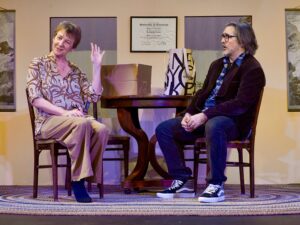
In “Buddha’s Birthday”, we watch the doubt-ridden Pamela (Kristie Berger) over time. The first two scenes are an excellent setup: We initially see her as a university professor, lecturing to her Western civilization class, when suddenly an inexplicable slide of Buddha makes its way into the presentation. This scene is followed by her husband Lawrence (Christopher Hinsworth), who gives a somewhat similar lecture to his Western civilization students. Then we see both of them in their home environment and learn that Pamela is up for tenure. An overly anxious individual, she has just gotten a prescription from her doctor for anxiety medication. But she doesn’t know if she can ride out her emotions or if she should take the drug or not or whether meditation and contemplation might be sufficient to calm her nerves. Basically, she has an ambivalence about taking pills to make herself feel better.
Pamela’s angst about whether she should or shouldn’t take the pills is a very good example of the microcosm that she finds herself in: having to do with how she might choose to lead her life. The crux of the story is that Pamela’s worldview and value system falls somewhere in between Western scientific rationality (which is rooted in the philosophies of ancient Greece and Rome) and Eastern religious thought (which emphasizes harmony with the universe and spiritual enlightenment through inner stillness). Her constant struggle between these ways of perceiving and understanding her existential situation makes up the bulk of the tale. Whereas this struggle is internal to Pamela, the show’s other cast members embody this source of conflict and opposition overtly in their respective characters. Just like Lawrence, Pamela’s mother Roberta (Kathleen Ruhl) sees things in terms of individualism, rationality, and striving to get ahead. This is in comparison to Pamela’s niece Jennifer (Ada Grey) who believes that life is worth living in accordance with one’s emotions plus the love of beauty. Hence she has an interest in attending beauty college: a decision that disappoints her grandmother.
There is a brief mention about how Buddha’s birthday us supposedly sometime in the spring and that Pamela celebrated it many years ago. And today they are celebrating her mother’s 80th birthday. When the story conflates both birthdays, I can only guess about the coincidence: It appears that neither the Buddha nor Roberta has been a satisfying presence in Pamela’s life. While meditation and stillness have often been elusive, so has obtaining a mother’s love. Apparently, Roberta does not understand Pamela or value her accomplishments and seems to love her sister Ellen more than her. That’s because Ellen has supposedly achieved great things with her law degree by becoming a criminal defense attorney, and Roberta respects her ambition and her career path. Therefore, she finds it okay when Ellen can’t make it to the birthday party, due to working on an important trial. In contrast, Roberta minimizes the fact that Pamela has written an academic book dedicated to her.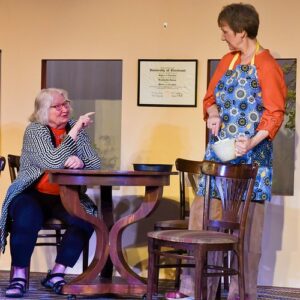
This is a contemporary play, which includes cell phones and ChatGPT. And it’s funny in many spots, especially whenever Ruhl takes the stage and steals the show with her zingers and her hesitations. Having her smoke cigars with Lawrence is a nice touch, providing the two of them with some form of relaxation in contrast with Pamela’s stress about doing meditation in order to quell her nerves.
Yet the play is problematic in a number of ways. For starters, it is too long at two hours with no intermission. One of its main faults is its overuse of words (something, ironically, which the story decries). In far too many places, a sentence of dialogue is followed by a sentence of explanation when the latter is unnecessary. Plus far too many portions of the script are repetitive for no good reason. One example is the joke said twice about putting Hume before Descartes. The joke wasn’t funny in the first place; and even if it was, there’s no need to say it again. I would also suggest that the playwright do a keyword search and see how many times a given word or phrase is being used—and then decide if it’s necessary to say it again or not. (Let start with the words “emotion” and “emotional”—a clever nod to Leonard Nimoy as Mr. Spock on “Star Trek.”) Then there’s the issue of pacing. The character of Jennifer needs to be introduced maybe ten or fifteen minutes earlier. This will help get the point across sooner.
Moreover, a number of tangents make the story more scattered than it needs to be. For example, there is the Betty Boop doll, which Pamela’s mother once gave her. That’s a thread which is somewhat funny and interesting, but it goes nowhere. I suspect that the leaking skylight is supposed to symbolize the intrusion of natural forces into a carefully manicured and organized home environment. If that’s the case, then the play really doesn’t need the the character of the wild raccoon that constantly wants to come into the house. This adds nothing further to the plot, except perhaps at the very end of the show… and then something else could have easily substituted. (Spoiler alert: What customer service agent would let a raccoon or any other small creature board an airplane without proper vaccination papers and without being stowed in a kennel, but I digress.) Having said all this, the puppetry by Emilie-Helene Wingate is wonderfully executed, and the raccoon nicknamed Bowie is cute and funny and provides a sense of comic relief when the characters constantly yell at it to leave.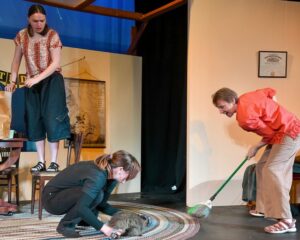
The directing by Iris Sowlat works incredibly well for this type of tale, as things move smoothly from scene to scene. Thanks to Kevin Hagan, scenic design is great. I liked the white backdrop on which the Pamela and Lawrence show slides at the beginning, plus the lectern. When the curtain is raised, we see a dining room with peach walls and a set of skylights. We never see the kitchen or the entrance to the home, and this works really well in conjunction with the script. Very imaginative is showing the sky above the house. I particularly like the lighting design by Alvaro Ledesma, who floods the house with a palette of colors to express various moods. But my favorite segment is the rain coming down very hard and at different speeds—and when we hear the thunder claps (Ledesma’s sound design as well) plus associated music throughout. Props are nicely crafted, and they feature curved dining room furniture and artwork and diplomas on the walls—not to mention backpacks, decorative shopping bags, a tofu cheesecake, a stepstool, and other accoutrements. The artistry could hardly have been better!
The play demonstrates the strengths and vulnerabilities of each of the characters, especially that of Pamela. Her existential dilemma is very real, as is the obliviousness of the other characters to her mental anguish. For them, the world is so much easier to comprehend than it is for her, because the ruts in the road have already been established and have precedent behind them. But Pamela feels the need to understand things from scratch and reimagine her entire life, which means reinventing everything on her own terms.
Despite the great ideas in this story, the script itself needs tightening. Once the necessary work is put in, then I can recommend the show. I’m anxiously awaiting a shorter, sharper next draft.
 “Buddha’s Birthday” is playing through August 17, 2025, at the Edge Theatre, 5451 N. Broadway, Chicago.
Tickets are $38.00 plus applicable fees.
Performance Schedule:
Thursdays, Fridays, and Saturdays – 7:30 p.m.
Sundays – 3:00 p.m.
For more information and to purchase tickets, visit: www.lucidtheater.com or https://sites.google.com/amycrider.com/lucidtheater.
To see what others are saying, visit www.theatreinchicago.com, go to Review Round-Up and click at “Buddha’s Birthday”.




More Stories
“In Pursuit Of”
“The Brief Wonderous Life of Oscar Wao” reviewed by Paul Lisnek, Curtain Call Chicago
“The Play That Goes Wrong”