
*** “There is only one future.”
This chilling observation is uttered by the historical villain who haunts “Berlin,” the latest world premiere at Court Theatre. While each one of us has our own set of unique experiences which shape us as our lives unfold before us, the characters depicted in “Berlin” are trapped in what feels like a hermetically sealed bell jar. There is no escape for any of them as the Weimar Republic crumbles around them. Love is in small order in this “Berlin,” but loss is prevalently abundant — the loss of innocence, the loss of ideals and, most sadly of all, the loss of hope. Mickle Maher has adapted the graphic novel by Jason Lutes of the same name, which features twelve disparate citizens of the German capital who each represent a specific archetype.
While some may consider the main narrative of “Berlin” to be the somewhat tenuous romantic relationship between the young artist Marthe Muller (Raven Whitley) and the journalist Kurt Severing (Tim Decker), this is most definitely an ensemble-driven show. All of the various stories combine and overlap to create an almost symphonic rhapsody, albeit one that can sound like a cacaphony at times. We meet a young firebrand anarchist (Ellie Duffey) and her laborer mother (Elizabeth Laidlaw) who works in the local factory. Terry Bell is polished and suave as an American jazz musician, Kate Collins is a bitter baroness holding on to her glory days, and Jack Doherty is simply charming as an awkward teenaged newsie exploring the possibility of love for the very first time. Rounding out the ensemble is Gus Van Swearingen as a union organizer, HB Ward as a disillusioned father, Molly Hernandez as a cabaret singer and Brandon Ruiter as the ghost of Marthe’s cousin. Also, Marthe develops more than just a platonic relationship with the sexually adventurous and boldly androgynous Anna Lenke (Mo Shipley).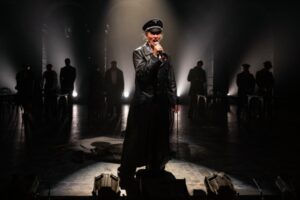
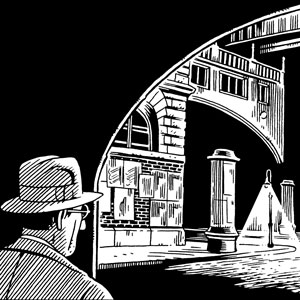
Since “Berlin” is based on a graphic novel, it is no surprise that the action takes places on a monochromatic black stage. John Culbert’s scenic design is heavily influenced by Romanesque architecture, from the massive brick walls with rounded arches located upstage to the onyx cobblestones which frame the stage’s apron. Likewise, the costumes designed by Jacqueline Firkins reinforce that stylistic aesthetic. Fabrics are all heavy wool or thick cottons, dyed the gamut from charcoal grey to the inkiest ebon. The only splash of color is the silver tinsel on the bodice of the baroness’ dress and the beaded fringe of its hemline. Tailoring is impeccable, especially the jet black velvet blazer worn by Shipley and the pinstripe trousers donned by Bell. However, the most striking design element of “Berlin” has to be the lighting created by Keith Parham. Utilizing a design plan which has 25 mixed fresnel and ellipsoidal spotlights mounted on poles on either side of the stage allows for some very dramatic images as light floods in from both sides. Also, at key moments, severe backlighting can nearly blind the audience (intentionally) but in more tender moments the footlights add a warm glow to the proceedings. Overall, Parham’s lighting can be stark and even jarring, but never cold.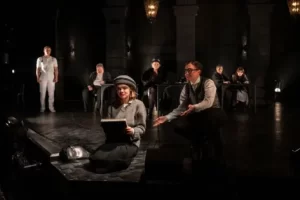
Director Charles Newell has done an incredible job of creating controlled chaos in many of these scenes. There are instances when this “Berlin” can feel almost like an agit-prop theater piece from the late 1960s, especially as actors drag tables across the stage to create irritating and grating rattles or knock over chairs in the path of each other’s blocking. But those are merely sensory triggers. Listen closely to what Maher has honed in on the most from the novel by Lutes. You will find that it’s the ubiquitious theme of time. While the events of “Berlin” occur between 1928 and 1933 (that monumentally significant year in Germany’s history), the fears and desperation that these characters experience are truly universal, especially as they face an uncertain future as their democracy dissolves. The poetic image of the river that runs through Berlin is a key element of Maher’s script, as several characters refer to the river as a solution, either as a means of escape from the city (or, more darkly, as an escape from life itself). As that river keeps flowing, so does time.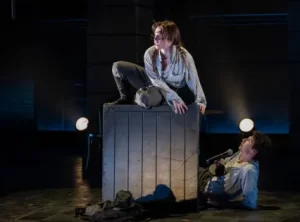
Newell’s production is informed by many different artists who share a Teutonic heritage. The spirit of Franz Kafka seems to be infused in the proceedings. True, Kafka was Czech, but he wrote all of his novels in German and even lived in Berlin for a brief period during his formative years. The concept of gender politics, particularly as it relates to the two youngest characters and their sexual awakening, is reminiscent of Frank Wedekind. The Brechtian device that Newell incorporates, introducing each individual character separately, seated at a table behind a microphone and speaking directly to the audience, certainly resonates with scholars of history who may be all too familiar with the House Un-American Activities Committee. For others, it eerily foreshadows the Nuremberg trials which took place a dozen years after the events depicted in “Berlin.”
_____________________________________________________
“Berlin” has been extended until May 18, 2025
Court Theatre is located at 5535 South Ellis Avenue, Chicago, IL 60637
Remaining performances are as follows: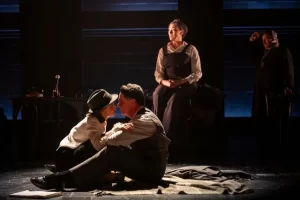
Wednesday, May 7 at 7:30 PM
Thursday, May 8 at 7:30 PM
Friday, May 9 at 7:30 PM
Saturday, May 10 at 2:00 PM and 7:30 PM
Sunday, May 11 at 2:00 PM and 7:30 PM
Wednesday, May 14 at 7:30 PM
Thursday, May 15 at 7:30 PM
Friday, May 16 at 7:30 PM
Saturday, May 17 at 2:00 PM and 7:30 PM
Sunday, May 18 at 2:00 PM and 7:30 PM
Tickets: Please visit www.courttheatre.org or call the box office at (773) 753-4472
Run time is approximately 2 hours and 30 minutes with one intermission
To see what others are saying, visit www.theatreinchicago.com, go to Review Round-Up and click at “Berlin”





More Stories
“In Pursuit Of”
“The Brief Wonderous Life of Oscar Wao” reviewed by Paul Lisnek, Curtain Call Chicago
“The Play That Goes Wrong”