
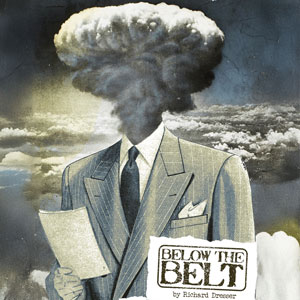
***** Delightful, wonderful, excellent! These were the words I heard upon leaving Friday night’s performance of “Below the Belt”, written by Richard Dresser and directed expertly by Jared Goudsmit. Dresser’s witty banter and highly proficient comedy are not only supremely funny and poignant but sublimely executed on stage. Acting by Jeremy Osinga and Garrett Wiegel is exceptional, with their impeccable sense of timing, together with their facial expressions, body language, and comic gestures. I was very impressed, and the audience loved every moment of it (as measured by their laughter). Of course, one would expect the plot to be relatively thin (as with most comedies), but a detailed storyline is wholly unnecessary for this 1-hour and 45-minute show (with one intermission) to move along quickly without skipping a beat.
“Below the Belt” is a humorous take on the corporate, assembly-line world of the late 1950s and early 1960s. In this play, Hanrahan (Osinga) and Dobbitt (Wiegel) are both checkers at a factory that creates units. But units are never specified, so we never know what product the company is making—or even what the checkers are checking for. All we know is that they observe the other workers and look at the product from afar to make sure that the units are being built correctly. If something is deficient, then it’s human error (and not any mechanical fault), according to their boss Merkin (Aidan Beasley). In addition to working under the same supervisor, Hanrahan and Dobbitt share the same living quarters: a small dorm-like bedroom in the middle of a desert. Hanrahan is the senior worker, who introduces himself and their shared room to the ambitious newbie Dobbitt. He explains that the bed by the window gets too cold and the bed by the radiator gets too hot. Having no Goldilocks Zone in between is a very good analogy for the way this show is constructed. The two checkers are depicted as extreme personalities, with Hanrahan (initially) delivering most of the comedic blows while Dobbitt is the more conventional straight man, much like the famous duos Abbott and Costello, and Laurel and Hardy.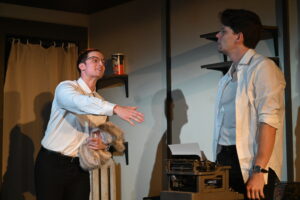
But then you have their boss Merkin, who gets his jollies by playing the two men off each other. One example of how this is done is very subtle: There is only one chair beside Merkin’s desk, and if he calls both employees into his office at the same time, then one of them is forced to stand. It’s a clever way to create subservience to the supervisor as well as competition for the prized seat. Another device that Merkin uses to create rivalry is to have his two employees respond to one beep or two beeps, depending on which person he wishes to summon to his office. Of course, there is some confusion at first about whose beep is which and how quickly the tones must be executed; this bit is silly and brilliant. As things become more ludicrous and as the characters become increasingly more ridiculous, the audience gets more and more sucked into the performance. Thus, it is no surprise that Dobbitt learns to act more and more like Hanrahan as he is acculturated to the preposterous circumstances in which he finds himself.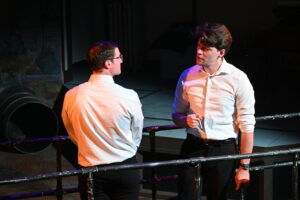
The story holds up a mirror to the prevailing culture of the early 1960s, where men of a certain age are married and are expected to be loyal to their employer and remain in the same corporation for the rest of their lives. And so they remain cogs in a vast corporate machine. This is depicted by Hanrahan and Dobbitt conforming to Merkin’s wishes by following his nonsensical orders and choose to please him even when they know better. While conformity helps to reassert the corporate hierarchy, there is simultaneously a pushback in the opposite direction, where each man wants to prove to himself that he isn’t being manipulated by his circumstances. So under Merkin’s sadistical tutelage, Dobbitt and Hanrahan are constantly encouraged to pick fault with each other and put each other down, while urged to get closer to their boss. Merkin’s strategy of creating infighting among his employees is thus designed to make them more loyal to him and walk on eggshells around him. At the same time, Merkin teaches his underlings to take great joy in toying with other people’s emotions and pitting them against each other, so that they might feel less threatened by their colleagues and (theoretically) more self-secure. Generally speaking, the more that all three choose to play games of dominance and one-upmanship, the more competitive and meaner they become. The irony is that all of them overtly claim that they want to be cooperative and work as a team. Despite the toxic workplace, the three are expected to socialize and have a good time together, especially when they attend a company party.
Set and prop design by Tom Fitzmaurice and Lilly Caines are carefully done. The stage is divided into three parts, one of which is Merkin’s office, complete with a 1960s desk phone and rotating fan. Another area is the room that Dobbitt and Hanrahan share, containing a drip coffee maker, 1920s typewriter, and 1940s phonograph. All throughout, the furniture is pretty much vintage. And the third sector consists of a double railing that is meant to resemble a bridge overlooking a polluted river (which exists in our collective imagination). Towards the beginning of the play, Hanrahan berates Dobbitt for wanting to look towards the prettier side of the river and insists that his junior colleague face the ugly side of the river with all the air pollution from the company’s manufacturing plant. Here we see the nicely executed mural by Eddie Corkery that shows two smokestacks and three electric poles plus a large sewer pipe, which at one point emits sewer gas via mist (with no offensive odor for the audience to smell). Then there are the songs that play as we are being seated. Among them is the 1952 hit “You Belong to Me” which is particularly prescient, as these three men “belong” to the company that they find themselves in; in other words, they are owned by it. The question on the table is whether or not they would be able to break free. To highlight the action, the original score by Alex Wiegel provides the necessary piano chords and music just where they need to be. Costume design by Emma Millisor is appropriate for the business environment of the early 1960s, that is, with all the men wearing white long-sleeved shirts and dark trousers. Sound design by Grace Patterson works well for this venue.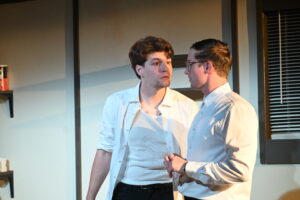
On opening night, Osinga played Hanrahan and Wiegel played Dobbitt, but the audience learns during a short talk after the show that the two actors swap roles over the course of the run, that is, from one performance to the next. This keeps the comedy fresh. The only issue I had was Dresser’s title “Below the Belt”, which has a somewhat different connotation nearly fifty years after the play was written. To my mind, a title that better clues us into organizational culture, corporate backbiting, and career ambitions would be more apt.
In short, this is great comedy and psychologically brilliant! If you are seeking a thoroughly enjoyable show which exaggerates your own likely frays with mean-spirited supervisors, inappropriate employees, cutthroat colleagues, and divisive and derisive office politics—and if you can laugh at the absurdity of it all—then this production is for you!
The play is only around for two more weeks, so I urge you to get your tickets now!!!
“Below the Belt” by No Dogs in the Kitchen Productions is playing through Sunday, September 28, 2025 at City Lit Theater, 1020 W. Bryn Mawr Avenue, in Chicago, on the second floor of the Edgewater Presbyterian Church.
General Admission Tickets: $16.88-$32.64
 Performance schedule:
Fridays and Saturdays at 7:30 p.m.
Sundays at 3:00 p.m.
For more information, visit: https://nodogsinthekitchen.org/.
To purchase tickets, go to: https://www.simpletix.com/e/below-the-belt-tickets-227311.
To see what others are saying, visit www.theatreinchicago.com, go to Review Round-Up and click at “Below The Belt”.




More Stories
“Hamilton” Reviewed by Paul Lisnek “Curtain Call Chicago”
“In Pursuit Of”
“The Brief Wonderous Life of Oscar Wao” reviewed by Paul Lisnek, Curtain Call Chicago