
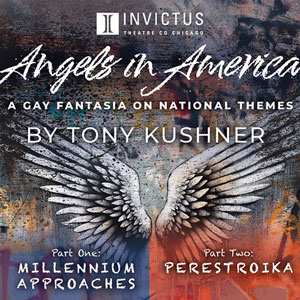
Part One: Millennium Approaches
Part Two: Perestroika
***** Tony Kushner has quite a lot to say. And with blunt force, he demands to be heard and taken seriously. His 1993 Pulitzer Prize-winning, epic masterpiece, Angels in America, takes the audience on a fantastical journey of death and destruction in Ronald Reagan’s America, yet spreads a message of life’s intrinsic value and our collective hope for the future. Through plagues and persecution, failing bodies and broken hearts, this is a transcendent and timely story of life itself, undergirded with a vision of the universe coming apart. This production presents these ideas in a moving, beautiful and unexpectedly bold way.
Explicitly molded as a reaction to the marginalization and contempt faced by the nation’s LGBT+ community in the 1980s and the horror of the HIV/AIDS crisis, Angels in America is a play about its time. Yet, it is a play of its time, and we should heed Mr. Kushner’s prophecies today, especially given the growing hostilities and threats to our gay, Black and immigrant communities by the current Republican administration. Angels in America reveals its myriad meanings and messages, and it does so against a specific context: the emergence of the LGBT community as a political force following a decade of people literally fighting for their lives in the face of a plague and a government whose silence and inaction was motivated by the intense hatred that lies just beneath mere tolerance.
This play is far from a relic of years past. Kushner, a true poet and master of language, presents his ideas on politics, love, life, religion, sex, and living an authentic life. In the process, he gives us a bed-side transfusion of timeless insights and the raw truth into the human experience. And the memorable characters and exceptional stage settings contribute to the depth and richness of this theater experience. A soaring, two-play epic that is a seven-and-a-half-hour marathon for actors and the production team (and the audience alike), this production is staged in two parts, “Millennium Approaches” and “Perestroika.” Invictus artistic director Charles Askenaizer is directing both parts of the drama, which is set in NYC at a time when an AIDS diagnosis was both lethal and stigmatizing. A single cast performs both parts in repertory, allowing audiences to experience the characters’ entire stories over a single day or successive days. You should see this in its entirety.
Set over the course of two months in 1985 and 1986 (with an epilogue in 1990), the AIDS epidemic is a key element of the story. Two characters have the disease. But that’s only a piece of it. Kushner subtitled the play “A Gay Fantasia on National Themes.” The national themes are many and worth revisiting today: history, equality, justice, freedom, race, political activism, spirituality, societal change, democracy and love. The play delves deeply into these themes, but does so most compellingly with abandonment-in-crisis issues and the resulting loneliness that soaks through and stays with each character in different ways. Each of these characters’ lives slowly becomes linked and entangled throughout the course of the play while giving us a powerful reminder of the terrifying reality of what it was like to be queer during a major health crisis impacting the gay community. This play is impactful and profound. It has been called Kushner’s magnum opus, and the deep love and praise this play has received is known far and wide in the literary world.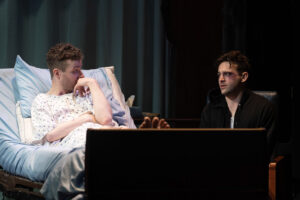
Early in Part One, we find ourselves in the Manhattan apartment of a young man named Prior Walter (Ryan Hake). It’s 1985, and Prior, a descendant of a distinguished American family, has AIDS. He’s only 30 years old, and when he gets sick and infirm, his anxious lover, Louis Ironson (Grant Carriker) looks into the crystal ball and bolts. Prior is at home, haunted by loneliness and his body’s slow failure, when he experiences some very strange phenomena, including a powerful recurring erection and visits from a couple of ancestors from the 13th and 17th centuries, both of whom experienced death and destruction in their times. After the ghostly Priors 1 and 2 vanish, in comes the Angel (Nicki Rossi). She is fabulous. Radiant and winged, she focuses intently on Prior along with her eight vaginas, leaving a few celestial orgasms in her wake.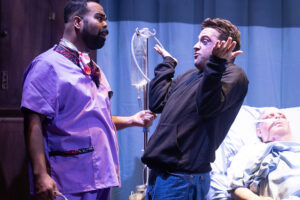
There are seven primary characters – eight, if you count the Angel. There is the hateful, closeted, litigious Roy Cohn (Michael D. Graham), who in real life helped “finance” the political and moral bankruptcy of Donald Trump and made sure Ethel and Julius Rosenberg were executed while he was Joseph McCarthy’s chief counsel during his crusade against communists and gays. Cohn is diagnosed with AIDS at the same time Prior is. But facts are a “matter of opinion” according to Cohn. He threatens to end his doctor’s (Renae Stone) career if his diagnosis is disclosed.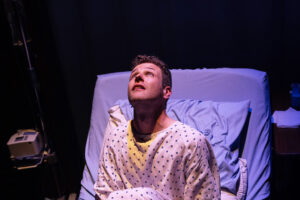
Cohn has a protégé named Joe Pitt (Joe Bushell) who has ambition but lacks direction. Just the kind of smart, attractive young man Cohn will seek out and manipulate to do his dirty work. Not realizing Cohn is gay, Joe can’t tell him or anyone that he is struggling with his sexual identity. Afterall, Joe Pitt is married to Harper Pitt (Anne Trodden) both of whom have been raised with strict Mormon values. Harper literally and figuratively flies high on valium airways as her awareness of Joe’s sexual proclivities and her increasing isolation continue to propel her downward.
At night, Joe leaves his wife and goes for walks to observe and connect with men in Central Park’s Ramble. When he meets the quilt-ridden Louis, they connect sexually. They are bound by their failures to be honest. In a breakthrough moment after some cohabitation, Joe strips off his Mormon undergarments suggesting to Louis that he is removing the barriers to a physical relationship. Louis is terrified of intimacy: he perceives it as a responsibility and during that time of AIDS carries the risk of having to care for someone in sickness.
Belize (Miguel Long) is a heroic, no nonsense nurse, a former drag queen, who works on the AIDS ward at St. Vincent’s Hospital in NYC. Belize seems to be the only one who deals in realism on a daily basis and tries his best to combat the worst of the terrifying reality of what it was to be queer during a deadly health crisis. Cohn, meanwhile, has exploited his political connections and privilege and has stockpiled a ton of a rare and promising AIDS drug, AZT, when few had access. Belize knows what a doomed slimeball Cohn is and shares his drugs with the needy, including Prior.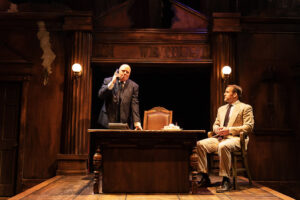
There is a beautiful moment of hallucination when Prior leaves heaven and returns to the real world, choosing life over the end of suffering, climbing down to return to his hospital bed. It’s inexplicably emotional, to see this animalistic pursuit of survival. The humor and feelings found upon his return makes the heartbreak more real and powerful.
Back to the Angel. Communing with the spiritual world appears to be an escape valve from the fag-bashing and internalized self-hatred. Part One is a more serious political drama; Part Two continues the tragic narrative within the framework of a dark, absurd screwball comedy. The weight of the first part adds to the humor. It’s a period of fantastical awakening and recognition following destruction, hurt and betrayal. There’s a sense of delightful, funny recklessness driving the piece. This is not a depressing slog as I seem to suggest. This is a powerful piece of political writing, theory and advocacy. It is also brilliantly funny throughout.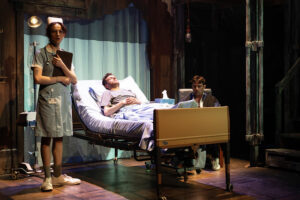
What makes Angels in America a testament to Askenaizer’s achievements is his well-chosen script; the skilled actors, several of whom are cast in multiple roles; and the sophistication of its production crew. The dialogue is sharp, witty, and the play is ambitious in its intentions taking on essentially a decade of complex American history. The performances are magnificent. There’s an energy on that stage, and is reflected back in the audience’s engagement and response throughout.
Michael D. Graham brings a terrifying ferocity and fear to Cohn’s character. Graham knows how to play a human monster and is utterly magnetic. Ryan Hake’s Prior is both deeply vulnerable yet strong. He artfully masks the frightened child within with a wonderful 1980s camp. Hake’s Prior becomes much more than a victim of AIDS but a prophet and brave forger for life and love. Anne Trodden, as Harper, is convincing as a highly damaged wife in a challenging role. She spends much of her time alone, unhappy and high on valium. When Harper and Prior meet “on the threshold of revelation” in shared hallucinations, they are wonderfully matched. The entanglement and connection between these two characters when they see into each other’s pain is riveting and soul-crushing.
After falling in lust with Louis and lying halfway between proudly out and Cohn’s I-don’t-have-AIDS-I-have-liver-cancer, is Joe Bushell. The battle that plays out inside Joe Pitt’s head ricochets throughout the theater and into our laps. Grant Carriker as the quilt-ridden Louis is epic in his word play, hiding behind his intellectual words and ideas. Kushner appears to take his own personal Jewish intellectual skepticism and pours a lifetime of feeling and guilt into Louis. Miguel Long as the dry and droll nurse, Belize, conveys a more opaque presence, wisdom and common sense. You feel his protective presence and compassion. Nicki Rossi is an angel that is absolutely remarkable and unforgettable.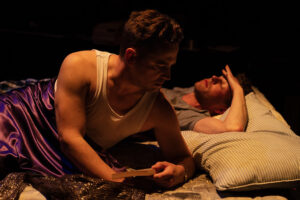
Renae Stone has the joy and difficulty of playing numerous roles spanning from Joe’s mom, a male doctor, Ethel Rosenberg, a rabbi, the oldest living Soviet revolutionary and an angel. She too, is sensational in her various characters, especially the unexpected connection as Joe’s mother, Hannah, forged with Prior. Hannah finds herself lost and adrift in Manhattan, with no connection to her son or daughter-in-law. She has been abandoned by them just like Prior has by Louis. This creates one of the most touching bonds throughout the entire show.
The production at the Invictus is both grand and intimate. It succeeds gloriously in its dichotomy. This is so poignantly presented under Askenaizer’s direction with his talented cast and production team. The effective scenic design (Kevin Rolfs), stage projections (G. “Max” Maxin IV), expert lighting (Brandon Wardell) and sound design (Peter Wahlback) expands and highlights every aspect of this play. Together, the production team effortlessly transitions the audience from one moment to another, emotionally and visually. The magic of the theatrical design and its production is noteworthy. This is quite an accomplishment given the epic scope and multiple scenes over the 7 plus hours of performance.
The costuming (Jessie Gowens) and wigs and makeup (Hannah Andruss) were perfect. Their work developed the characters, set the tone, created feeling and underscored emotions. Clothes and appearances help tell a story. But they should not become the story (unless you are that glorious Angel!).
At the end, the Angel announces, “The great work begins.” We will not die secret deaths anymore. To speak out is to live. Silence and hesitance equal death. My emotions ran sky high as, I felt, the Angel was asking me and everyone in the audience to speak for our many gone friends. To be, in effect, a messenger for all we wished they could say. Tears flowed freely for what has been lost and all that has been gained.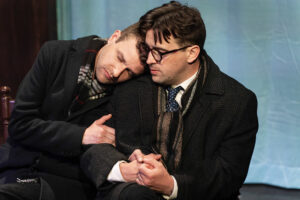
Invictus Theater boldly and brilliantly brought this astonishingly complicated piece of art to its stage. There is poetry and vitality in this. There is an ability to arouse deep emotions with its broad luxurious strokes. It’s both ordinary and mythic, funny and tragic. And like a great work of public art, this theatrical achievement is urgent and timeless and a gift to us all.
Listing Information:
 Angels in America, Part One: Millennium Approaches
and
Angels in America, Part Two: Perestroika
by Tony Kushner
directed by Charles Askenaizer
Parts One and Two will run in repertory through September 21st.
PART ONE: Millennium Approaches will play Fridays at 7 pm, Saturdays at 12 pm, alternate Mondays at 7 pm starting Monday, June 30; and Sunday July 6 at 12 pm, and Thursdays August 28 and September 4 at 7 pm. Final performance Saturday, September 6 at 12 pm.
PART TWO: PERESTROIKA will play Saturdays at 7 pm, Sundays at 12 pm, alternate Mondays at 7 pm starting Monday July 7; Thursday, July 3 and Friday, August 29 at 7 pm; and Friday, September 5 at 7 pm. Final performance Sunday September 7 at 12 pm.
There are no performances on June 29, July 4 or 5, or on August 30, 31 or September 1.
Windy City Playhouse
3014 W. Irving Park Road
Chicago
Tickets: Monday $25. Friday through Sunday $38. Multi-show subscription packages available.
To see what others are saying, visit www.theatreinchicago.com, go to Review Round-Up and click at ” Angels In America”





More Stories
“In Pursuit Of”
“The Brief Wonderous Life of Oscar Wao” reviewed by Paul Lisnek, Curtain Call Chicago
“The Play That Goes Wrong”