
**** It’s the seventieth season of the Joffrey Ballet, and to mark the occasion, the company has revived four works that were important moments for the careers of its early contributors. Those works, choreographed by co-founders Gerald Arpino and Robert Joffrey, founding company dancer Glen Tetley, and Martha Graham, whose modern dance vision inspired a new direction for the classic art form, originally premiered between 1962 and 1980 (although some of them are set to much older pieces of music), and are a tribute to how dance evolved in a relatively short time. Each piece differs widely in tone, and with eye-popping scenic designs, the accompaniment of Scott Speck conducting the lyric Opera Orchestra, and the Joffrey ensemble’s amazing versatility, make for a rich mixed program.
First up is “kettentanz”, choreographed by Gerlad Arpino in 1971, which combines several nineteenth century waltzes and gallops by Johann Strauss, Sr. and Johann Mayer. It begins with a line of dancers trotting it sporting enormous smiles and costumes designed by Joe Eula to resemble Austro-Hungarian Empire peasant garb. Around an enorous tree ( scenic design by Jack Mehler), they engage in swift, cutting displays of technique, one for each of the nine short pieces of music. It’s essentially a game of “look what I can do”, and with such joyous music, is an amusing diversion, though perhaps one that is a bit lost on people ( like this reviewer) who don’t have an eye for the skills of being showcased. At the performance I attended, Olivia Duryea especially stood out for the prolonged delicate intensity of her solo performance in Mayer’s “Schnofler Tanz”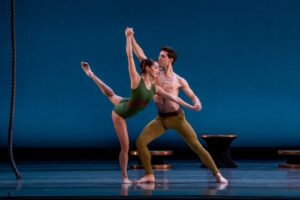
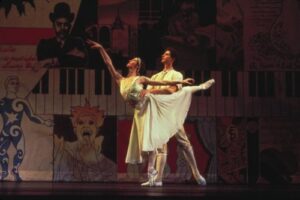
The second piece is “Secular Games”, a 1962 piece choreographed by Martha Graham, which is a beach episode set to music by Robert Starer. On what is described by the program as a “Socratic Island” a group of shirtless men attempt to one-up each other by posing with a ball as id they’re Hamlet contenplating Yorick’s skull, each demonstrating their superior intelligence as well as physical perfection. When a group of women enter, the competition turns to romantic rivalry, with the men and women self-sorting through elaborate . The tone is comedic. (one dancer withered and rolled offstage dejectedly after a man passed her over), but not in a mean spirited way. Following a pause, we get a more idealistic take on love with an exerpt from Robert Joffrey’s “Postcards”, a 1980 ballet he choreographed to music by Erik Satie about love in Paris. Mezzo-soprano Camille Robles sings in accompaniment to a Pas de Deux (Jeraldine Mendoza and Jose Pablo Castro Cuevas at the performance I attended) that depicts a whirlwind passionate romance. The original set design by Joe Brainard and Herbert Migdoll, costumes by John David Ridge, and lighting by Jennifer Tipton complete a vivid idyllic image.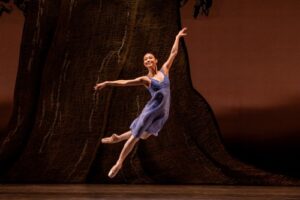
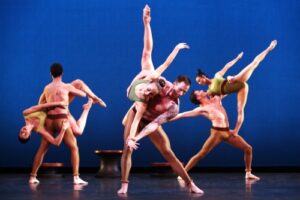
The longest and most dramatic piece is the fourth, which is also a Joffrey premiere. Glen Tetly’s 1973 “Voluntaries”, set to Francis Poulenc’s “Concerto in G Minor for Organ, Strings, and Timpani”, has the grandeur of a space opera. On a desolate moon or asteroid (set design by Rouben Ter-Arutunian), we see a heron-like courtship dance between the main dancers (Victoria Jaiani and Dylan Gutierrez at the performance I attended). The blaring organ is an ominous counterpoint to the lovers’ lighter theme, or perhaps, a commentary on the power of the propagation of life despite the vulnerability of the individuals. At other times other couples enter, often with men holding folded women aloft like in a ritual display, and sometimes the Pas de Deux on one side of the stage is balanced by a pas de Trois on the other. Ter-Arutunian’s costumes, white leotards with pastel-colored scales, are distinctly of the 1970’s.but still otherworldly. Watching the piece reminded me of reading Dune: a vision of the future that is of its era, but still expresses a wide-spanning vision. Personally, I found it to be the most affecting of the four pieces, but all of them still have something to offer even a casual dance viewer. For those with a deeper understanding of dance history, watching all of these fully staged in quick succession is an opportunity not to be missed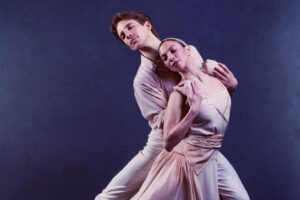
American Icons will continue at the Lyric Opera House, 20 N Upper Wacker Drive, Chicago, thru March 1 with the following showtimes:
 February 26: 7:30 pm
February 27: 7:30 pm
February 28: 2:00 pm and 7:30 pm
March 1: 2:00 pm
Running time is two hours and three minutes with two intermissions and one pause.
Tickets start at $46; to order, visit joffrey.org or call 312.386.8905.
To see what others are saying, visit www.theatreinchicago.com, go to Review Round-Up and click at “American Icons”


More Stories
“The Brief Wonderous Life of Oscar Wao” reviewed by Paul Lisnek, Curtain Call Chicago
“The Play That Goes Wrong”
“Carmen” reviewed by Frank Meccia