
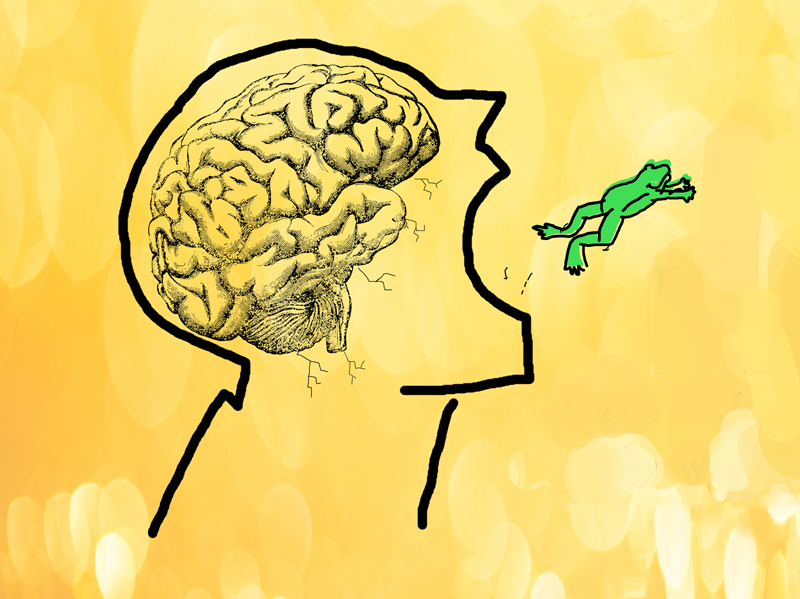
 ***** “A New Brain” by William Finn and James Lapine, with music and lyrics by William Finn, is a fun, cleverly conceived, and nicely written operetta. The main character is Gordon Michael Schwinn (Dakotta Hagar)—and it’s no coincidence that his last name rhymes with Finn! What’s so wonderful about this production is the brilliant directing by Jay Españo! The use of a relatively small theatre is remarkable, such that actors constantly go up and down the aisles and crisscross the floor from one end to the other. You don’t know when and where a particular actor might be located (on or off stage) or when a troupe of dancers might suddenly show up directly in front of you, entering from the main doors and cutting across the audience! Despite the fact that this play tells a very sad story, the music and lyrics make it funny and sweet, and the personalities and antics of the characters make the performance entertaining and hopeful.
The story goes like this: Schwinn is a songwriter who believes in the power of music, even though he is relegated to writing ridiculous songs about frogs for his ungrateful boss Mr. Bungee (Taylor Bailey). An optimist by nature, Schwinn also has an alter ego (in the form of Mr. Bungee) which serves as his naysaying and negative side. The problem is that Schwinn has suddenly become prone to seizures; and after collapsing for no good reason, it becomes clear to his mother Mimi Schwinn (Michelle McKenzie-Voigt) and his male partner Roger (Beck Hokanson) that something is very wrong. As both want to find the root of his problem, they and realize that something medically necessary needs to be done quickly. After a thorough physical examination, Doctor Berensteiner (Elijah Warfield) concludes that Schwinn is suffering from a serious brain disorder and that surgery on a defective portion of his brain matter is the only way to prevent seizures in the future. After the audience briefly sees the surgeon at work, we turn to the waiting room. This is followed by Schwinn’s recovery, supervised by the mean nurse Nancy (Britain Shutters) and the nice (gay) nurse Richard (Cordaro Johnson). In addition, Schwinn goes through a near-death experience… and we in the audience don’t have a clue what the consequences might be. Will he live or will he die?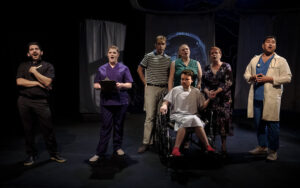
During his diagnosis and recovery, Schwinn’s mother and male partner want him to rest and heal as they try to get him through these tough times, as compared to his work colleague Rhoda (Caitlin Preuss), who wants him to continue producing songs for his job; it doesn’t matter whether he is laid up or not. When the minister (Jonas Davidow) comes into the picture, Schwinn spurns any connection with him. It’s not only because Schwinn is Jewish, but he is skeptical about religion and the seeming certainty of belief. Another character is Lisa, a homeless lady (Lena Simone), who appears from time to time throughout the show, breaking up the Schwinn story. She has all of her possessions in a shopping cart and looks for some kind of handout and other ways of making money. Kudos to costume designer Shawn Quinlan for creating a character who is a real character, who wears a bizarre but captivating outfit made up of a conglomeration of stuffed animals and beanie babies, especially teddy bears. That garment plus her force of her personality (and her direct interaction with the audience) makes Lisa a presence to be reckoned with! And for that matter Schwinn’s mother (a Jewish mother I might add, with her guilt, etc.) also has her own force of personality. Perfectly attired in her late 1950s dress, she immediately makes you think of a set of traditional values from that era, and yet she’s perfectly accepting of the fact that her son is gay.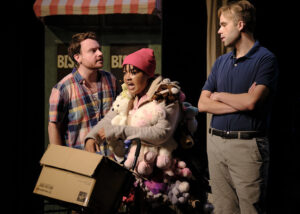
Choreography by Britta Schlicht is marvelous! I particularly liked the dancers dressed as ponies, corresponding to the fact that Schwinn’s father (with the crazy moustache) used to bet on horses, but is now out of the picture. This scene plays up the mother’s refrain that all of Schwinn’s bad qualities (whatever these may be) have been inherited from his father (and clearly, not from her). The song that accompanies all this riffing about bad genetics is so funny too! And of course, props design by Parker Vos makes the show special with all those rolling hospital beds and IVs and incidentals that are suddenly being brought in from the theater’s main entrance.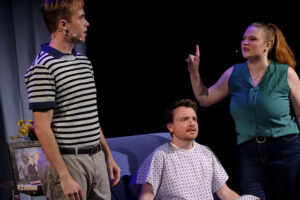
Lea Davis’s lighting is fantastic! I loved the outline of the brain on the back wall of the stage in LED “neon” lights, which turn different colors. Plus the lighting design not only adds to the uncertainty of Schwinn’s prognosis and outcome but spotlights the various actors and dancers as they move from one part of the theatre to another. Projection design by Connor Blackwood is excellent! We see all sorts of images throughout, from the realism of the ocean to abstract designs, but my favorite is watching the movements of the puppeteer’s hands during Schwinn’s near-death experience: one of the moments that he goes in and out of consciousness. The scenic design by Gael Owens is comparatively minimal, largely consisting of long white curtains upon which to display the projections. These curtains also serve to define various areas of the stage, such as demarcating a semi-private room or a surgical theater or some other space. While this is all very creative, what is lacking is a scrim to separate the actors from the musicians who perform in the background. On too many occasions, the musicians are much too visible when the curtains are parted. That being said, music direction by conductor and keyboardist Robert Ollis is wonderful, together with the other musicians in The New Brain Band: Eric Grunkemeyer (French horn), Benjamin Heppner (percussion), Adam Nigh (reeds), and Justus Wright (2nd keyboard/synthesizer). Sound engineering by Valerio Torretta “Val” Gardner could not have been better! We can make out all the words being sung. Above all, the actors have such beautiful singing voices! It is a joy to listen to them; with each one being better than the next!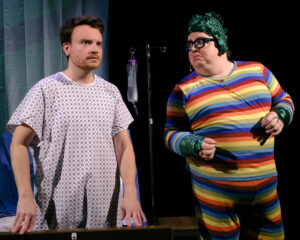
This LGBTQ-themed drama leaves us wondering about what is left undone in our own lives—and what is truly important about why we need to live. What will make us feel fulfilled? Is it love and relationships? Is it meaningful work? Is it dreaming about what we need to do in the future? We witness Schwinn’s agonies and those of his loved ones, especially when it comes to what he should do next and what risks he should take. Yet the intended result of obtaining “a new brain” after surgery is accompanied by the promise of a new approach to life and a greater appreciation of it. The show is a perfect balance of light and dark combined with self-doubt and angst over an uncertain outcome. The bottom line of this play is that music is healing and that music is magical. That’s the story being told in song and the essence of the tale itself.
“A New Brain” is playing through September 14, 2025, at the Hoover-Leppen Theatre on the third floor of the Center on Halsted, 3656 N. Halsted, Chicago.
Tickets: $35
Seniors and students $30.
 Performance schedule:
Thursdays, Fridays, and Saturdays at 7:30 p.m.
Sundays at 3:00 p.m.
For more information and to purchase tickets, visit: https://www.pridearts.org/ or call 773-661-0770.
To see what others are saying, visit www.theatreinchicago.com, go to Review Round-Up and click at “A New Brain”.





More Stories
“The Brief Wonderous Life of Oscar Wao” reviewed by Paul Lisnek, Curtain Call Chicago
“The Play That Goes Wrong”
“Carmen” reviewed by Frank Meccia