
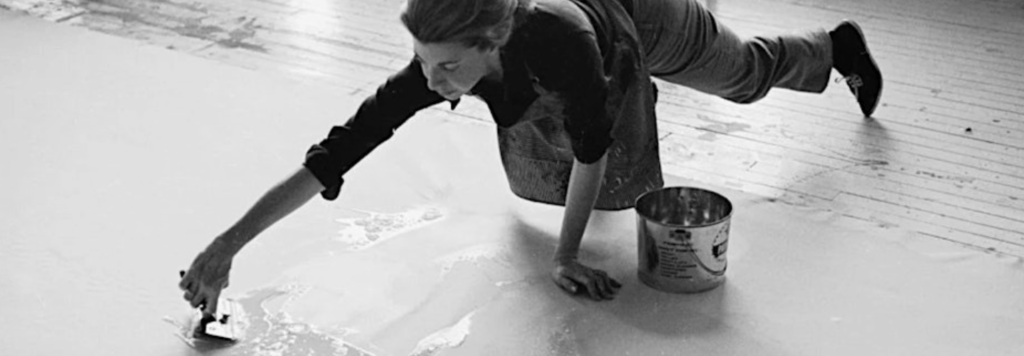
 ***** Helen Frankenthaler (1928-2011) was one of the most celebrated abstract painters in the United States when she started making prints in the early 1960s. She was best known for her innovative “soak-stain” technique, which involved using thinned paint directly onto canvas and watching how the result was not entirely controlled. She achieved her desired effect when colors would run together in unanticipated ways, thus creating spilling, splattering, and bleeding. Frankenthaler’s artistic rigor, using thousands of takes and trials to get a specific image the way she wanted it, has led to the depth and beauty of her creations. With the aim of creating from the subconscious, her end product becomes a vocabulary of color and a conglomeration of amorphous shapes and unexpected forms. This is an approach which has resonated with many artists working in abstraction.
The current exhibit entitled “Pouring, Spilling, Bleeding: Helen Frankenthaler and Artists’ Experiments on Paper” at Northwestern University’s Block Museum of Art debuts a recent gift of 34 works from the Helen Frankenthaler Foundation, part of the Frankenthaler Prints Initiative. In 2023, The Block was one of 10 university art museums in the U.S. to receive a portfolio of Frankenthaler’s prints and working proofs, along with funding to support interpretation and public engagement. And in addition to her works, today’s exhibit brings together those of successors and colleagues as well as those who were influenced by her work, including Joan Mitchell, Robert Motherwell, and Soo Shin.
Frankenthaler’s lithographs, etchings, woodcuts, stencils, screen printings, and monotypes generally contain multiple techniques and different processes, often creating soft washes of color. We can notice incredible variations of color when paper of different textures is being used, as well as differences when working with stone versus wood block in different runs through the printing press. Yet there are many artworks with harder, more contrasty designs. Upon entering the exhibit, one of the first pieces we notice is called “Altitudes” (1978) where the “swirls” rise from left to right, and the one next to it “All About Blue” (1994) is a lithograph and woodcut that gives one somewhat of a feeling of being underwater.
While Frankenthaler often worked alone to create paintings that translated into print pieces, she also worked collaboratively with printers and print shops. For example, one significant portion of the exhibition is devoted to her print “Divertimento.” In the early 1980s, Frankenthaler was invited to work on a lithograph at the University of Hartford print workshop in Connecticut. She worked with master printer John Hutcheson for over 18 months, with the pair spending hundreds of hours to arrive at the final print. The Block Museum owns 23 trials of her working prints that resulted in the final image, which is to be viewed vertically, while at the same time that she was experimenting with the same elements horizontally. During her trials, she experimented with colors that ranged from orange to light purple to dark navy, plus black and white, we can see her handwritten criticisms of how the work is to be improved or discarded, most notably a huge black X on one canvas. Her eventual color choice was basically a deep orange on pink. This series, in particular, reminded me of the proverbial Rorschach test, and I found it interesting that despite so many alterations, Frankenthaler kept one personified element throughout, which made me wonder if she saw the same thing as I did within the abstraction, either on a conscious or a subconscious level. And that is probably why the vertical print turned out to be the treasured one. (Now you have to visit the museum and see this image for yourself!)
My guest had a specialization in four-color lithography and a special affinity for much of Frankenthaler’s work, pointing out aspects that I might have otherwise missed. We got into a discussion about the grain of the wood being used in several of her works, particularly in the series called Tales of Genji VI (1998), based on 11th century Japanese tales. Number 241 was executed using one large piece of wood with a very deep grain and was one of our favorites, while Number 242 was done using a different variety of wood (perhaps birch as opposed to pine), with the effects of the thinned paint being very different.
My other favorites include Sam Gilliam’s three-dimensional drape painting (1970), using an untreated canvas (which looks like a small canopy), Sol LeWitt’s “Brushstrokes in Different Colors in Two Directions” (1993), made up of a visually appealing series of three canvases—a blue version, a gray version, and a red version, and Colette Stuebe Bangert’s “New Spring Greening” (1960), where you feel you could pluck out the dark pink roses from among the flowers in the field.
In all, Frankenthaler’s improvisation and spontaneity make her work fresh and compelling—and an inspiration to many other artists. The American painter Morris Louis once said, “Her work is a bridge between Jackson Pollack and what was possible.”
“Pouring, Spilling, Bleeding: Helen Frankenthaler and Artists’ Experiments on Paper” will be on display through December 14, 2025 at The Block Museum. 40 Arts Circle Drive on the Evanston campus of Northwestern University.
Free parking is available on the street, or after 4:00 p.m. in Northwestern’s Lakeside Parking Structure at 1 Arts Circle Drive.
Before 4:00 p.m. on a weekday, The Block offers free two-hour validation for parking in their automated garage at 1847 Campus Drive. Park on any open garage level. “When parking in the automated garage, take a white ticket on entry…. During your visit, ask our front desk team for a validated ticket. When exiting the garage insert your original ticket and the scan the second green validation ticket at the scanner. Validations offer two hours of free parking.”
FYI: A keynote lecture by author and scholar Alexander Nemerov will take place on October 17th at 6:00 p.m. for those who want to learn more about Frankenthaler and the other artists being featured.


More Stories
” To Be A Saint”!
Dyslexia and how you can make people aware- as discussed on Around The Town with Al Bresloff February 22nd
Wayfarer Theaters Highland Park “PRESENTS”!