
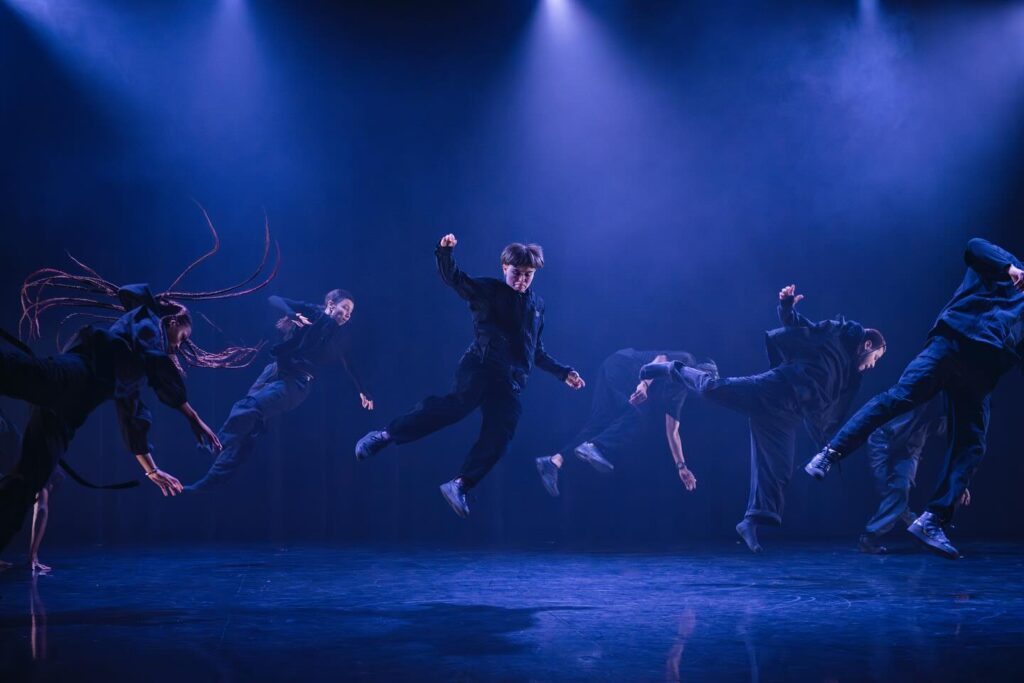
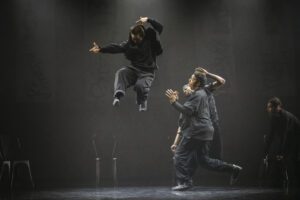
 **** “LXIV (six.four)” was a presentation of hip-hop dance unlike no other. Held on only two nights, March 14th and 15th, this was a production of Chicago Dance Crash, with movement and choreography by artistic director KC Bevis, bolstered by rehearsal director Phillip “Phree” Wood and choreographer James Morrow. It is an artform that is difficult and strenuous: I know, because I briefly took a class in it myself. There are lots of square, jerky, quick, and rotating physical movements that are hard on all parts of the body. Hip-hop fuses the idea of being “hip”—aware, sharp, in the know—with “hop,” a word rooted in motion. Reflecting the experience of marginalized communities, the dance form grew from its origins in the Bronx over fifty years ago into a nationwide movement and subsequently a global cultural force. Competition is built into its DNA: Dancers often try to top one another, echoing the contests and jam sessions that have shaped black artistic expression since the early days of jazz and blues.
The titular work that anchors the first half of the program has to do with the game of chess, and the term six.four has to do with the placement of a chess piece on the chessboard. It refers to the square in the sixth row/fourth column. The dance thus represents a battle between chess pieces, with the lowly but mighty little pawn being the one who ultimately occupies this square during a “shocking checkmate.” Before the onset of the dance, the audience is given some brief introduction about the chess pieces and the rules of chess; and during the dance, the curtain lifts to reveal the placement of each of the powerful pieces at one end of the board. “Each chess piece is brought to life as a fully realized character navigating power, hierarchy, and human complexity.” During the competition among the dancers to gain control of squares (and the board, by default), one tries to outdo and defeat the other using some combination of physical prowess and strategy. As the program states, “LXIV (six.four) begins on the Board and follows the journey of Pawn Roman. When she encounters the Players [meaning the other chess pieces], Roman learns that promotion on the Board is not easily granted—it must be earned.”
The second half of the program is called “Immortal Games.” This dance is related to the first and places this chess competition from the year 1851 into the history books, because of Roman’s personal growth. As the program states: “It is here that Pawn Roman faces a choice: claim their hard-won promotion and evolve to a stronger Piece or leave the Board altogether, rejecting its hierarchy, power imbalances, and predetermined roles once and for all.” The fact that Pawn Roman and all the Players are given agency is an important factor in this dance. After all the fighting is done, there’s ultimately a re-evaluation of human relationships, with the resolution being the end of the game. Here chess is used as a metaphor for life. It symbolizes restrictions in choice, given life’s structures that we are born into. It also represents some amount of freedom to move to gain advantage or to preserve one’s place or to sacrifice one’s ambitions.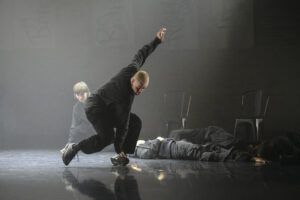
The characters are made up of Pawn Roman (Jalyn Willis) and the rest of the Players: King Subtle (Sawyer Newsome), Queen Era (Eryn Jones), Rook Arthas (Phillip “Phree” Wood), Rook Jan (Rodrigo “Rico” Mercado), Bishop Gram (Brien Parish), Bishop Creed (Nas), Knight X (Logan “L2K” Howell), and Knight Boo Boo (Ibrahim “RAH” Sabbi).
A driving, visceral beat unified the dancing. Its pulse through the Ann Barzel Theater was unmistakable. The music in the first half was an original sound score by e j e c t, whereas in the second half, the composer was Rob Flax, performed by Flax and James Morrow. “The musical score for “Immortal Games” was composed using Flax’s Chessboard Drum Machine, a groundbreaking creation that transforms a chess board into an electronic instrument using original software by engineer Shaun McFall.” Basically, McFall built a custom MIDI chessboard that generates sound in response to each moving chess piece, so when each dancer moves, a specific sound moves with them. As the advance piece states: “The dance score was largely improvised and guided by a set of rules that mirror the structure of the game itself, allowing strategy and instinct to unfold throughout every aspect of the work.”
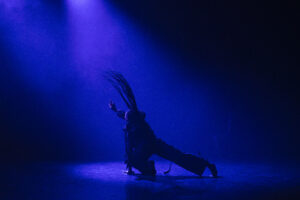
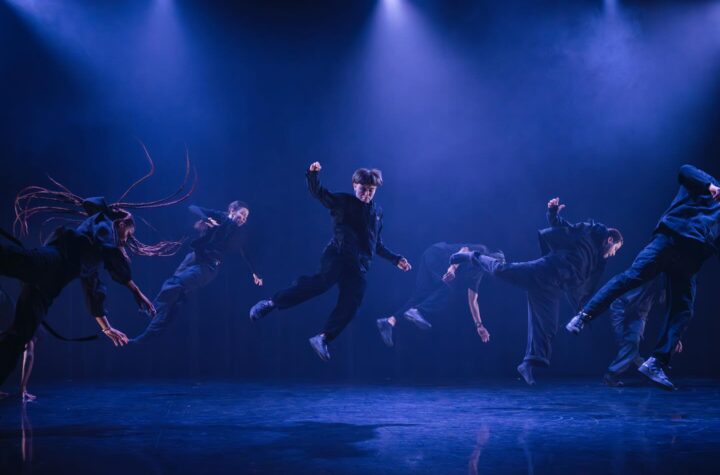
I loved watching how the dancers seemed to defy anatomy. They isolated body parts with such precision in the course of executing their astonishingly intricate movements. The choreography explored combinations of solo and group work. Individual performers, often met with cheers, delivered signature flourishes. The theater vibrated with energy as the young crowd shouted and laid claim to their favorites in battle with each other. I can only appreciate the hard work and vigor that goes into making this intensely physical art into such an innovative performance. The dancers definitely deserved all the cheering, hooting, hollering, and support from a vocal and enthusiastic audience last Sunday night. At the end, we gave the performance a long and loud ovation: a fitting conclusion to an exhilarating evening.
I’ve never been to the Visceral Dance Center before. It is a beautiful space, and you need to make it a destination if you want to see Chicago Dance Crash and experience different and surprising.
There were only two performances of “LXIV (six.four).” These took place on Saturday, March 14 and Sunday, March 15. 2026, at 7:30 p.m. at the Ann Barzel Theater at Visceral Dance Center, 3121 N. Rockwell Street, in Chicago.
Tickets were $25 for adults and $15 for children 12 and under.
For more information and to learn about their other offerings, please visit:
For more information, please visit https://chicagodancecrash.com/.
For questions or requests, email: info@chicagodancecrash.com
Note: I had a problem with the excessive amount of mist being used in the theater. While it may look very arty when the dancers perform under clouded and shadowy illumination, inhaling the extremely moist air is not the best thing for anyone with breathing issues.


More Stories
Enjoy March Hoops ( a/k/a March Madness) at American Place
Chicago Chefs Cook Presents: The ” I Cook For” Benefit
The “Oscars” 2026 Academy Awards