
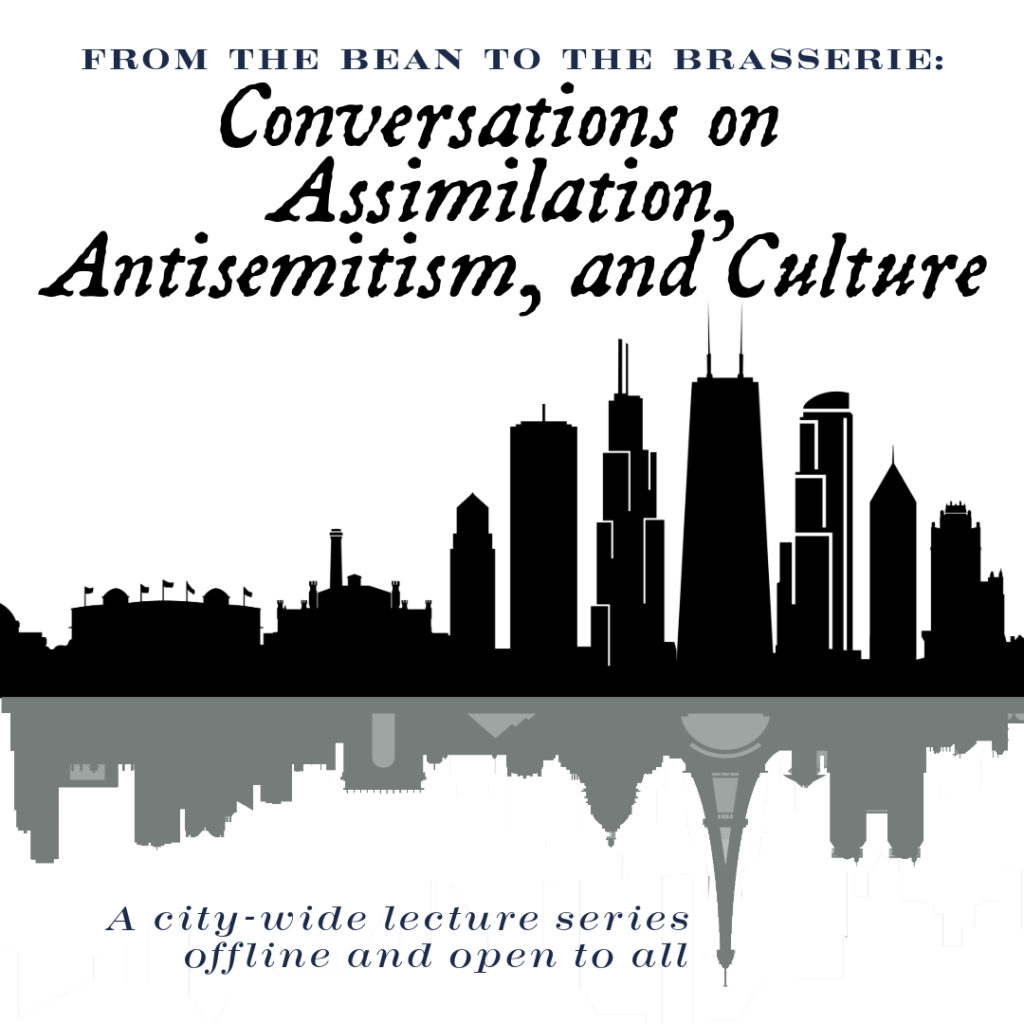
 Maurice Samuels, the Betty Jane Aniyan Professor of French, at Yale University, spoke about “Antisemitism in France: Past, Present, and Future” on Friday evening, April 11th at Theater Wit. The main purpose of his talk was to provide some context for the play “Prayer for the French Republic”, currently in previews at the Northlight Theatre.
Samuels started out his talk by explaining that France currently has the third largest number of Jews in the world, next to the United States and Israel and has been “ground zero” for antisemitism for many years. His lecture focused on placing antisemitism in historical context and developing parallels (and pointing up differences) between the situation in France today and that of its recent and historical past.
He explained the religious origins of antisemitism as having to do with the teachings of the Catholic Church. As a consequence, the Jews living in France were basically ghettoized and could only serve in traditionally ascribed occupations as money lenders or merchants. Although King Charles VI expelled the Jews from France in 1394, three small Jewish communities came into being after that year: The first was a community of Sephardic Jews, living in Bordeaux, who escaped the Spanish Inquisition in 1492; the second was a group who lived in Provence and belonged to the Pope (who wanted to retain his bankers and money-lenders). And the third and largest group were the Jews who lived in Alsace-Lorraine, which was not annexed as a French territory until 1648.
The major change in the treatment of France’s Jews came about with the French Revolution of 1789. That was when the ideologies of the revolutionaries prevailed: meaning equality before the law for all citizens and the belief in the universalism of all people. More specifically, it was in 1790-91 when the Jews were emancipated and Jewish men became full citizens. Among other things, they could now attend universities, work in the professions and in previously prohibited careers, and become a part of the civil service. Basically, Jews could now participate in modern society, and their social and economic aspirations were no longer restricted. The Jews, like all other minorities, were now expected to assimilate to French society.
For Samuels, the same equality that the Jews were provided under modern French law was also the same equality that later made them a target for antisemitic attacks. The fundamental issue was this: When the Jews and everyone else were now being viewed solely as individual citizens, this made for a type of secularism where the public sphere was kept completely separate and apart from religion. This created an official blindness towards religion and religious differences. Specifically, there was considerable resentment when Jews came to occupy increasingly visible positions during the 19th century and were elevated to “the highest levels of national life.” The example Samuels gave was that of the Dreyfus Affair, which took place beginning in 1894 when Captain Alfred Dreyfus, a Jewish artillery officer was wrongfully convicted of treason for communicating French military secrets to the German Embassy in Paris. French army major Ferdinand Esterhazy was the actual traitor (and was prosecuted for his crime), but despite the evidence, many Frenchmen refused to believe it. For nearly twelve years, discussions about Dreyfus’s guilt or innocence stirred up considerable division among the general public, even though the Jews were only .2% of the French population.
Despite the fact that France was considered a refuge for Jews who emigrated from Russia and Eastern Europe during the early 20th century, an undercurrent of antisemitism prevailed when many Frenchmen supported the Vichy regime in the 1940s and the persecution of France’s Jewish population. According to Samuels, one quarter of all Jews at the eve of WWII were deported or killed in the Holocaust. After the war ended, the French as a whole felt the importance of rebuilding the Jewish community and became “the greatest supporter of Israel.”
This was the moment when Samuels distinguished what he termed “the old antisemitism” from “the new antisemitism.” While the old antisemitism includes negative religious beliefs about Jews and proscribes the positions that Jews can hold in society, its definition has been expanded in recent years to include hostility to modernity and the modern economic order (i.e., globalism). In contrast, the new antisemitism is with reference to conflicts between Jews and Palestinians with reference to the Middle East and the State of Israel. Antizionism and demands for changes in Israeli policy have subsequently been tied to Muslim threats against individual Jews in France, many of whom have become targets since the year 2000 (for example, as with the Charlie Hebdo attacks in January 2015). Samuels ended his talk as follows: “What’s saddest and most dangerous is that ideas about antisemitism are being used as a political weapon and that radical imams are fostering antisemitic radicalism. There needs to be more effort to prevent this ancient hate from taking new forms.”
The evening wrapped up with questions from the audience. Some discussion followed about how people in France have reacted to the situation in Israel and Gaza after October 7, 2023. Yet the question on most people’s minds had to do with Samuels’ affiliation with Yale University. Considering that the Trump Administration is holding up funds to major research universities (like Columbia and Northwestern) because of presumed antisemitism, has Yale been so affected? The answer was this: “Not yet, not at the present moment.”
Samuels’ most recent book is “Alfred Dreyfus: The Man at the Center of the Affair”, published in 2024. In 2011, he became the inaugural director of the Yale Program for the Study of Antisemitism, which “promotes the study of the perception of Jews, both positive and negative, in various societies and historical moments, and also encourages comparisons with other forms of discrimination and racism.”
Maurice Samuels’ lecture “Antisemitism in France: Past, Present, and Future” took place at Theater Wit, 1229 W Belmont, Chicago, on Friday, April 11th at 7:00 p.m. Registration was free and required, and space was limited.
This “CityTalk” is part of a nine-event lecture series on the subject of “Assimilation, Antisemitism, and Culture”, sponsored by Theater Wit, Northlight Theatre, the Northwestern Crown Family Center for Jewish and Israeli Studies. These talks, inspired by the play “Prayer for the French Republic”, are being held in various venues throughout the Chicago metropolitan area during April and May 2025.
For more information about these upcoming events in the “CityTalk From the Bean to the Brasserie” series, go to https://www.theaterwit.org/citytalk/.




More Stories
” To Be A Saint”!
Dyslexia and how you can make people aware- as discussed on Around The Town with Al Bresloff February 22nd
Wayfarer Theaters Highland Park “PRESENTS”!