
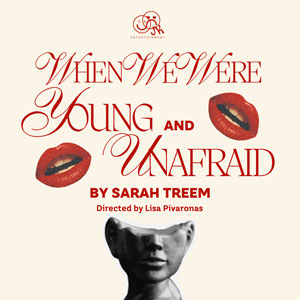
*** At the dawn of the second wave of women’s liberation in a pre-Roe vs. Wade America, we faced a crucial period when many societal gender rules were being broken or rewritten. This was a time of enormous benefits and potentially devastating risks. All of which Playwright Sarah Treem explores head on in JK Entertainment’s new presentation of “When We Were Young and Unafraid” now playing at the Greenhouse Theater Center under the direction of Lisa Pivaronas.
The title itself, “When We Were Young and Unafraid”, suggests that with growing age, wisdom and experience, the place of women in this country and the concerns about this issue remain warranted. Today, for example, reproductive health care for women is outlawed throughout much of the United States through active abortion bans or gestational restrictions. If that is not enough, our current administration has significantly reshaped how the Violence Against Women’s Act is enforced, funded and administered through our Departments of Justice and Health and Human Services, headed by political partisan puppets, diluting or eliminating core protections and provisions for victims of domestic abuse.
Past troubles or difficult journeys can be justified or perhaps don’t even matter if the final outcome is positive. Real, lasting human rights progress is yet to be realized and enshrined in the hearts and souls of America (or more accurately in the heartless majority of our political leaders). But lasting improvements are destined to happen if new generations of voters immerse themselves into the current toxic body politic and effect change. And it is with that frustration we go back to 1972 and begin this story, featuring four strong women’s roles and a token, broken male character.
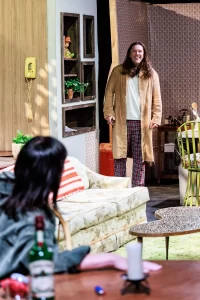
The play is set on a low-density island in the Puget Sound close to Seattle. We are transported believably into the cozy, slightly neglected home of Agnes (Laura Fudacz) and her daughter, Penny (Nicole Renee Stocks). Agnes is running a bed and breakfast, but secretly the house has served as a longstanding shelter for battered women. From the start of the story, there are immediate mother/daughter undercurrents of tension, generational divides and conflicting world views between the high-achieving high school senior and her mother, a former nurse who lost her license for performing abortions. In her isolation, Agnes seems out of touch with the changing times in that scarier world that is the mainland. The real action starts when a new guest, Mary Anne (Olivia Kaye DaSilva), arrives vulnerable, badly battered, scared, scarred and humiliated. And she loves her husband nevertheless, the guy who beat her up. DaSilva convincingly finds her character’s inner masochism throughout.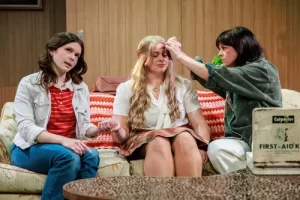
Staying in the Bed and Breakfast wing of the house, there is Paul (Tommy Martin), a flawed, failed and wimpy specimen placed to contrast the strength of the other characters and to demonstrate how low a certain woman can go around men (spoiler alert: Mary Anne goes quite low!). In walks a loud and bombast Angela Davis-type radical lesbian, Hannah (Danah M. Montgomery), seeking work at the B & B after noticing the business sign was falling apart. She is on the scene in search of a man-free commune. She holds radical views of who qualifies as a feminist and has redefined what lesbianism means. Yet, she ends up in Agnes’s house as the voice that cuts through perceived bullshit whenever she sees it.
Treem’s vast experience as a writer for major TV dramas has given her a fine sense of developing individual scenes or mini-dramas. Her female characters have little difficulty articulating their viewpoints or where they stand on the scale of political consciousness. Each comes from vastly different backgrounds and has differing notions of what womanhood means. This is an exciting premise in the well-written script that reveals many secrets and surprises as the story unfolds in a pivotal historic moment in this country. As you bring these characters into each other’s realm, you are sure to bring conflict, and suspense and intended humor. Many in the audience would not agree, but I found little to laugh about in between its more organic emotional intensity. Frankly, I felt mostly anger – not the intended levity – as women today continue to be held back, paid less, remain subservient, are on the streets homeless to escape physical and emotional abuse, and are fired by anti-DEI government initiatives a half a century later. OK. There have been advances, but not enough.
Throughout all of this, Laura Fudacz as Agnes, under her calm, steady-as-you-go surface, is simmering. A bubbling boil eventually breaks, and you will not be disappointed when she loses it. Fudacz’s climactic performance is highly convincing. I was charmed by Nicole Renee Stocks’ innocent performance as Penny. A young woman with so many innate talents, focus and intelligence suddenly is at risk of losing it all over a few adolescent mistakes. Olivia Kaye DaSilva’s Mary Anne, captures convincingly the intense, complex emotions of a battered woman along with the denials, hopelessness, lack of direction and a reliance on subservience to men as providers. Tommy Martin was sufficiently annoying and smarmy as his role required. Then there is Danah M. Montgomery as Hannah. This is an exceptionally strong, attention-grabbing and loud, raised-fist performance and harks back to the role of the militant communist activist Laureen Hobbs, played by Marlene Warfield, in the movie “Network.” Fudacz’s subdued demeanor balances beautifully Montgomery’s brashness, creating poignant moments in several scenes they share.
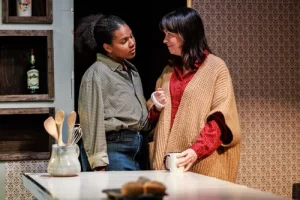
There are numerous points of authenticity in this production. The smartly designed set (Richard Keeley, set design) is of a place and time. The costumes (Jamie Kendall, costume design) are completely 60s and 70s accurate, and in Hannah’s case, course radical feminist attire. And kudos to the sound designer (Michael Incardone) with thought-out song choices of the era and the sound of percolating coffee. All of it works.
Finally, the intimacy of this experience forces the audience to consider their own thoughts and feelings about the many difficult issues and the shocking revelations disclosed that impact the lives of women. It was quite an unforgettable experience sitting in that theater watching this fiery portrayal, hoping some good will emerge from the bad. There is no example given of a healthy heterosexual relationship in this production. One can be left with a potentially pessimistic conclusion that there is an innate imbalance between men and women. But what left me with hope is seeing a powerful and selfless example of a woman helping women.
JK Entertainment presents:
When We Were Young and Unafraid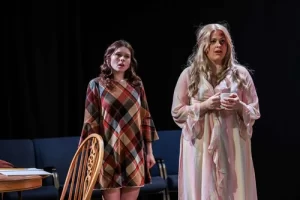
Written by: Sarah Treem
Directed by: Lisa Pivaronas
 Through November 29, 2026
Thursdays 7:30 pm
Fridays 7:30 pm
Saturdays 2:30 pm and 7:30 pm
Sundays 2:30 pm
General $41 (includes service fee)
Senior $36
Student $36
For this production, JK Entertainment has partnered with Connections for Abused Women and their children. $1 from every ticket sold will be donated to help support their efforts in the Chicagoland area.
Running time is 2 hours and 20 minutes including an intermission.
Greenhouse Theater Center
2257 N. Lincoln Avenue Chicago
Tickets:
(773) 404-7336
To see what others are saying, visit www.theatreinchicago.com, go to Review Round-Up and click at “When We Were Young and Unafraid”.



More Stories
” Big: The Musical” (Milwaukee) reviewed by Amy Menzel
“Jersey Boys” (Chicago) reviewed by Julia W. Rath
“Annie”