
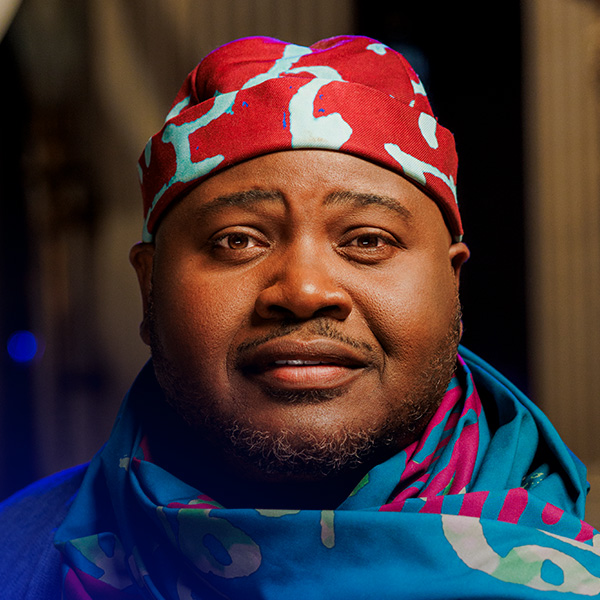
 ***** A full orchestra with a large cast of singing actors expressing themselves in your own language and in a musical style that is recognizable to you is an experience with great emotional power, but it’s rare for that to happen in English in what we consider opera. Therefore, it’s a treat to hear Omar, a Pulitzer-Prize winning 2022 opera with a libretto by Rhiannon Giddens and music by Giddens and Michael Abels performed at the Lyric Opera of Chicago. It tells the story of Omar ibn Said, the author of the only known first-hand account of slavery in the United States written in Arabic. The production, revived by its original director, Kaneza Schaal, and conducted by Kazem Abdullah, is visually vibrant but focused on the emotionality of its story, which tells how one man’s life was turned upside down by unimaginable horror. It’s also a beautiful piece of music that showcases America’s many heritages, and spotlights how Muslims have been present in the United States for longer than they are often credited.Omar (tenor Issachah Savage) is a Fula man in what is now Senegal who loves his faith and believes God will guide his community through turbulent times. His brother, Abdul (bass-baritone Matthew Dexter) disagrees, and believes the only way to ensure their safety amid the upheaval caused by European demand for slaves is to join in raiding their neighbors. Their mother, Fatima (mezzo-soprano Zoie Reams) wants Omar to dissuade Abdul from this, but Omar says people have to come to spiritual maturity in their own time, through their own struggles. Unfortunately, someone else has made a better deal with the slave traders. Their village comes under attack, Omar’s family is killed, and he is bundled onto a ship for nightmarish transport across the Atlantic Ocean with little hope of ever returning.
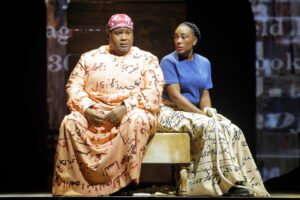 Enslaved people came from an enormous variety of cultures, and Omar has both a language and religious barrier with other Africans, as well as African-Americans and White Americans. What he can gather is enough, though. He observes a father poignantly talk up the value of his wife and son at auction in an attempt to get them good treatment. He hears a young man ahead of him to be sold grotesquely praised for his strength, in contrast with himself. He makes a friend, Julie (soprano Kearstin Piper Brown), who encourages him to flee to Fayetteville to work for her master, who she says is better than the one he ends up going to, and he memorizes the city’s name. The man who buys Omar can tell he thinks of himself as a gentleman and is offended by it, but Omar does flee. And although Omar gets caught, when he writes in Arabic on the walls of the jail, the townspeople are fascinated, and Julie’s master, Owen (bass-baritone Kyle Ketelsen), ends up taking him after all. Owen thinks it would be proving some sort of point to convert a man who is knowledgeable of the Quran to Christianity, and he likes to think of his plantation as the home to many talents. That gives Omar an idea about why he was called here, and he begins preaching.
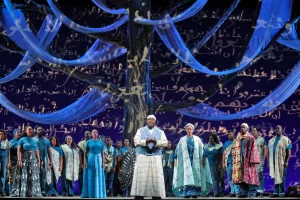
It’s easy to see why Omar won the Pulitzer for music. We can hear in it ballads, hymns, what would become bluegrass, and even old American songbooks. In one scene on Owen’s farm, enslaved people raise their spirits with dance (choreography by Kayla Farrish) that Julia explains as part of the difference between “waiting to go [to Jesus] and desperate to go.” Even a concert version of the show would be worth going to, but Schaal’s design team has put together a whirlwind of colors, which together with the chorus and dancers, makes the stage feel like a full, crowded world. The script calls for Omar to spend most of the show in a stupefied terror, but in addition to his sweet voice, Issachah Savage has a very expressive face that can convey both the pure sadness of Omar’s circumstances and the serenity he feels at prayer.
The real Omar ibn Said’s autobiography is only about fifteen pages long. It was also lost for most of the twentieth century, which is part of why it isn’t better known, and since Omar was never freed and was dependent on Owen’s agenda to get his story out, it is a lot more complicated than just a straightforward denunciation of slavery or account of his life. I might have enjoyed a work that wanted to engage with that complexity more, or that was more willing to imagine the inner life of a philosophically inclined, formerly privileged Muslim from a slave-holding society instead of shying away from putting words into a real person’s mouth. On the other hand, seeing the opera did inspire me to learn more about its source material, so it succeeded at one of its core goals, and at a time when Muslims are having their place in American viciously challenged, there’s a lot of value just in pointing out the reality that they’ve been in the story for a long time. Omar is a good production, and for those who continue to explore why its source material exists, it’s like the tip of an iceberg.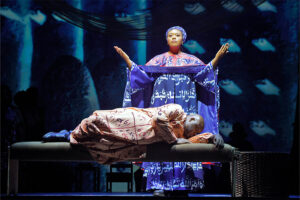
Omar will continue at the Lyric Opera House, 20 N Upper Wacker Drive, Chicago, through October 28 with the following showtimes:
October 28: 7:00 pm
Running time is two hours and forty minutes with one intermission. There is also a thirty-minute preview talk an hour before the show.
Performances are in English with supertitles.
The Lyric offers parking deals with Poetry Garage at 201 W Madison St. if inquired about in advance. Tickets start at $131; to order, visit LyricOpera.org or call 321-827-5600.
To see what others are saying, visit www.theatreinchicago.com, go to Review Round-Up, and click on “Omar.”



More Stories
“The Time Traveler” reviewed by Frank Meccia
“The Book of Mormon”
“Jersey Boys” 20th Anniversary Tour- MILWAUKEE