

 ***** Once upon a time, the lands were ruled by an irascible tyrant. A madman filled with conspiracies that only exist in his head. He is vindictive, demented, and his retribution harsh. He only hears what affirms his understanding of his self-serving, materialistic worldview. Kicking off their 40th anniversary season, Chicago Shakespeare Theater presents two Shakespeare productions in repertory with 14 extraordinary actors in simultaneous performances of The Winter’s Tale and A Midsummer Night’s Dream under the expert direction of Edward Hall.
As the contemporary parallels of The Winter’s Tale hit painfully close to home, Hall does not make a political spectacle of this work. This is an odd romance – both a tragedy and comedy at once – put to an ambitious pace, but never compromising the clarity and beauty of Shakespeare’s poetry. Shakespearian scholars have considered this later play to be one of the Bard’s “problem plays,” since it begins as an ugly tragedy but shifts to almost something silly and highly entertaining 16 years later in a country called Bohemia, famous for fairy tales and magic. Edward Hall is able to beautifully deconstruct this “winter’s tale” and present it in a fairly coherent staging, using the deep wells of talent and resources this leading theater company offers. Hall’s staging is striking for its intense drama and moments of delightful, colorful whimsy. The cast is likewise adaptable, finessing multiple roles, live music, a few choreographed pastoral romps, sheep impersonations, nasty conflicts and tender moments of budding love.
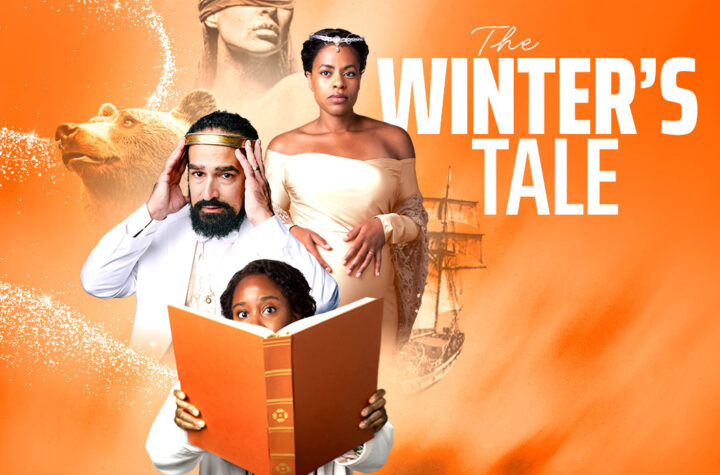
The Winter’s Tale begins with King Leontes of Sicilia (Demetrios Troy) who becomes irrationally jealous over the easy rapport between his pregnant wife, Queen Hermione (Jessica Dean Turner), and his close childhood friend, Polixenes (Chike Johnson), King of Bohemia. Hermione gives birth soon after to a daughter, Perdita (Felicia Oduh), whom Leontes refuses to acknowledge. The king imprisons his wife for treason and orders the infant to be abandoned and left to fend for herself in a far-off wilderness. Because of the king’s inexplicable pathological jealousy and his powerful position, his behavior destroys his wife, his only son, Mamillius (Felicia Oduh) and everything and everyone around him. That’s just the first half.
After an intermission, the action resumes 16 years later in Bohemia, which is governed by King Polixenes. Perdita has fallen in love with Polixenes’ son, Florizel. Angry at his son’s desire to marry the daughter of a shepherd, serious sparks fly. Hall manages to unite two discordant halves bringing the audience from the depths and darkness of the first Sicilian half to the verdant and bucolic world of Bohemia using a contrast of lighting (Marcus Doshi) and scenic and costuming (Michael Pavelka), sound effects (Emily Hayman), and to the entertaining music of “Sheep Trick” (Kieran McCabe, composer). This play moves with assurance, embracing the moods and inexplicable events from the depths of despair to reconciliation and resurrection. And ultimately to the magical unveiling of a living statue. The evening ends with a happy mass redemption and to a reunion of the entire cast of characters (both dead and alive).
This is not necessarily an easy play to follow. One minute there is romance. There is ugly raw emotion. There is an odd mixture of comedy and the supernatural. Hall’s production makes it work and he holds the entire cast to a consistent, serious standard of acting as he makes bold, creative chances with his staging. He is aided here by Jessica Dean Turner, who is on stage only intermittently, and who presents Hermione with ferocity, dignity, determination and charm; and by Issy van Randwyck in her steady, commanding presence as Hermione’s righteous confidante, Paulina. Demetrios Troy plays Leontes as a truly mad, soulless, unsympathetic character who can also show deep sensitivity.
In the lighter, “Bohemian” moments, Kevin Gudahl and Dan Haller give restrained performances as the old and young shepherds and help transition the story to more comedic fare. Their herd of sheep is unforgettable. Sean Fortunato, by deliberately overplaying his role of rogue crook, Autolycus, brings much needed and timely comic relief while demanding the audience’s full attention as he literally strips people bare of their belongings. He is a wild-haired, leather-clad cross between Tim Curry and Kiss. And very entertaining. The lovely young lovers, Florizel and Perdita (the exiled daughter of Leontes and Hermione), Esteban Ortiz-Villacorta and Felicia Oduh, are the picture-perfect future royalty right out of The Daily Star tabloid.
Then at the end of the show, the two worlds of Sicilia and Bohemia collide. You feel that it will truly require a miracle to bring these feral figures into harmony. There is loss and pain in this show that is not fully assuaged. Ultimately, there is pleasure, too, in this bittersweet tale. There is measured optimism. The story insists that healing and redemption are possible. And as we watch our own national tales of tyranny, there is hope. Even when hope has felt evasive for many of us and beyond reason or reach. To be reminded of this powerful message, even for only one night, is every reason to savor this winter’s tale.
Chicago Shakespeare Theater presents:
“The Winter’s Tale”
By William Shakespeare
Directed by Artistic Director Edward Hall
Through December 12, 2026
Performance Listing:
Tuesdays at 7:00 pm
Wednesdays at 1:00 pm and 7:00 pm
Thursdays at 7:00 pm
Fridays at 7:00 pm
Saturdays at 2:00 pm and 7:00 pm
Sundays at 2 pm
Note: Audiences can experience both repertory productions in one day: “The Winter’s Tale” and “Midsummer Night’s Dream” on November 21 & 24 and December 5 & 12.
Chicago Shakespeare Theatre is located at Navy Pier. Garage parking can be validated at the theater, so bring ticket with you.
More information at www.chicagoshakes.com or on social media at @chicagoshakes
To see what others are saying, visit www.theatreinchicago.com , go to Review Round-Up, and click on “The Winters Tale.




More Stories
“Hayward”
“The Years Between Us” reviewed by Frank Meccia
“Radical Futures” reviewed by Julia W. Rath