
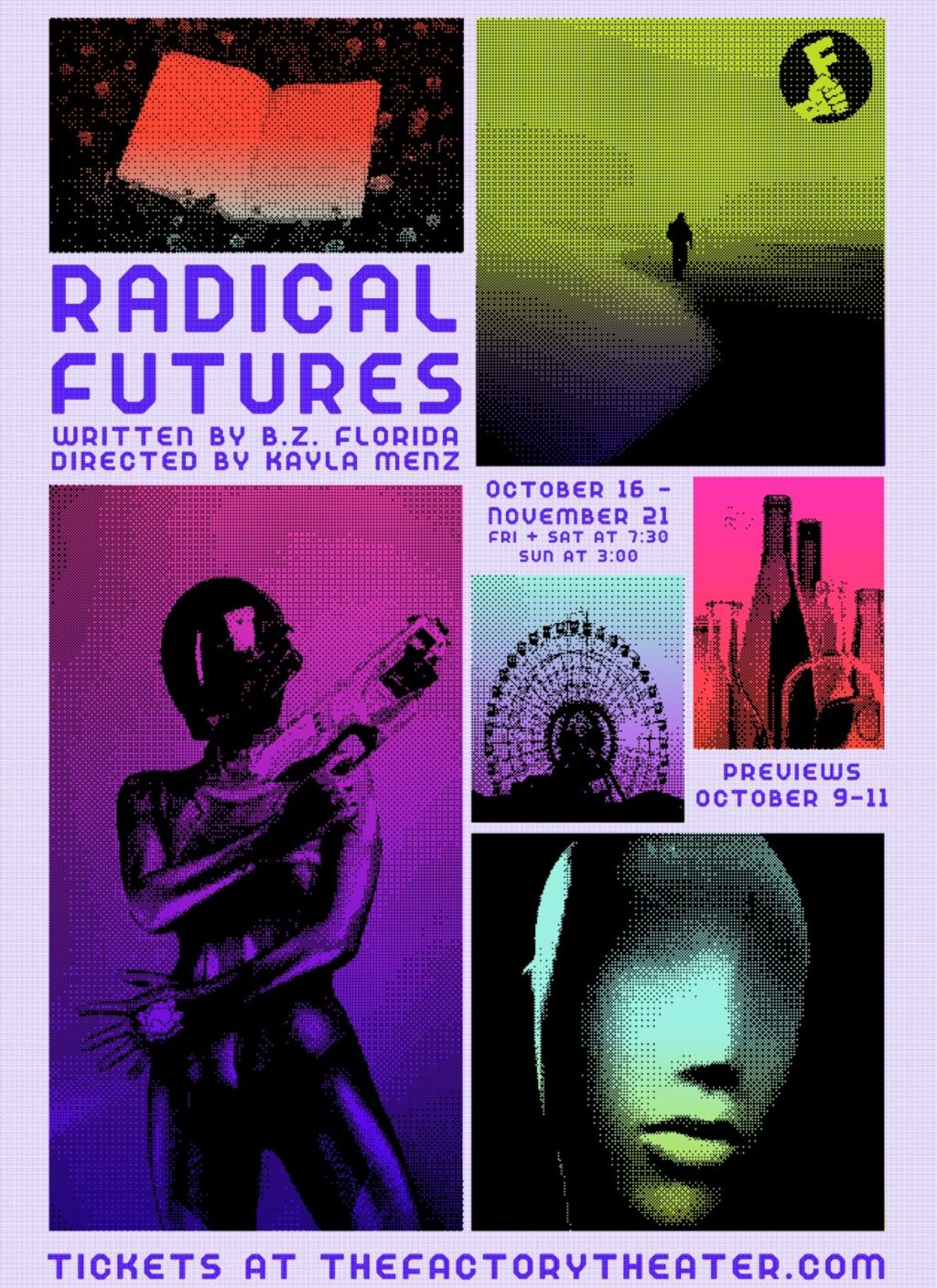
 ** Choppy and uneven, “Radical Futures” is a hodgepodge that lacks cohesion. Written by B.Z. Florida and directed by Kayla Menz, the play is centered around a failing dive bar. It seems that Neil (Eric Frederickson) and Warren (Bradford Stevens) once owned this bar together, but after a dispute concerning Neil’s deceased daughter, Neil bought out his business partner and hasn’t seen him since, that is, until today. Just around closing time, Warren walks into the bar and demands a drink. Neil is reluctant to serve him and says he’s already put in a long day. “Nine o’clock?” doubts Warren. Neil says it’s a Monday… and then grudgingly serves him a drink. They wind up not just having one cocktail together but several, and they rotate as bartender. They use different liquors and different recipes, and after the two drink the concoctions, they eventually toast to better times. But after each drink, the audience gets to see some new scenario, starring other actors in novel times and places. We are told in the press materials that the two men “try to reconnect over hallucinogenic cocktails that trigger visions of tomorrow”, but it’s never clear from the acting whether these cocktails are that potent. It is also debatable whether their “sci-fi visions grow wilder and more intense” and whether both men see them or only Neil.
So let’s pull this show apart. It is billed as a science fiction story, so I took a guest with me who has read lots of sci-fi books and is otherwise well versed in this genre. She pointed out to me that the various liquors being used in this show have the names of famous science fiction writers. I would not have caught that, although I did notice that they once created a drink called Dystopia. However, neither she nor I could see the connection between the name of the sci-fi writer and the vignette that followed. “Maybe if I studied each scene more, I could figure out some kind of connection,” she said. But off the top of her head, she could not see it. Nevertheless, this begs the question of whether the audience ought to know more about authors of science fiction before walking into the theater.
The play is basically constructed as follows: Six scenarios are intercalated between scenes featuring Neil and Warren serving drinks to each other. In the first scenario (that is, after the first drink), a man hires two women (Annie Beaubien and Hannah Mary Simpson) to kill off his girlfriend (Squeek Rangel). There is some humor in the way that this scene is devised, but for me, the vignette had nothing to do with science fiction or the future. The second scenario is about a career counselor (Simpson) who is unhappy in her job. This is revealed when she has trouble dissuading a college woman (Rangel) not to go into the same field as she did. She prefers to counsel those who would be miserable in their jobs but would stick with them for the rest of their lives. While there is something here about a person’s future and some cleverness in the turnabout, there is no science fiction element once again. All this seems particularly irrelevant to Neil’s and Warren’s relationship. In another scenario, Kelly (Beaubien) and her father (Matt Chester) fight with each other about the fact that he indentured her to a company called Mournful Entertainment at the age of 15 rather than having her live with him at home and attend high school as a typical teen might do. Now that she is an adult, she lets him know how upset this has made her. It’s an interesting premise, but it doesn’t go anywhere. With some tweaking, the vignette could point to a dystopian future. But as it stands, Kelly’s circumstance could have happened in nearly any era.
In my favorite vignette, Beaubien plays the part of a robot and is fantastic in that role! At a time when there are no more humans left on earth, a robot has a defective part and wants to dig up the body of a “dead robot” in order to replace it. If a robot has no soul, then there should be no issue with snatching a replacement part. But the robot preacher (Chester) wonders whether that might defile the body. We learn that he was originally human but, over the years, gradually replaced each and every one of his body parts with robotic parts and mechanisms. The question becomes where his human soul went and where is it buried… and whether a robot capable of self-consciousness could potentially wind up in hell. Or is hell simply a human construction? To my mind, it’s worth getting a ticket just to see this portion of this show.
Then there are two separate scenarios being led by an alien being (Rangel), who has come to earth and seems to be calling the shots (pun, intended). This alien gets the audience to clap during both scenarios where there is literally a battle of words. The first time, two women are launching a word at a time to wound their opponent, whereas the second time, it is Neil and Warren who are pitching epithets. My guest really liked this sequence—where ordinary words literally cause pain—but I found it become rather tedious. I liked the concept though, and perhaps using different words might have improved things. Maybe the words could have started out funny or ridiculous (like when Eugene Ionesco says the word “Rhinoceros”) and then things could become more serious. Now for the spoiler alert, the key word happens to be “regret”, and clearly Neil and Warren regretted that they had previously ruined their friendship. Apparently after having a few drinks (and possibly witnessing some of these vignettes together), the two men learned to find gratitude for each other despite the disputes they once had.
There is unfortunately a lack of explanation regarding what previously happened to Neil’s daughter and how Warren may have been involved with some of this—which led to their friendship breaking up. Later on in the show, Kelly sits at the bar, and Neil says that she reminds him of his deceased daughter, that is, had she grown up—and her father explains how proud he is of her. The question becomes whether they are real people or whether they somehow exist in Neil’s imagination… or in his hallucination.
Costume design by Valerie Cambron is fantastic! I’m not sure I liked the alien with blue hair that resembles the swirl on top of a soft ice cream cone, but, other than that, the rest of the costumes are great. The Hunger Games outfits are appropriate and so is the robot costume and the robot preacher costume, among others. The set featuring the bar is very authentic-looking, thanks to scenic designer Devin Meske and props designer Randy Rozler. Among other things, the wealth of liquor bottles on the shelves, the collage of posters on the walls, and the four stools at the bar made me feel as if I could go up on stage and pour myself a drink. Additional furniture and props are brought in/wheeled in whenever a scene takes place that is not at the bar. Lighting by Piper Kirchhofer is excellent, with the liquor bottles being backlit (at first with purple) and the round ceiling fixture plus LED lights changing colors to suit the mood. All the lighting nicely shifted as the vignettes moved from one to the next. And Gina Montalvo’s sound design is fine for such a small venue. I especially liked the popular music being played before the show started and in several spots during the performance.
But what is the point of the larger story? What are we supposed to take away from it? Is it meant to show us that aliens are actually running our lives when we humans would like to think that we are in control? Does it have to do with regrets we have regarding relationships with others? Is there some underlying reason for all these vignettes to be in this show, as opposed to some of them? Despite the fact that I looked at my watch a half dozen times, I did not regret seeing this play, because some aspects are promising and there is an inkling of a plot.
“Radical Futures” is playing through November 21 at The Factory Theater, 1623 W. Howard Street, in Chicago.
 Performance schedule:
Fridays and Saturdays at 7:30 p.m.
Sundays at 3:00 p.m.
An understudy performance is scheduled for Sunday, November 15 at 3:00 p.m., with an Industry Night performance following on Monday, November 16 at 7:30 p.m.
Tickets: $30.
For more information and to purchase tickets, visit: https://thefactorytheater.com/.
To see what others are saying, visit www.theatreinchicago.com, go to Review Round-Up and click on “Radical Futures”.

More Stories
“A Dark Wood”
“Don Giovanni” – Lyric Opera reviewed by Jacob Davis
“A Strange Loop”