
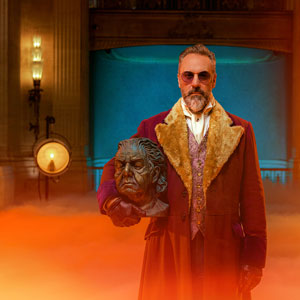
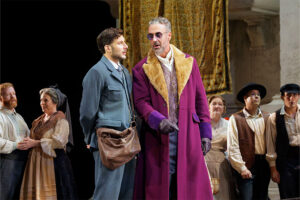
 ***** It’s a new season at the Lyric Opera of Chicago, and with it, a revival of Robert Falls’s production of Mozart’s Don Giovanni. This is the second revival of a production that first played in 2014, and the third season in a row in which the Lyric is performing one of Mozart’s operas that has a libretto by Lorenzo De Ponte and were all written within a span of five years. And having seen all three productions of this staging and the Lyric’s other recent Mozart-De Ponte productions, I believe that they’ve only gotten better. Although Don Giovanni is known for the drama of its overture and ending, Mozart and De Ponte gave it the subtitle of a “humorous drama.” The strange mixture of its tones, both edgy sex comedy and revenge tale, is on full display here, and is one that the director and cast seem comfortable with, resulting in a night of amusements, thrills, and some of Mozart’s most beloved music.We open with a largely-offstage altercation whose consequences will reverberate for the rest of the play. Don Giovanni (bass-baritone Christian Van Horn through October 24, bass-baritone Kyle Ketelsen afterward) storms out of a richly appointed house injured and angry, with Donna Anna (soprano Mané Galoyan) chasing after him, partly chained and demanding he return to face her wrath. Giovanni tells his servant, Leporello (bass-baritone Tammaso Barea) they must leave immediately, but Anna fights with him and is joined by her father, the Commandatore (bass David Leigh), who holds Giovanni at gunpoint. But Giovanni boldly rushes the Commandatore, wrestles the gun away from him, flees to a safe distance, and then spins on his heel and shoots the old man from about twenty feet away before he and Leporello make their exit, leaving him to die in his daughter’s arms. Donna Anna is comforted by her friend, Don Ottavio (tenor Lawrence Brownlee), but admits that since the assailant was wearing a mask, she is not sure of his identity.
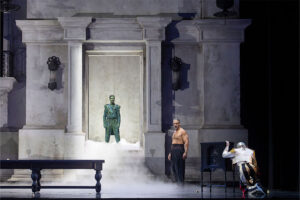 Later that night/morning, as he snorts coke at a bar, Giovanni finds this encounter very amusing, although Leporello complains that their lives are out of control. They are joined by Donna Elvira (soprano Nina Solodovnikova), who is furious at Giovanni for abandoning her and is determined to take him back by any means necessary. Giovanni no longer has any interest in her and Leporello explains that his master’s body count is in the quadruple digits, but this does nothing to dissuade Elvira from wanting Giovanni to be hers alone. With the sun now up, Giovanni and Leporello spot the wedding of a peasant couple, Zerlina (soprano Anna El-Khashem) and Masetto (bass-baritone Christopher Humbert, Jr.) and Giovanni orders Leporello to assist in a scheme to seduce the bride. Elvira interrupts, and witnessing the argument between her and Giovanni causes Anna to realize that Giovanni is her father’s killer. She explains to Ottavio that Giovanni attacked her the previous night, and he vows to assist her in toppling the Don. Meanwhile, Leporello is envious of his master, and Giovanni schemes to offload Elvira and Masetto onto him while having his way with Zerlina.
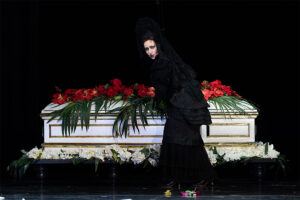
I dwelled on the first scene in this summary because the fight elicited confused laughter from the audience, which I believe was the intended response. Even with Anna’s later recontextualizing it as Giovanni having horrifically tied her up to assault her before murdering her father, it looked like a farcical series of errors that happened to result in death. That absurdity is prevalent in Elvira’s fixation on conquering Giovanni, the ease with which Giovanni convinces Zerlina to humiliate her husband during their wedding ceremony, Anna and Ottavio’s bumbling, futile revenge schemes, and even how Giovanni convinces Leporello to change clothes with him by exploiting Leporello’s envy. Even the famous deus ex machina of the final scene before the epilogue looks like the sort of random, whacky misfortune that would happen to the villain in an animated show on Adult Swim or Comedy Central. I give a lot of credit to the whole cast for pulling off this tone, but especially Van Horn as the titular character and Barea, whose charisma is more subtle but rivals that of the Don himself. (I’m also pretty sure that a change from the 2019 revival Falls made this time is that Leporello no longer attempts to rape Zerlina on his own, and that Giovanni is now lying when he accuses Leporello of doing this. That production, in which Leporello was a lot more of an active co-perpetrator, was made in the context of MeToo discourse that doesn’t necessarily fit neatly with De Ponte’s libretto. Falls also directed Amadeus at Steppenwolf last year and may have developed a more specific angle on Mozart’s humor and dramatic intentions.)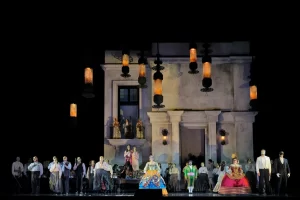
While the staging becomes more refined, Mozart’s music is consistently wondrous, and in good hands with Lyric Music Director Enrique Mazzola conducting. Donna Anna’s Act IV aria, “Non mi dir,” is one of my favorite pieces of opera music, and even in a black comedy, Galoyan’s rendition of it was, to me, a moment of pure joy. Brownlee brings his signature coloratura to his role as Don Ottavio, despite the character not being treated with very much dignity by the script, and Solodovnikova’s fiery performance as Elvira keeps the opera’s energy high where it needs to be. Walt Spangler’s 1920s Spain set design is still beautiful, as are Anna Kuzamanic’s costumes, which demonstrate an uneasy melding of the traditional and modern during Primo de Rivera’s dictatorship. This Don Giovanni’s tone is very tongue-in-cheek; during the epilogue, the characters stab their fingers at the audience while declaring that getting dragged to the underworld by a statue is a foreseeable natural consequence that will doubtlessly be repeated many times. The production’s comfort with contradictions makes it all the better for comedy, drama, and some of the best opera music.
Don Giovanni will continue at the Lyric Opera House, 20 N Upper Wacker Drive, Chicago, through November 1 with the following showtimes:
 October 18: 2:00 pm
October 21: 2:00 pm
October 24: 7:30 pm
October 30: 7:00 pm
November 1: 2:00 pm
Running time is three hours and twenty-five minutes with one intermission. There is also a thirty-minute preview talk an hour before the show.
Performances are in Italian with English supertitles.
The Lyric offers parking deals with Poetry Garage at 201 W Madison St. if inquired about in advance. Tickets start at $48; to order, visit LyricOpera.org or call 321-827-5600.
To see what others are saying, visit www.theatreinchicago.com, go to Review Round-Up and click on “Don Giovanni.”


More Stories
“A Strange Loop”
“Escape to Margaritaville” reviewed by Julia W. Rath
“Instructions for a Seance” (Milwaukee) reviewed by Amy Menzel