
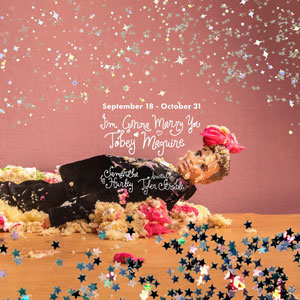
 ** Rude, crude, and often nightmarish, “I’m Gonna Marry You, Tobey Maguire” is a dark romantic dramedy that combines elements from Stephen King’s novels “Misery” and “Carrie” and the movie thriller “Fatal Attraction.” Written by Samantha Hurley and directed by Tyler Struble, the mashup of fantasy and reality makes this story funny and sad at the same time. While the play starts out rather creatively, it gradually descends into horror—and it’s unclear how much of this is meant to be real or fantastical or some combination of both. While bawdy references and clever one-liners hold our attention, the show is ultimately too convoluted and contrived to be satisfying. Yet the story might be more captivating to a younger audience, particularly fans of “Spiderman” and those who may have had crushes on TV and movie idols at some point in their lives.
Shelby Hinkley (Alex O’Shea) is an irrepressible and impressionable eighth-grader who is absolutely in love with Tobey Maguire (Jasper Johnson) from his image on TV and in the movies. She is also the president of his fan club, which she runs from her home computer. Despite the fact that she is 14-1/2 years old and he is nearly twenty years her senior, Shelby wants to marry her teenage idol. So she enlists a friend and as a result of an elaborate kidnapping plan, Tobey has now become her prisoner, shackled to a pole inside her basement. Except for the friend who won’t say a word, nobody knows that he is down there.
While this dramedy is funny in lots of spots, it is equally appalling. We watch how Tobey is denied food, the ability to use the bathroom, and any possibility of freedom. In keeping with Shelby’s fantastical imaginings, we see the way she envisions her heart-throb via a large poster on her wall, decorated by Christmas lights. The Tobey Maguire Poster comes alive when actor Lucy Stoole animates it in a humorous fashion. Simultaneously, Tobey uses the same poster to reflect on his public persona. This device also allows Shelby to realize that her “marriage” to Tobey has not been entirely successful, since the “love-of-her-life” has not turned out to be the kind of person that she anticipated. So when her dreamworld becomes shaken, Shelby’s affection turns to anger, and her love turns to hate. Thus, obsession and hero worship meet up with depression and suicide.
We note that Shelby’s father is absent and her mother occasionally yells loudly from upstairs. At the very least, Shelby’s mother is neglectful and unsupportive of her daughter and is likely abusive. This could explain in part why Shelby is so prone to fantasy. Then too, towards the end, the character of the real estate agent Brenda Dee Cankles (Stoole) is introduced. If the realtor could figure out that something was amiss inside the foul-smelling basement, couldn’t Shelby’s mother figure this out too? And if the mother is intent on selling the property, wouldn’t she have visited the entire house before handing over the sale to a professional?
The audience participation portion of the show lasted almost ten minutes and, to my mind, doesn’t add anything to the plot. This is the point in the performance when Johnson, now wearing a spiderman suit, breaks character and converses with the audience. Afterwards he says, “And now the ending.” If anything, this segment makes the show more choppy and uneven than it already is. With that being said, I really liked how Johnson handled this portion on opening night. His improvisation was very good.
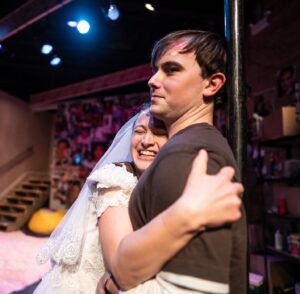
Set over an approximately a six-month period during academic year 2003-04, this play could have taken place at almost any time over the last sixty years. But this show is marked not just by the music and costumes of the day but by a wacky TV set that takes center stage with its fuzzy videos. Scenic design by Trenton Jones, features a basement room and a computer area off to one side and a staircase that presumably goes up to the next level. In addition to featuring the TV set, prop design by Elly Burke consists of lots of posters of Tobey Maguire that hang throughout. An element that is sometimes funny is the introduction of the book “Kidnapping for Dummies.” (Johnson, however, needs to hold the book in the proper orientation to read from it, in short, not upside-down.) Projection engineer Peter Boenish and animator David Sajewich have done a good job featuring weird video images on the TV set, initially taken from Shelby’s podcast and later from different TV and movie scripts that point up various aspects of her life. Costume design by Madeleine Reid is well done and appropriate for the era. In addition to the Spiderman costume that Johnson wears at one point, I especially liked Shelby’s jeans with the heart appliques and, of course, the wedding dress. Wig, hair, and makeup designer Syd Genco has done an especially fine job with Stoole’s appearance. Above all, intimacy and violence choreographer Kira Nutter scores high marks in creating realistic scenes having to do with affections and physical fighting between Tobey and Shelby.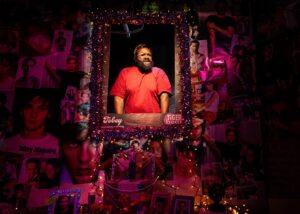
I initially thought that this would be a coming-of-age story where Shelby learns to become her own person. I also expected that this would be a farce, in keeping with the advance materials I had read. But when Shelby’s personality borders that of John Wayne Gacy and when she is constantly being cruel and morally corrupt, the web of emotions that this play spins only made me feel more and more uncomfortable. When Tobey’s persona turns out not to be the superhuman whom Shelby imagines, this marks the moment when her dreamworld collapses and an even uglier side of her comes to the fore. She becomes a living fiasco. Then when you add in Shelby’s fantasy life, the narrative becomes still more fatalistic and perverse—and everything gets more and more gross.
Basically, as the tale becomes more unrealistic and Shelby becomes increasingly more unstable, things that might have seemed funny at first aren’t so funny anymore. More to the point, I was creeped out by the physical assault and torture. While the beginning demonstrates Shelby’s childish leanings with the focus on her fan club and her desire to marry Tobey, the humor dissolves into mental illness, which is a tragic phenomenon. While the impetus behind the play is an intriguing one, it appears that the playwright may have struggled with exactly what the story should be about and where the ending needs to go. But if you’re into horror, then perhaps this script would appeal to you more than it did to me.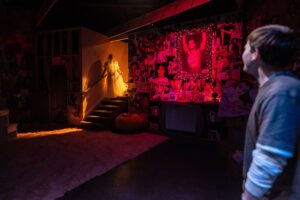
“I’m Gonna Marry You, Tobey MacGuire” is playing through October 31, 2026, at The Den Theatre Chicago, 1331 N. Milwaukee Avenue
General admission tickets: $36.75
 Premium seats: $47.50
Performance schedule:
Thursdays, Fridays, and Saturdays – 7:30 p.m.
Sundays – 3:00 p.m.
For more information and to buy tickets, go to https://thedentheatre.com/performances/2026/9/18/im-gonna-marry-you-tobey-maguire-the-den-theatre-comedy-club-chicago or call (773) 697-3830.
To see what others are saying, visit www.theatreinchicago.com, go to Review Round-Up and click on “I’m Gonna Marry You Tobey Maguire”.


More Stories
“The Prayer Circle” reviewed by Frank Meccia
“Liliom” ( Joffrey Ballet) reviewed by Jacob Davis
“Bonnie’s Last Flight: