
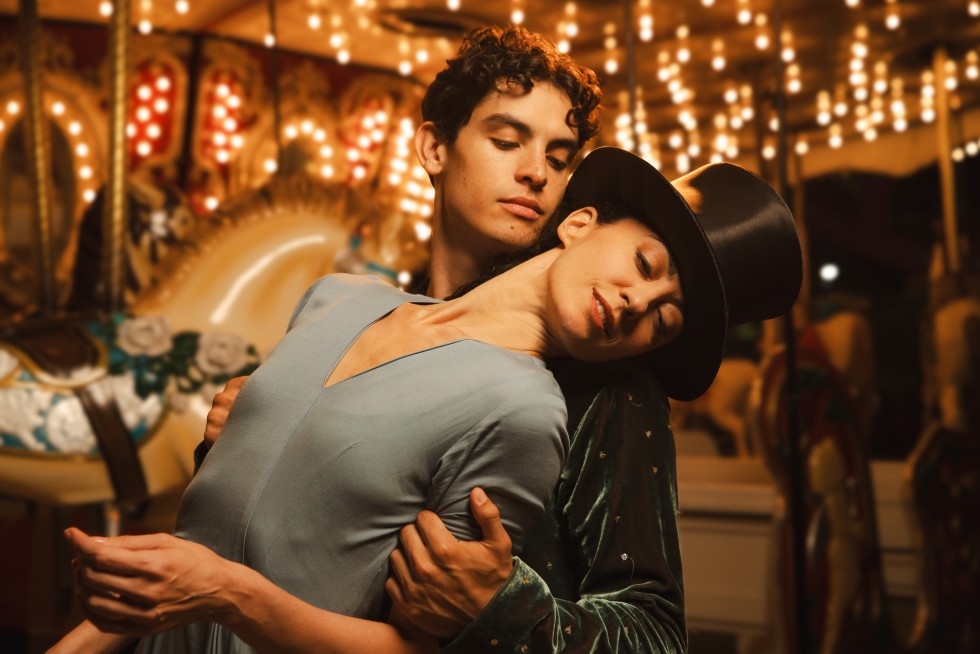
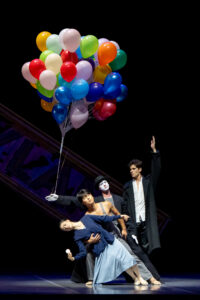
 ***** A sexy tragedy set in the jazz age with ballet, an amusement park, and a visit from a ghost whose wife could never forget his leather pants. Such is John Neumeier’s 2011 adaptation of Ferenc Molnár’s 1909 play Liliom, now making its Joffrey Ballet debut. Although most people are more familiar with the story as the basis of Rodgers and Hammerstein’s 1945 musical Carousel, Neumeier re-imagined it as taking place during the Great Depression. In this production, Michel Legrand’s all-original musical score is performed by the Lyric Opera Orchestra and Rob Parton Big Band, and the production emphasizes otherworldly beauty amid a world that alternates between the cold austerity of the Depression and the garish, escapist fantasy of the amusement park. Combined with the sensuality of the Joffrey Ballet’s dancers, it is a vibrant retelling of a difficult story.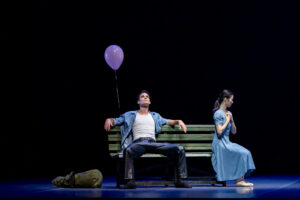
Actually, that’s not quite the order of events Neumeier presents. Liliom is already dead at the beginning of the play, but has been permitted a brief opportunity to return to Earth to meet his adolescent son, Louis (Hyuma Kiyosawa). Still lacking any healthy way of tolerating frustration, he blows this chance, leaving Julie to reminisce with her son about what she saw in him in the first place. Liliom’s spirit still exists in the present and is capable of achieving some sort of peace, so it is not accurate to say he is only a memory, but Julie’s recounting of him is heavily colored by grief and her perspective of him has likely changed from having lived to be fully mature while he did not. I found one of Neumeier’s most affecting scenes to be the one in which Liliom and Julie attempted to engage each other through dance at the beginning of their relationship, and at first, both of them awkwardly cycled through rote movements that were flashy, but unconfident. As they warmed up to each other, they became more graceful and distinctive, and after Julie becomes a mother and Liliom becomes a ghost, they stay fully in that mode.
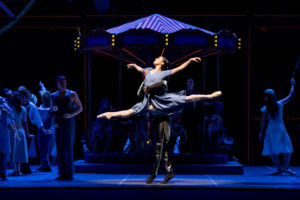
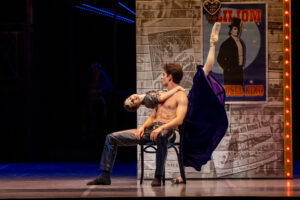
Neumeier’s staging presents Liliom as much more of a dark lust object than Rodgers and Hammerstein could have or attempted to do with Billy Bigelow. (Although it is possible to see in him the DNA of characters William Inge and Tennessee Williams wrote just a few years later.) He also stages the moment that Liliom slaps Julie as looking as unthreatening and excusable as it possibly could, like it was a reflex from years of defending himself from people pawing at him, and he is visibly shocked as soon as he does it. There’s always a risk that the genre of working-class social problem-play Molnár’s original belonged to will be condescending and stereotypical, which, combined with eroticizing a doomed, violent man at the bottom of society, results in a sort of kink fantasy that can go really wrong if it isn’t done with a lot of self-awareness. The production is signposted as having mature themes, and since ballet characters are always presented in a heightened form and don’t talk, Julie isn’t forced to declare that getting hit doesn’t hurt when you love the person doing it, but it’s still something prospective viewers should know about. Nicholas Koo was conducting the night I attended, and Legrande’s jazz composition was as flexible as Ferdinand Wögerbauer’s set and the lighting Neumeier designed with Jim French. The unemployment line, Playland’s not-entirely-wholesome fun, and the menacing realm of otherworldly judgement are distinct sculptures on the same carousel, and its riders are afforded a dignified presentation by the dancers who embody them. John Neumeier’s Liliom is a rich story renewed in a way that finds grace in the lives of ordinary people and makes them legible to us over a century later.
Liliom will continue at the Lyric Opera of Chicago, 20 N. Upper Wacker Dr., thru September 27, at the following times:
September 24: 7:30 pm
September 25: 7:30 pm
September 26: 2:00 and 7:30 pm
September 27: 2:00 pm
Running time is two hours and thirty minutes with one intermission.
For tickets, call (312) 386-8905 or visit joffrey.org.
To see what others are saying, go to Theatre in Chicago and click “Liliom.”



More Stories
“Bonnie’s Last Flight:
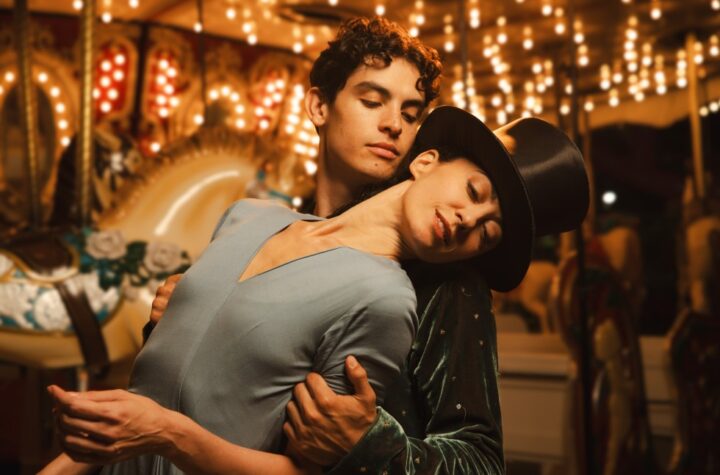
“Ride the Cyclone” reviewed by Wayne Mell/ 2nd look by Frank Meccia
“Play On !” reviewed by Julia W. Rath