
 ***** Slow-moving but deliberate and emotionally charged, the Chicago premiere of “Blood of the Lamb” combines unease and dark humor with the devastating reality of the decline of women’s rights in the United States today. This taut psychological drama by playwright Arlene Hutton has been set in a near-future America, shaped by post Roe vs. Wade legal and political labyrinths. It is quite a coincidence that this work of speculative fiction was written in 2022 just before the Supreme Court ruled in the Dobbs case, which overturned the federal guarantee of a woman’s right to a legal abortion in all fifty States.Skillfully directed by Anna C. Bahow, this two-hander rotates casts*, and on the second opening night, we followed the interaction between Val (Kirsten D’Aurelio), a self-righteous attorney, and Nessa (Heather Dennis), a woman dealing with the loss of her pregnancy. It seems that Nessa’s flight from Los Angeles to New York was abruptly rerouted to Dallas on account of a medical emergency, namely, her own. Instead of a hospital stay or a short layover at the airport, she’s been confined to a holding room in the custody of Val, assigned to the nonviable fetus she carries. As the lawyer for this stillborn baby, Val has been tasked to look out for its “best interest.” Nessa wants nothing more than to board the next outbound flight to New York to see her own doctor for emergency treatment. Instead, Texas law has other plans. As Val constantly fills out mounds of paperwork and fields relentless calls from lawmakers, the two women are pulled into a surreal bureaucratic nightmare.
When Texas legislators decide to take control of Nessa’s destiny, they deprive her of the agency to do what’s best in her own interest and that of her family. While a desperate Nessa strongly believes in the practice of modern medicine in the interests of preserving her own life and her own fertility, Val’s devotion to her Christian faith turns her charge’s fate into the will of God. It seems to matter more to Val that her cell phone or her laptop computer could “die” without being given an electronic lifeline than it is for a woman to die because of a decaying fetus inside of her. Thus, “Blood of the Lamb” merges a Kafka-esque structure with a clash between opposing personal and religious philosophies. This dystopian drama about “political and medical themes surrounding reproductive rights and medical procedures” is heartrending. Acting is superior, with both Dennis and D’Aurelio playing totally believable characters in very challenging roles.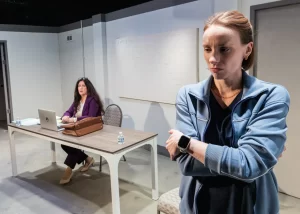
Thus, we see both women trapped by the prevailing gender ideology in the Texas of the future. It is not only Nessa who is in a bind but also Val, who is treated as subservient to the male legislators to whom she reports. But who are these legislators who decide what the laws should be based on? Who gave them the power? And why is there so much bureaucracy?
Scenic design by Amy Gilman is simple: comprised of flat light blue walls, two gray doors, and a round drum ceiling fixture which diffuses bright white light. The props, designed by Tristan Brandon, consist of a conference table with two chairs plus a small glass table holding a box of Kleenex, plus a laptop computer and a cell phone—and, of course, the appropriate cords and cables. There is a non-descript textured painting in white on one of the walls. These elements create a space that is contemporary yet simultaneously real and existential, bolstered by Emily Hayman’s sound design and Karen Wallace’s lighting design. Costumes by Rachel M. Sypniewski are well suited to the story, with Nessa in activewear (appropriate for an airline passenger) and Val in a purple suit and low heels (appropriate for her role as an attorney), and she wears a shiny silver cross. Plus, dramaturg Christina Renee Jones has created an exhibit in the back of the theater that goes through some of the history regarding women’s reproductive rights.
The script is excellent with both women caught up in a no-win situation having to do with their own cultural conceptions of sex and gender and the role of the medical profession, especially with respect to unforeseen and tragic outcomes of a lost pregnancy. With the characters consumed by this conundrum, I asked myself how this 90-minute performance might end. Although the conclusion was not obvious, I happened to guess correctly and was more than content with the ending. In contrast, my guest was disappointed with how things ended even though she loved the rest of the show. And that’s all I will say about it… except that this raises the question of whether a theatregoer can be satisfied with something rather vague versus something more definitive. If there was any one “fault” in the script, the story would have been more impactful had Val, a devout Christian, prayed out loud in Jesus’s name (rather than silently) when being confronted by Nessa’s situation, knowing full well that she was responsible for the other woman’s fate from now on.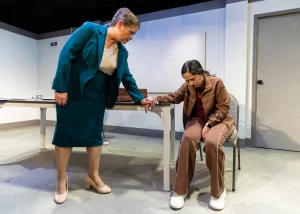
The playwright’s conjecture that Texas law in the near future would make any unborn baby—alive or dead—a full human being entitled to the rights of citizenship is very creative. This possibility not only creates a secondary status for women forced to carry such a child, but, by extension, this leads to the diminution of all women as independent persons, entitled to life, health, and the right to their own bodies. Even women like Val, in positions of power within the Texas hierarchy, are restricted in how they can live out their lives, except that they have largely internalized the fact that their rights have been subsumed by the State. Basically, this play illustrates what could happen when two women from polar perspectives are forced to confront each other in an atmosphere of conflict and desperation—and in so doing, the story draws attention to the existential moral crisis of our time.
“Blood of the Lamb” is playing through October 3, 2026, at The Den Theatre, 1331 N. Milwaukee Ave., in Chicago, inside the Crosby Theatre on the second floor.
Tickets are $35 general admission
$25 students and seniors
Performance schedule:
Thursdays, Fridays, and Saturdays at 8:00 p.m.
Sundays at 3:00 p.m.
Industry Night performances: Tuesday, September 22 and Tuesday, September 29, both at 8:00 p.m.
Kirsten D’Aurelia (Val) and Heather Dennis (Nessa) perform on Thursdays and Saturdays, with a Tuesday performance on September 22.
Delia Ford (Val) and Meghann Tabor (Nessa) perform on Fridays and Sundays, with a Tuesday performance on September 29.
Representatives of Midwest Access Coalition will participate in talkbacks following performances on Sunday, September 13 and Thursday, September 24. “Midwest Access Coalition provides pregnant people with practical support, including assistance with the cost and logistics of getting to an abortion appointment. Many of the people served by the organization are traveling out of state to access reproductive resources and care.”
For more information and to purchase tickets, visit: https://www.prometheantheatre.org or call The Den Theatre Box Office, 773-697-3830.
Photos: Steven Townsend, Distant Eras
*Anna C. Bahow writes in her Director’s Note: “For this production, I chose to double-cast. Neither cast is billed as the ‘main’ cast. No performance is the definitive one. That randomness is the point. Arlene Hutton’s play is not about two specific women. It is about the millions of women who could be either woman, depending on where they were born, what they earn, and what state or county they are in. Change the actors and the argument in the play stays the same. Where you live still decides what happens to your body. State lines still hold, and the laws behind them keep getting harsher.”
To see what others are saying, visit www.theatreinchicago.com, go to Review Round-Up and click on “Blood of the Lamb”.





More Stories
“Jersey Boys” 20th Anniversary Tour- MILWAUKEE
“Mud Row”
“The Winters Tale” reviewed by Mark Reinecke