
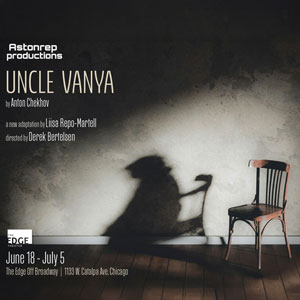
 *** Liisa Repo-Martell’s fresh 2022 adaptation of Anton Chekhov’s “Uncle Vanya” remains true to the towering work. In Astonrep’s U.S. premiere production, Rian Jairell excels in the role of Ivan Petrovich (a/k/a Uncle Vanya), who is at the heart of this eponymous classic. Delivering a wonderfully feisty and fiery Vanya, Jairell makes the play more than just an avuncular narrative. Rather, it is a slice of life about the decline of the landed gentry in Czarist Russia in the late nineteenth century in the face of growing impoverishment. Directed by Derek Bertelsen, the story has to do with a generation caught between changing economic circumstances, where landowners and land managers alike must decide whether any value remains in living off a country estate.
The tale is as follows: Vanya’s late sister had been married to Professor Alexandre Serebryakov, portrayed with crisp authority by Geoff Isaac. The professor and his much younger second wife, Yelena Andreyevna (Andi Muriel) have traveled through the countryside to visit Alexandre’s brother-in-law Vanya and his daughter Sonya (Natalie Hurdle), who have been managing what was once Alexandre’s uncle’s rural estate. Sharing the household is Maria Vasiyevna (Mary Mikva), Vanya’s mother and Sonya’s grandmother. Then there’s Marina, the longtime nurse and domestic, embodied authentically by Liz Cloud. The circle widens to include Ilya Ilych Telegin (Mike Rogalski), a neighboring landowner, down-on-his-luck, who lives on the estate as a dependent. (He gets the nickname “Waffles” because of his pockmarked, cratered skin.) Dr. Mikhail Lvovich Astrov (Robert Tobin) is a country doctor, who regularly checks in on the professor’s health, but he has an ulterior motive: his interest in the professor’s wife, the beautiful Yelena.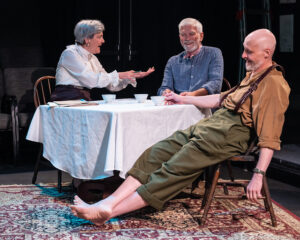
Once the characters are assembled, their emotional entanglements surface. Both the professor and the doctor are smitten with Yelena. Sonya initially dislikes Yelena and harbors feelings for the doctor herself. What complicates every relationship is that the professor, who once owned the property outright, transferred it to his first wife, who left it to their daughter in her will—and now Sonya’s mother is deceased and her father remarried. The drama lies in watching each character confront what Sonya’s inheritance means for their past, present, and imagined future. More specifically, Alexandre’s desire to move to the city and sell the property outright upends the relatively copasetic relationship among the family members. But the hardships that Sonya and Uncle Vanya undergo in paying the mortgage are still preferable to being thrown off the land entirely and having no social status whatsoever. This would mean that Vanya would become destined to descend into poverty and possibly into the much-despised peasantry… with Sonya not being marriageable at all.
The central fundamental issue underlying this play has to do with the extent to which both men and women are legally allowed to inherit real property or transmit it to others. Here in the latter part of the nineteenth century, we see a conflict between the older feudal and customary law in Russia (with its limited formal mechanisms for property transfer) and the new laws created by Czar Alexander II. Together with the reforms of the Emancipation Decree of 1861, which abolished serfdom, the czar’s broader legal reforms allowed wills and testaments to become a significant legal and social institution. Basically, the root of the characters’ uneasiness about life has to do with the transition from one rule of law to another. Related to this, a secondary thread has to do with the role of women and their desirability as marriage partners. If women are allowed to inherit, then the value of the real property that they bring to a marriage becomes important. But if family tradition is intent on denying women to be a party to wills and trusts, then the value of a bride in certain social circles largely lies in her physical beauty. Yelena is considered gorgeous and Sonya considers herself to be homely, with both being lonely in different ways—and unhappy. Neither are the men happy with the professions that they have chosen for themselves. Both the doctor and the professor feel that they have failed to accomplish what they have set out to do. And Vanya goes so far as to think of the professor as being a fraud.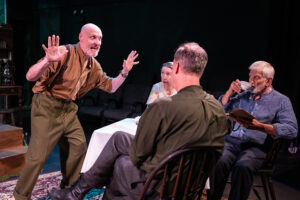
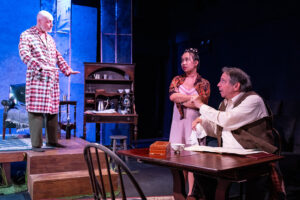
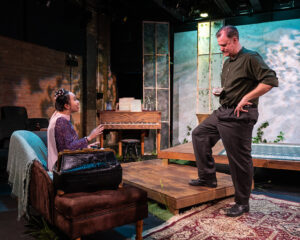
The action unfolds on a multilevel stage, divided into areas that are supposed to mimic several rooms as well as a bit of the outdoors of the estate’s manor house. Yet the scenic and prop design by Jeremiah Barr, while nice-looking, needs to be re-envisioned. While the dark teal chair, the wooden open-front china hutch, and the piano are good, everything needs to look more battered by time. Most importantly, the use of space on stage is problematic, particularly the location of the four-chair dining table. One of the chairs in the set was maybe 12-18 inches away from the first row of the audience, nearly in the way of my seat. More significantly, the actors kept having to go around this chair. Basically, the setup of the thrust stage relative to the audience affected sight lines, and I can’t recall a performance where the actors were so close to the audience and provided such a distraction. That being said, the lighting by Samantha Barr is good and evocative. I especially liked the green leaves projected onto the backdrop before the show begins as well as a later version when everything turns red in the second act. Also, Melanie Thompson’s sound design is perfect for such a small space. Best of all, it was great seeing Uncle Vanya sleeping in his chair before the action starts. That is very realistic. Less realistic is the use of modern dress in telling this tale from the days of Czarist Russia. Also note that this production is characterized by its lack of Russian accents. Plus, the English language text includes some profanity so as to make the dialogue feel more contemporary, even though this is not true to Chekhov’s original.
In all, the people who inhabit Chekhov’s world are bound together by cultural and historical circumstances, mostly beyond their control. So while some individuals, like Alexandre, Telegin, and the doctor, want to hold onto the past, others, like Uncle Vanya, find themselves seemingly rudderless in their journey through life. And we see what can happen to people when the norms of a traditional culture are in the process of shifting. The story thus becomes a study of longing, disappointment, and the uneasy process of examining choices when and where they exist. In so doing, the play tackles the subject of what it means to be miserable, where each and every character is unhappy in their own way. But how many bitter disappointments must there be in one’s personal life and one’s career? How horrible must life get before a person believes that they are utterly useless? And how bad must things be before contemplating how and when to end it all? Or when, and under what circumstances, does one simply throw up their hands and accept the inevitable, regardless of how emotionally painful it is? Ultimately, it is the characters’ combined misery, which they cannot break free of, that is the tie that binds them together.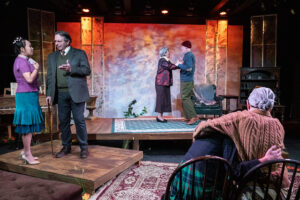
“Uncle Vanya” is playing through July 5, 2026, at the Edge Off-Broadway Theatre, 1133 W. Catalpa Avenue, Chicago.
General admission tickets are $25
 Performance schedule:
Thursdays, Fridays, and Saturdays at 7:30 p.m.
Sundays at 3:00 p.m.
For more information and to purchase tickets, please visit: https://www.astonrep.com/ or call 312-620-4583
To see what others are saying, visit www.theatreinchicago.com, go to Review Round-Up and click at “Uncle Vanya”.




More Stories
“Buddy- The Buddy Holly Story”
“Adolescent Salvation” reviewed by Paul Lisnek (Curtain Call Chicago)
“That’s Weird, Grandma’s 25th Birthday” reviewed by Julia W. Rath