

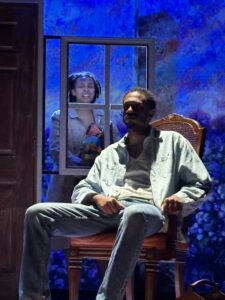
 ***** A keenly emotional play about a black family in a small-town Alabama community, “Gee’s Bend” is based on the true story of colorful handmade quilts that feature bold and innovative geometric patterns and careful attention to design. A poignant and award-winning script by Elyzabeth Gregory Wilder is at the core of this tightly woven narrative which spans the years 1939 to 2002. It features the fictional Sadie Pettway (Kaitlyn Fields) and her family, who live in an area called Gee’s Bend along the Alabama River, named after Joseph Gee, who in 1816 established a cotton plantation and brought enslaved people with him to work the land. The rich cultural heritage which their descendants inherited is at the root of this tale. While the river gives life to the land, the water represents a crossroads for African Americans as a symbol of freedom from oppression and a place where history, memory, and spirituality are merged with the possibility for personal growth and transformation.Before the press opening performance last Sunday, artistic director Tim Rhoze (who elegantly and meaningfully directed this production) explained that “Gee’s Bend” is one of his favorite plays and that he had produced the show previously in Evanston.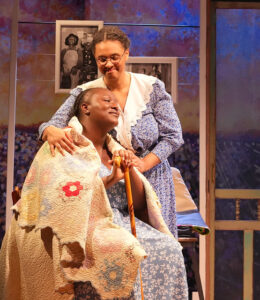
The story is basically as follows. We meet Sadie Pettway as a teenager during the 1930s, together with her mother Alice (Toccara Castleman) and her older sister Nella (Jasmine Robertson). Alice gave her younger daughter Sadie a great gift when she taught her how to sew all sorts of lovely quilts, which had both a practical and an aesthetic value. At the same time, Nella, though never gifted with the needle, could definitely appreciate the craft. We subsequently watch how Sadie becomes involved with her future husband Macon (Tyrone Norwood) and marries him at the age of 15. Despite their affection for each other, Sadie and Macon were of very different personalities, and he thought the quilts were ugly. But no one could deny their practicality, especially when he became ill later in life.
The crux of the story, however, has to do with Sadie’s emerging consciousness in conjunction with the Civil Rights Movement. A watershed moment in her life was her decision to actively follow the example of the Reverend Dr. Martin Luther King, Jr., and march with him in 1965 from Selma to Montgomery, Alabama, to affirm the voting rights of African Americans. In subsequent marches, she also fought for the desegregation of public accommodations and the lifting of barriers to equal treatment under the law.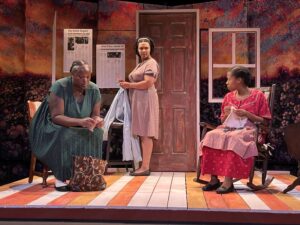
But what makes “Gee’s Bend” so compelling is the clash of philosophies within the same family. Sadie’s husband knew full well that speaking truth to power in the South was dangerous, because many hateful whites would be out to get “colored people” who acted too uppity and refused to “stay in their place.” Seeking to preserve whatever gains that he had already made during the course of his life—such as his house, his material possessions, and his lovely wife and children—Macon was content with remaining silent about the inequalities and indignities surrounding him. While he felt that he had crafted a decent life for himself within the existing confines of racial segregation, Sadie could see beyond this… to the Promised Land… and continued to get involved in “good trouble” with the aim of upending the status quo.
Another theme is the importance of being tied to the land. For Sadie, the planting and picking of cotton in the fields was part of the rhythm of life. Sadie could not imagine how or why her daughter Asia (Castleman, in a double role) would ever want to relocate from their house in the country to take a job in a city like Selma. For Asia, living off the land wasn’t as important as much as earning income from a job and being able to afford a nicer home and have a better life (as she perceived of it). Since Asia lives in an era after the Civil Rights Movement, she lacks the profoundness of perspective regarding the struggles that her mother and others went through to improve their lot in life. In sharp contrast to Asia, Nella is frozen in the past. Because of her dementia, she is unaware of time passing, and her mind is fixed in the Jim Crow era. Among other things, she doesn’t realize that the ferryboat that once carted people across the river has not operated for over 35 years. When Nella thinks that her mother is still alive when, in fact, she passed away some time ago, the irony is that this is indeed true on an emblematic level, since Alice’s spirit remains alive in the fabric of all those handmade family quilts.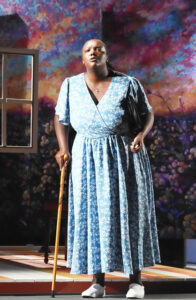
This relates to the value of quilts and quiltmaking. To Sadie’s great surprise, a reverend from the Immanuel Lutheran Church believed that he could sell these at Bloomingdale’s (in New York City) and earn her some good money. Not only was he successful, but the reverend was able to feature these quilts in museums as articles of folk art. Thus, everyday quilts from Gee’s Bend became special and unique collectibles. The stories behind these quilts—having to do with the scraps of material, sewing thread, and labor as well as their provenance—also made them saleable.
A final theme has to do with the door key to the house. Sadie’s mother always said never to lock the door, because blessings must flow to those who enter. This idea embodies trust in other people: that they will not harm you or take your possessions away. It is the ultimate faith in the goodness of others.
The set, designed by director Rhoze, largely consists of the interior of a wooden house with a plank floor. Behind it is painted a cotton field with a multicolored sky, the fine work of muralist Sarah Kaiser. Props by Ben Blount include several types of chairs, a magazine holder, and several other accoutrements, plus two pages from “The Montgomery Register” that hang on the wall initially. These are replaced from one scene to the next to mark the progression of time. Local artist and quilting instructor Melissa Blount created prop quilts used in the show. Lighting by David Goodman-Edberg and sound by Rick Sims are nicely done. Costumes by Kate Parker Barrows befit the era, and there are several costume changes, the most important of which features Sadie in a flouncy pink dress. If there is any fault, I would have liked the use of makeup to indicate the appearance of bruising on Sadie’s body. This would have been in keeping with the time when her husband beat her up for daring to defy him by marching for the cause of civil rights.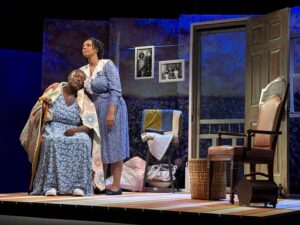
At a time when there are some who want to erase history and take away the hard-fought vote from African Americans, “Gee’s Bend” shows us a small slice of life having to do with democratic action to overcome the hardships of Jim Crow. In the course of watching this show, we witness the continual strengthening of Sadie’s sense of purpose in going against the existing white power structure of that time. Though her fortitude was boundless, her struggle was two-fold: political in the grand scheme of things—and personal when it came to her husband and family and their ways of viewing the world. Sadie’s life experience thus illustrates the many sacrifices that people endured to affirm their beliefs in the ideals of liberty, economic opportunity, and equal justice for all.
Gee’s Bend is playing through June 7, 2026, at the Fleetwood-Jourdain Theatre (inside the Noyes Cultural Center), 927 Noyes Street, in Evanston.
 General admission tickets are $33.
Performance schedule:
Saturdays 7:00 p.m. and Sundays 3:00 p.m.
For tickets, visit:
https://app.amilia.com/store/en/cityofevanston/api/Program/Detail?programId=xaoLenb
or go to: https://app.amilia.com/en/Login or call 847-866-5914.
For more information about this and other shows at the Fleetwood-Jourdain Theatre, see: https://cityofevanston.org/explore/arts_culture/theatre/fleetwood_jourdain_theatre.php
To see what others are saying, visit www.theatreinchicago.com, go to Review Round-Up and click at “Gee’s Bend”.




More Stories
“The Attic: Things I’ve Seen While Lying On My Back”
“Jekyll & Hyde” : The masterpiece from Division Street, Moves to the Broadway Playhouse!
“You Can’t Fake the Funk: A Journey Through Funk Music” reviewed by Julia W. Rath