
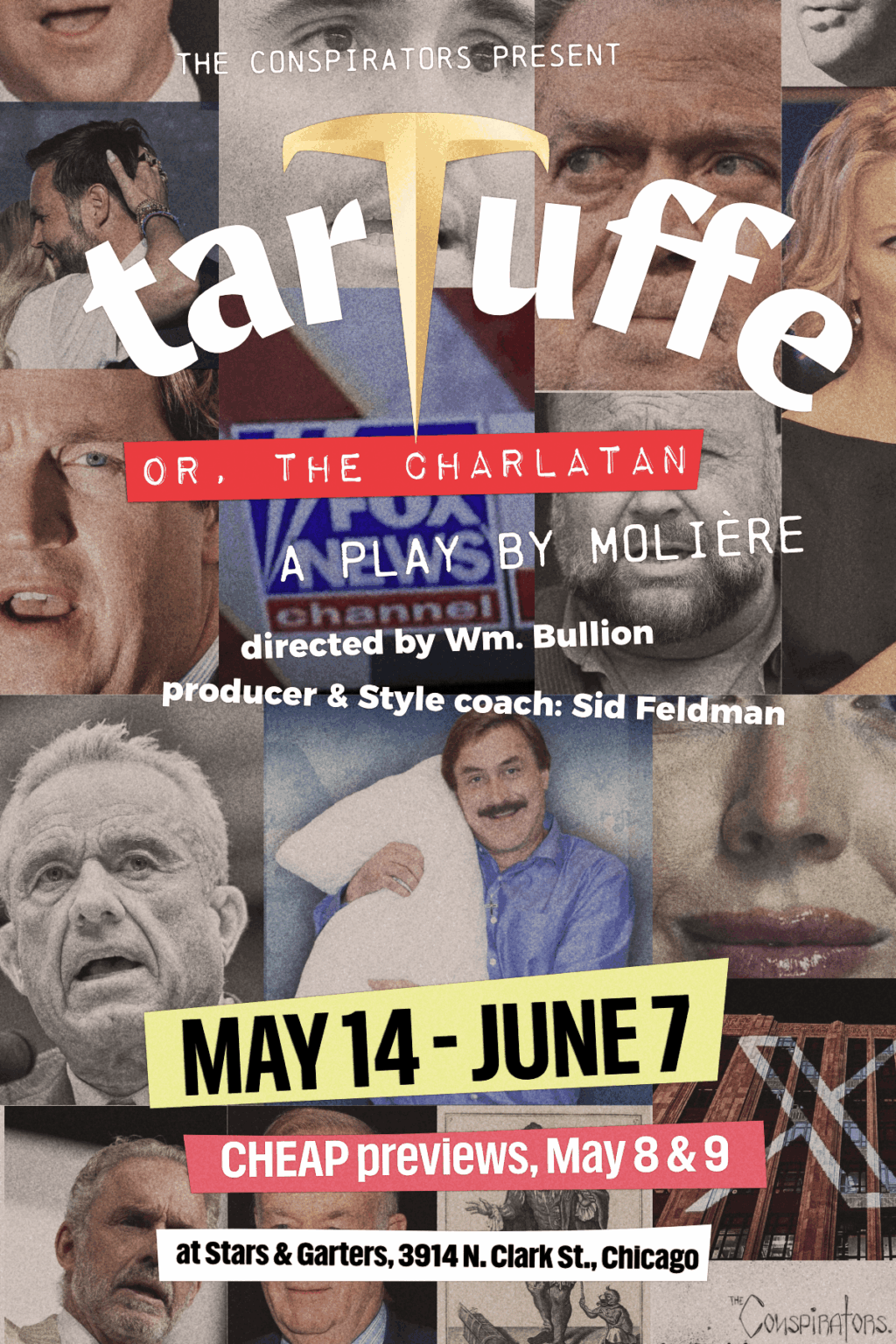
 ***Molière’s “Tartuffe or, The Charlatan”, originally performed in 1664, is a wickedly playful satire about hypocrisy and gullibility that is true to human nature no matter what the era. Currently being produced by The Conspirators, this French farce, while true to the original, is full of surprises.
For those as yet unfamiliar with the play, the sanctimonious Tartuffe (Deacon Leer) manages to charm the aging patriarch Orgon (Henry DelBello) with his exaggerated displays of virtue. The charlatan’s influence thus throws the family into turmoil. Because Orgon has been blindsided by Tartuffe’s slick and finely crafted exterior, he arranges for his daughter Mariane (Riley Marie Fortin) to marry him. In a society where a father’s word is law, Mariane’s pining about the prospects of being wedded to such a despicable person goes unheeded. Instead, to further prove the rightness of his beliefs, Orgon doubles down on his demands. Others, however, see through Tartuffe and know that he is, indeed, far from being virtuous. Objections to Tartuffe and the marriage also come from Orgon’s childing wife Elmire (Oline Hale) as well as from his son Damis (Anthony Soto), among others, whereas Orgon’s mother Madame Pernelle (Vi Burnette) thinks of Tartuffe as being nothing short of a saint. So whereas Orgon disowns his quick-tempered contrary son and continues to listen to his admiring mother, he eventually humors Elmire, who has developed a cleverly conceived plan to convince her husband about Tartuffe’s duplicity and his self-serving nature. Basically, she asks Orgon to observe Tartuffe’s treachery for himself… as he remains hidden and unnoticed.
Tucker Privette’s comic agility excels in the role of the maid Dorine. The well-endowed prosthetic worn by Privette is a hoot, not to mention the red wig and feather-duster. In this queer and frivolous portrayal, Dorine’s pendulous bosom is the butt of many jokes. Yet Dorine gradually reveals genuine emotional stakes in what is happening to Orgon and his family. Other characters include: Flipote (Grace Reynolds), Cleante (Tailia Neidorf), Valére (Jacob Dorris), and Laurent (Phillip Smith).
While every generation can read something new and distinctive into Molière’s writing, the playbill makes the explicit comparison between this show and Donald Trump and his MAGA movement. Director William Buillion and producer Sid Feldman write: “Tartuffe, or the Charlatan, is about your Fox News-addicted uncle at Thanksgiving. Patriarch Orgon (as well as his mother Mme. Pernelle) is devoted to holier-than-everyone Tartuffe and absolutely REFUSES to believe he could possibly be lying to him…. Haven’t we all, at one time or another, just shaken our heads at a blind cult follower, knowing they can only learn the truth the hard way?”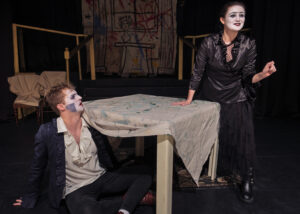
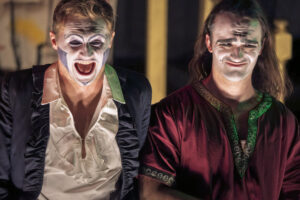
The biggest change from the original French version is the excellent translation/adaptation Into English with its poetic rhymes. But best of all is the creative blend of the old and the new into an artform which producer and style coach Feldman calls “the style.” This is basically the infusion of punk rock elements into the narrative on top of the burlesque, thus adding modernity to the story and anachronistic weirdness in a good way. I liked the traditional whiteface painted on all the characters together with the exaggerated eyeliner and frown lines, etc., making everyone seem clown-like. There is, in addition, the inclusion of punk and shabby chic clothing, with worn-out textures, T-shirts with writing on them, and a relaxed notion of style… on top of actors whose costumes could have been worn in the 17th century. All this is thanks to the creativity of costume designer Ollie Voirin. Then there are all sorts of accoutrements, from punk rock music to a minimalistic set in a black box theater. Scenic design by Morgan Laszlo largely consists of painter’s tarps hanging on the walls and over chairs. The paint on them features all sorts of logos and symbols and scribbles, the most prominent of which being “Punk not dead.” Above all, I’d like to credit Tom Jacek, the exemplary percussionist. With his use of a woodblock or a snare drum or a mechanically operated slide whistle, etc., he amplifies the emotions of each of the characters and enhances the action on stage. His marvelous sound effects and choice of instruments—separately and in sequence—are perfectly timed with the action.
While the ensemble’s lively energy is great and there are many moments when the overacting is well done, the production nevertheless suffers from some unfortunate directorial choices. While the blocking is fine, there’s no need for the acting to always be at such a fevered pitch. The problem is that if the characters are always at full volume (that is, an 11 out of 10) and everyone is so busy shouting past each other (together with the canned music being played much too loud), then the audience is not being given enough time and space to consider the characters’ existential circumstances and the choices they make. Sometimes we need still moments of reflection to understand the extent of the corruption and the villainy. Sometimes we need enough quiet time to listen to the voice of reason and to process how what happened back then might mirror what’s happening today. To make this production shine, moral clarity and moral authority need to predominate. This means, among other things, having a moment to pause and reflect not only on each of the characters’ lives but also on the magnanimousness of the King of France in reasserting community standards and the moral economy.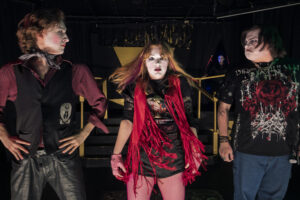
When the characters (not just the audience) fail to absorb the king’s nobility and his far-sightedness, his subjects are immediately left to their own devices. So at the end of the performance, we witness them gleefully pound away at Tartuffe, who lies on the ground helpless. This is reminiscent of mob rule, where citizens choose to impose their own sense of vigil ante justice above and beyond the dictates of well-thought-out law. Having said this, the show poses a question to a modern audience by inference: Is there a mean between these two extremes, that is, between a government that focuses on the decrees of a king or dictator (benign or otherwise) as compared to the vicissitudes of the mob? The answer to this question takes us away from this 17th century narrative and instead replaces it with a late 18th century one, having to do with our nation’s underlying belief in the virtues of democracy, democratic action, and the revolutionary spirit of our Founding Fathers.
The story of “Tartuffe” shows us how some people can be blind to the fact that one of their number could be so heinous, despite mounds of evidence proving as such. This farce is also meant to be a cautionary tale about how self-serving individuals can hide in plain sight—and will occasionally tell you exactly who and what they are. Not only do the characters in this play speak lines that have intrigued timeless audiences through the centuries, but the frequent reviving of Molière’s work indicates its continuing relevance. Scoundrels and con artists can exist at every turn and in every walk of life—and the community needs to remain vigilant in order to discover them and root them out.
“Tartuffe or, The Charlatan” is playing through June 7, 2026, at Stars & Garters Theater, 3914 N. Clark Street, in Chicago.
General admission tickets are $30.
 Performance schedule:
Thursdays, Fridays, Saturdays, and Sundays at 7:00 p.m.
Special industry performance: Monday, June 1 at 7:00 p.m.
To purchase tickets, go to: https://events.humanitix.com/the-conspirators-present-tartuffe/tickets.
phots by Logan and Candice Conner
For more information about The Conspirators, please visit. https://conspirewithus.org/.
To see what others are saying, visit www.theatreinchicago.com, go to Review Round-Up and click at “Tartuffe , or The Charlatan”.




More Stories
“The Attic: Things I’ve Seen While Lying On My Back”
“Jekyll & Hyde” : The masterpiece from Division Street, Moves to the Broadway Playhouse!
“You Can’t Fake the Funk: A Journey Through Funk Music” reviewed by Julia W. Rath