
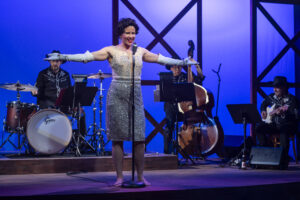
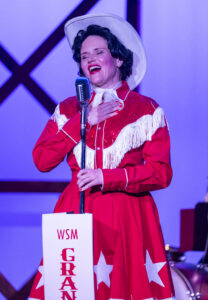
***** “What good is a secret if you can’t share it with someone?” Such is the premise behind the cleverly inspired jukebox musical “Always…Patsy Cline”, created by Ted Swindley. This retrospective tells the story of this famed, multi-talented country-western singer, narrated from the perspective of her biggest fan, a woman named Louise Seger (Molly Hernández), a single mother from a small town who was busy raising two young children. Louise’s juiciest secret had to do with the fact that she finally got to meet her idol Patsy Cline (Liz Chidester) at a show at the Esquire Ballroom, in Houston, Texas, in 1961 and almost immediately they became the best of friends. This is a story that fascinates us because of its tight focus on the bond of female friendship between the two. Directed by Harmony France and music directed by Michael Mahler with band and vocal orchestrations by August Eriksmoen and Tony Migliore, this production not only gives the audience the opportunity to reminisce about Patsy and her bold singing voice but also to learn something about her life. What compelled her to sing such songs like “Your Cheatin’ Heart”, “Faded Love”, “You Belong to Me”, “I Fall to Pieces”, “Sweet Dreams”, “Lovesick Blues”, and many others?
Louise constantly thought of Patsy Cline and her inspired lyrics from the moment when she first appeared on television in 1957 singing “Walkin’ After Midnight” on the Arthur Godfrey Show. Yet most of the story is set in 1961 when Louise would constantly request that Hal, the manager of the local radio station, play Patsy’s songs on the air. But more to the point, after Louise finally gets to meet her idol live and in person, the audience not only becomes privy to their friendship but also to the importance of huge stacks of letters that she receives from Patsy over the years. So while the story proceeds chronologically from 1961 forward, it ends in the year 1975 when Louise is going through Patsy’s correspondence in order to reminisce about her dear friend—whose life was tragically cut short in 1966 at the age of 30. And her letters would always be signed “Always… Patsy Cline.”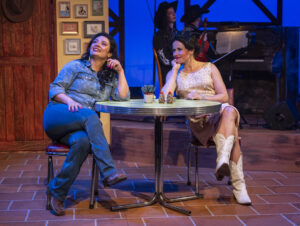
Chidester is made-up beautifully to look exactly like Patsy, with perfectly well-done make-up and hair. She delivers songs with enthusiasm and volume; and while Hernández is not as strong as a singing partner, their acting is great together. The band, consisting of Ian Paul Custer (keys and conductor), Nilko Andreas (guitar), Marc Edelstein (upright bass), Lior Shragg (drums), and Lauren Vogel (fiddle) could not have been more entertaining. Plus, the musicians would occasionally sing backup. Perhaps the best parts of the show are the interactive moments when the actors would get the audience involved in singing along and clapping.
Fashions of the late 1950s and early 1960s have been crafted to a T, due to the fine research and skill of costume designer Lily Walls. At first, we see Patsy in a cowgirl outfit, and then for the initial TV performance, she wears a blue evening gown. In much of the show, Patsy sports white: in the first half, a long sequined cocktail dress and in the second half, a satin white pantsuit for her stage appearances. Walls even nails the cut and material of Patsy’s casual pants and her raincoat, not to mention her big sunglasses.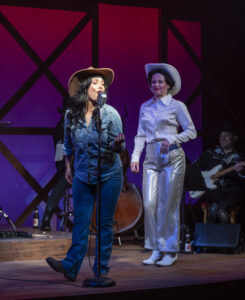
Set design by Tara M. Houston is relatively simple, with the band placed in the rear center of the stage. Stage left consists of what seems to be a Texas restaurant/roadhouse setting, while stage right is meant to look like Louise’s kitchen. It is through the lighting design that the band area is transformed into a stage within a stage for Patsy: to mimic those occasions when she performs at various venues, such as in Houston or Las Vegas, etc. Prop design with wooden tables and wagon wheels complete the effect, thanks to Tyson Carter’s work, and we see her stacks of letters held in a jewelry box on stage, but also hanging from the rafters above the whole audience. Lighting design by Michael Trudeau is mostly backlit, for example, in solid purple or red—or patterned, like a blue sky with clouds or a night sky with stars. Everyday life scenes feature flat lighting, while spotlights highlight specific performances of songs when sung in theatres or on television. The most important breakaway from this lighting pattern is the “Crazy” song (one of my all-time favorites), where it looks like honeycombs in gold cover the entire stage.
My main issue has to do with the sound on opening night. It would have been better had the standing microphone been used as a prop rather than being live. With the actors already miked with their headworn microphones, the addition of a hot standing microphone increased the volume unnecessarily. And while Patsy was always loud and forceful, Louise’s voice wasn’t always so much, creating considerable variation between them. That being said, the mix between the singers and the band was perfect. Also on opening night, a delightful reception consisted of Texas-style food. And in keeping with the story, the only beer being served at the bar was Schlitz.
The Backstage Guide, a publication of Community Service at American Blues Theater, is a sixteen-page guide to the show, separate from the program—and it’s so very well done! Providing all sorts of interesting background information, the guide describes Patsy Cline’s life and her influence on women artists, especially those in country music, and also introduces us to Louise Seger. In addition, it serves as a testament to the hard work of the director, music director, cast, and crew in developing this production—not to mention the work of authors, researchers, and professors whose articles have been reprinted here.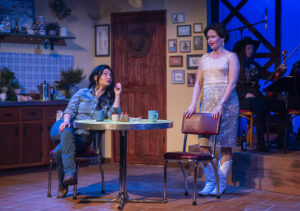
Since the narrative is basically told from Louise’s perspective, connections between events in Patsy’s life are somewhat in bits and pieces, and this may not seem all that satisfying to some audience members who might prefer a deeper dive into the star’s personal history instead. As an example, the life events behind the song “Crazy” (which is one of Patsy’s most famous) is never really explained in this musical. Despite this possible flaw and some superficialities, the advantage of this show is its lightheartedness in the face of the two characters’ personal tragedies. And of course, who could argue with the music!
I enjoyed listening to comments from the audience when the show ended. “This show is perfection,” said one person. “I’m so glad I came tonight!” said another. Yes, the presentation was lively and fun, and I will treasure the music and the memories… always….
“Always…Patsy Cline” is playing through June 7, 2026, at American Blues Theater, 5627 N Lincoln Avenue, Chicago.
 Tickets range from $34.50 – $64.50 (no hidden fees).
ALL SALES ARE FINAL.
Senior discounts – $5 off regular price
Student discounts – $10 off regular
Group tickets (for parties of 6 or more) are reduced by $5 per ticket.
To make reservations, call the box office at (773) 654-3103.
 Performance schedule:
Wednesdays – 2:00 p.m.
Thursdays and Fridays – 7:30 p.m.
Saturdays –
May 9th, 23rd, and June 6th only – 7:30 p.m. only (no 3:00 p.m. show)
May 16th and May 30th – 3:00 p.m. only (no 7:30 p.m. show)
Sundays – 2:30 p.m.
Industry Performance:
$34.50 tickets are available for the Thursday, May 21 performance with promo code INDUSTRY
Special Access Events – $34.50 ticket
American Sign Language-interpreted performance – Friday, May 22 at 7:30 p.m.
Touch tour – Sunday, May 31 at 1:30 p.m.
Audio described performance – Sunday, May 31 at 2:30 p.m.
The venue is fully accessible. There are no steps into the building or to the accessible seating section in the theater.
For any accessibility requests or for additional assistance, call (773) 654-3103 or email BoxOffice@AmericanBluesTheater.com.
For more information and to purchase tickets, visit: https://americanbluestheater.com/.
Parking:
Reserved parking is available in their lot for $15 per car. These spots are limited and must be purchased in advance online or by phone.
There is limited free parking available on Lincoln Avenue and some surrounding side streets.
Any parties with accessibility needs may reserve accessible parking at no cost. Please call (773) 654-3103 to reserve accessible parking.
A curbed loading zone is conveniently located in front of the entrance on Lincoln Avenue.
The show runs approximately 1 hour and 50 minutes, including a 10-minute intermission. photos by Michael Brosilow
To see what others are saying, visit www.theatreinchicago.com, go to Review Round-Up and click at ” Always…Patsy Cline”.


More Stories
“Buddy- The Buddy Holly Story”
“Adolescent Salvation” reviewed by Paul Lisnek (Curtain Call Chicago)
“That’s Weird, Grandma’s 25th Birthday” reviewed by Julia W. Rath