

**** The story of Orpheus and Eurydice is always popular, so why not a reversed version? That’s what happens in El último sueño de Frida y Diego, an opera that imagines the last day in the life of Mexican muralist Diego Rivera, as he is accompanied to the Underworld by his wife, the painter Frida Kahlo. It’s a new opera, having debuted in 2022, with music by Gabriela Lena Frank and a libretto by Pulitzer Prize winner Nilo Cruz, and only the second in Spanish that the Lyric Opera has performed as part of a mainstage season. It’s light on plot, but alternatively moody and plaintive, depicting artists on the threshold of transitioning into history. Like much of the work that made Rivera and Kahlo famous, director Lorena Maza’s production is also a loving depiction of Mexican culture and society in which the past and present exist simultaneously.
On the Day of the Dead, Diego (baritone Alfredo Daza) joins the crowds at the cemetery hoping to meet a departed loved one on the one day of the year they can return to the world of the living. Diego doesn’t normally do this sort of thing, but he is frightened because he knows his life is rapidly drawing to a close. Realizing that if he’s going to take the ritual seriously, he should be invoking the Aztec gods, he calls out to Mictlantecuhtli to allow Frida to leave the Underworld. In Mictlan’s land, the Catrina (soprano Ana María Martínez) tells Frida (mezzo Daniela Mack, mezzo Stephanie Sánchez on April 1) that Diego has summoned her. But unlike all the other ghosts, who are delighted to take an excursion to the living world, Frida sees nothing for her there. Her body was a source of agony, loving Diego likewise, and being separated from them for three years has allowed her to explore her own identity. However, another artist, Leonardo (countertenor Key’mon Murrah) argues that each world has distinct positives, and that this is a chance to experience colors again. After changing her mind several more times, Frida ultimately goes.
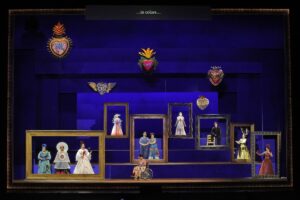
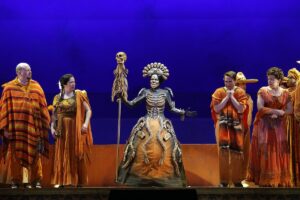
Diego has deteriorated further when Frida encounters him, and perhaps moved to pity by this role reversal, she reconciles with him. However, one of the rules the Catrina lays out is that they cannot make physical contact, or else Frida will have to remember physical pain. That doesn’t scare her for long, of course, and she and Diego end up embracing before leaving their worldly home for the final journey. Set designer Jorge Ballina makes Frida and Diego’s blue house a world of its own that only briefly exists in what is otherwise a sea of marigold-orange. When the living and dead again part with Diego now among the deceased, costume designer Eloise Kazan likewise has all the characters dispense with their multicolored Earthly garments to unite in the orange robes of the Underworld before Mictlantecuhtli’s throne.
Frank’s music, conducted by Roberto Kalb, is slow and melancholic during the scenes in the living world, picking up energy during the scenes in the Underworld, which have much more of a party atmosphere. Cruz’s lyrics, too, are heavy on poetry, with the exception of the playfulness of the Catrina. The play assumes that you are already plenty familiar with both major characters, especially Rivera, whom it doesn’t explore as explicitly as an artist whose work was deeply personal (even though he is largely responsible for the Catrina’s iconic status and the complex arrangements of ghosts from all eras are likely inspired by his historical murals.) There is a brief moment when the chorus recreates Kahlo’s most famous self-portraits, but it is just a moment. Nevertheless, the production is plenty beautiful on its own, with simple sets filled out with complex screens, floral arrangements, and candles. El último sueño de Frida y Diego is more about the emotional experience than the story, but the experience is a rich one.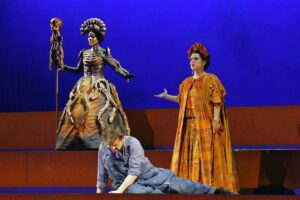
El último sueño de Frida y Diego will continue at the Lyric Opera House, 20 N Upper Wacker Drive, Chicago, thru April 4 with the following showtimes:
 March 29: 2:00 pm
April 1: 2:00 pm
April 4: 2:00 pm
Running time is two hours and fifteen minutes with one intermission. There is also a thirty-minute preview talk an hour before the show.
Performances are in Spanish with English supertitles.
The Lyric offers parking deals with Poetry Garage at 201 W Madison St. if inquired about in advance. Tickets start at $69; to order,
visit LyricOpera.org or call 321-827-5600.
To see what others are saying, visit www.theatreinchicago.com, go to Review Round-Up and click at “El último sueño de Frida y Diego.”





More Stories
“Buddy- The Buddy Holly Story”
“Adolescent Salvation” reviewed by Paul Lisnek (Curtain Call Chicago)
“That’s Weird, Grandma’s 25th Birthday” reviewed by Julia W. Rath