

 **** I was a big fan of Jackie Gleason and “The Honeymooners” when I was growing up. It was my dad’s favorite TV show, and we would watch it together in reruns. Consequently, “Changing Channels” by John Reeger was of particular interest to me because of the analogies to this 1950s program. Most importantly, watching the play gave me a reason to do a little googling about the original series. While I was familiar with Audrey Meadows in the role of Alice, I didn’t know that the original actor who played the part was Pert Kelton, who was blacklisted due to her husband’s suspected communist ties.
Directed by Kevin Theis, “Changing Channels” is meant to be the “behind-the-scenes” glimpse into this popular retrocomedy. Here the playwright recreates the story of Jackie Gleason and Pert Kelton in the characters of Eddie Gillroy (Orion Lay-Sleeper) and Maggie Carlin (Kat Evans) who star in a comedy series called “For Pete’s Sake.” Casting is great: Lay-Sleeper’s rotund body and overbearing bluster (somewhat overplayed in the first act) makes for a wonderful Gillroy, that is, a “double” of Gleason. Evans who plays Carlin is very talented in the role; and especially well done is the style of wig she wears, which is a carbon copy of Pert Kelton’s hairstyle. In today’s drama, the audience sees a slice of life from the year 1952, during the height of Senator Joseph McCarthy’s prominence when he and the House Committee on Un-American Activities accused many people in the media of being communists. By placing a stranglehold in defining what it means to be an American and by tarnishing people’s reputations through guilt by association, he and other public officials were responsible for many being placed on a blacklist and losing their jobs and sources of income.

Although the original actors’ names and the characters they once played have been changed to protect “the innocent”, what remains true to life are many details having to do with this time period. Reference is made to “Counterattack”, a weekly subscription-based newsletter that emphasized taking action against those accused of communist sympathies or who belonged to communist organizations. Then too, there was the CBS blacklist called “Red Channels.” According to The New York Times: “In December 1950, during the height of the Red Scare, CBS management required all 2,500 employees to sign a loyalty oath affirming they were not Communists or affiliated with subversive groups. This policy… was implemented by CBS President Frank Stanton to protect the network from McCarthyism-era attacks.” In “Changing Channels”, CBS (which produced the real “Honeymooners”) just happens to be the fictional broadcaster of “For Pete’s Sake.” And (spoiler alert), the play provides us with the positive example of how Carlin chooses not to sign the loyalty oath. In so doing, she stands up for the principles of freedom of speech and freedom of conscience and the Bill of Rights’ guarantee against self-incrimination. Her decision is in contrast to many others—including her husband Peter Bell (Skyler Tipton), who initially argued in favor of expediency. (Note that in real life Kelton’s husband was Ralph Bell, an actor-producer, who also had been blacklisted.)
Yet “Changing Channels” is also a story about people’s foibles and the examples that they set. Gillroy’s agent is a man named Bullets (Johnny Moran), who is constantly looking out for the actors’ future careers. Thus, he continues to explain the importance of signing the loyalty oath and all the legal reasons to go along with management. At the same time, Gillroy’s “best boy” Kenny (Andrew Pappas) sees past the glitz and glamor and seeming opportunities of the present moment. He is meant to be an example of a young person from the next generation, who looks to the future with hope and promise. The last character in the show is the unseen white mouse named Mortimer, a frequent visitor to Carlin’s dressing room. In a related plot, the men are scared of the mouse and want to catch it. So mousetraps are recommended. To bait the trap, there would need to be something in it that a mouse would find delicious and irresistible: in this case, a gumdrop. Such is the analogy to the real circumstances that the characters find themselves in.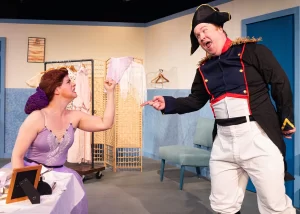
Joe Larkin has done a nice job with the scenic design of Carlin’s dressing room, including furniture like a TV set and a pink swivel chair and a blue loveseat and props such as liquor bottles on a tea cart—and a red rose in a vase. Considerable credit must go to Emily McConnell for the beautiful costumes which we see hanging from Carlin’s wardrobe rack and which Evans wears later in the performance. Sound by Petter Wahlbäck is good, and the use of the musical theme from “The Honeymooners” grounds the story. Lighting design by Liz Cooper is perfectly appropriate to tell this tale. I especially loved the graphic design of the entire “TV Guide” as the cover and interior of our playbill. Very clever! Now having said that, I wanted more and better: Since the 1950s TV sit-com was making a break from the established comedy shows currently on radio, more emphasis should have been placed on television as a trailblazing medium. Instead of the audience seeing the back of a television set and only hearing the voices emanating from it, I wanted to see black and white video clips of the actors performing in “For Pete’s Sake”, that is, excerpts from the two episodes which the audience only hears. Thus, the TV set should have been turned around in such a way so as to face the audience—which would have been how viewers would have watched the original Honeymooners series. I realize that incorporating a video screen that faces the audience would have represented a change in the lighting design and the stage layout as well as represent a major change in the stage direction for several scenes. But these days, the creation of a video for use in this production would no longer be an astronomical expense.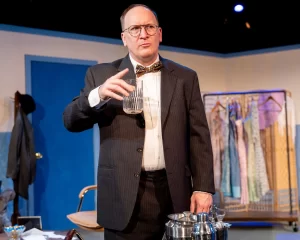
While a lot of principled people stood up for freedom of thought and expression during the McCarthy Era, others were willing to kowtow to the will of corporate executives and political hacks. More to the point, we see how each of the characters—from Gillroy and Carlin to Bullet, Peter, and Kenny—has reacted differently to the idea of signing a loyalty oath in order to keep their jobs. Hence, the underlying politics of a yesteryear TV show is still very relevant nowadays. Like then, many people in the media today have chosen to step up to preserve their right to dissent at great personal risk. The most obvious modern parallel is, of course, the canceling of “The Late Show with Stephen Colbert”, because Colbert dared to take on President Trump and his administration, not to mention that CBS is currently in the crosshairs concerning its deal with Paramount and now its future takeover of Warner Brothers media. Colbert, as we may know, was told he was being let go by CBS for “financial reasons” when, in fact, ideological differences are the more likely cause. (And don’t think the same sort of thing isn’t happening elsewhere on other networks, right now!)
Director Theis’s decision to stage a production about the loyalty oaths of the 1950s is all the more timely and relevant today as these can implicitly be compared to pledging allegiance to MAGA and President Trump. Hence, “Changing Channels” shows us what can happen to people when it comes to the tamping down of artistic expression and the takeover of our media by monied interests. It is also a story about what it means to be a reed blowing in the wind as compared to having a backbone when it comes to moral certitude. The play makes each of us ask the question: “What would I have done if I were in the same situation, that is, if my employer wanted me to sign?” And more importantly, we need to ask ourselves: “What do I live for?” Fame, fortune, glory, or the courage to do the right thing?
“Changing Channels” is playing through April 12, 2026, at City Lit Theater, 1020 W. Bryn Mawr Avenue, in Chicago, on the second floor (accessible via elevator) of the Edgewater Presbyterian Church.
General admission tickets – $40
Seniors – $35
 Students and military – $17
Performance schedule:
Fridays and Saturdays at 7:30 p.m.
Sundays at 3:00 p.m.
No performance on Easter Sunday, April 5
Additional performances:
Mondays, March 30 and April 6 at 7:30 p.m.
“Photos: Steven Townshend | Distant Era”
For more information and to purchase tickets, visit: https://www.citylit.org/ or phone 773-293-3682.
To see what others are saying, visit www.theatreinchicago.com, go to Review Round-Up and click at “Changing Channels”.





More Stories
“Shane” Reviewed by Julia W. Rath
“Sunday In The Park With George”
“Buddy- The Buddy Holly Story”