
**** Sunday evening, the combined talents of soprano Rowan Pierce and guest conductor and harpsichordist Richard Egarr made for a wonderful program of vocal and instrumental music, entitled “Baroque Blockbusters.” The two of them plus artists from the Music of the Baroque Orchestra created a blockbuster concert at the North Shore Center for the Performing Arts, in Skokie.
Pierce, with her resplendent voice and stirring vibrato, was perfectly cast as the religious adherent in Frederic Handel’s Motet “Silete venti,” HWV 24. With accompaniment by Egarr on harpsichord, oboes (Anne Bach and Erica Anderson), bassoon (Galina Kiep), and the full orchestra, her talents were on full display throughout. I especially enjoyed the Aria: “Date serta” with its fortissimo and subsequent resolution, followed by the Aria: “Alleluia”: repeated in all its vocal commutations and permutations.
Pierce returned after intermission to sing portions of Henry Purcell’s Suite from “The Fairy Queen.” Her playful yet plaintive singing about love, fairies, and spirits was truly magical. The harpsichord accompaniment of “Ye Gentle Spirits of the Air” is especially poignant as is the oboe (Bach) and bassoon (Kiep) during the “If Love’s a Sweet Passion” section. “The Plaint: O let me weep!” is nicely sung to violin (Kevin Case), cello (Anna Steinhoff), and harpsichord (Egarr). Then too, the viola (Elizabeth Hagen) and violin work skillfully as accompaniment in “See, even Night.” Nicely sung to cello (Steinhoff), bass (Collins Trier), and harpsichord accompaniment is “Hark! the Echoing air.” A good number of trumpet solos and duets (Barbara Butler and Jordan Olive) introduce the various acts: We hear how the Act IV Symphony focuses on the timpani (Douglas Waddell) and the Act V Symphony builds with its trumpets and full ensemble. The oboe duet (Bach and Anderson) in the Prelude to “Come all ye Songsters” is lovely. What a beautifully executed theatrical performance—which is the way that Egarr wanted us to think about Pierce and Purcell in his opening remarks to the second half of the concert.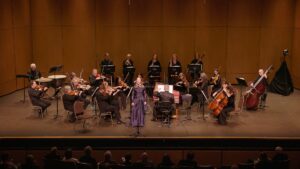
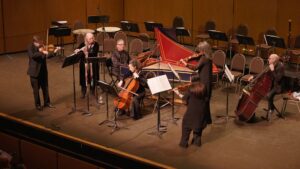
Speaking of explanations of the music, Egarr began the first half by discussing J.S. Bach’s series of Brandenburg Concertos as a prelude to the performance of Concerto No. 5, which opened the program. He started out by describing the relevance of all the component parts of the composition in relation to the composer’s life: specifically pointing out that No. 5 was written in large part to highlight Bach’s accomplishments as a harpsichordist. As for its musical performance, Egarr also told us that rather than having this concerto performed by a large orchestra (which is the way that we typically see the piece performed in this day and age), he would make use of a much smaller ensemble, that is, presented the way that Bach had originally intended.
But first I need to say that Egarr made for a very fine conductor when he led the vocalist and the larger orchestra and played the harpsichord to accompany them. But if his plan was to be faithful to Bach’s own performance of Concerto No. 5 (that is, employing seven musicians sans conductor), then either the first violinist (as concertmaster) or the harpsichordist (as percussionist) must step up to establish the beat and as many players as possible need to incorporate gross body movements alongside their instrumental proficiency to make things work. Hence, I was looking for dancing, swaying, or jumping—or exaggerated bowing on the part of the first violin. Especially during the opening Allegro movement, neither Egarr nor violinist Kevin Case was assertive enough to take control of the ensemble. As a result, some instruments were rushing, and the beat was all over the place. “Harmonies” were created that were unimaginable in Bach’s writing. If the plan happened to be for the concertmaster and the harpsichordist to share in the responsibility of keeping time, then they need to catch each other’s eye to signal each other and trade off roles. This did not happen here. To my mind, since Egarr was playing the featured instrument, it would have been best for the concertmaster to have taken the lead throughout.
The Affettuoso movement was an improvement, because the musicians got back together after the beautiful flute solo (Mary Stolper), followed by the violin (Case) plus harpsichord. By the third movement Allegro, Egarr nodded his head more, and that helped. Best of all was when he stood up from his seat at one moment to get the musicians to work as one. Throughout, his lengthy and lovingly-executed soloing was magnificent! Yet when the ensemble played as a group, the other instruments generally needed to be softer relative to the harpsichord. It was particularly at the beginning when the balance wasn’t what it should have been.
Then too, there was the lack of supertitles (which I have grown accustomed to). These would have been helpful for the translations for “Handel’s Motet “Silete venti” (sung in Latin) as well as for providing a clearer understanding of the 17th century English lyrics in “The Fairy Queen.” Noting this absence, executive director Declan McGovern in his opening remarks directed us to the libretto, beginning on page 24 of our program. Now a very minor thing: I felt that Pierce should have changed costumes during intermission. Her stately black ballroom gown was more than appropriate for Handel’s sacred theme. But a lighter-colored and frillier dress, more closely befitting the theme of fairies and sprites, would have better suited the Purcell. Her outfit should have overtly reflected her versatility in moving from a religiously based composition to one based on naturalism and secularism.
In all, it was a great evening of music. My guest and I enjoyed ourselves as did the audience.*
“Baroque Blockbusters” by the Music of the Baroque Orchestra took place on Sunday, March 1, 2026, at the North Shore Center for the Performing Arts, 9501 Skokie Boulevard, in Skokie.
This was followed by a performance on Monday, March 2, 2026, at the Harris Theater, in Millennium Park, 205 W. Randolph Drive, in Chicago.
Both performances started at 7:30 p.m.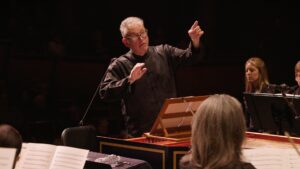
Live performance tickets ranged from $46 to $119. Discounts may be available for students and seniors.
On-demand performances will be available from Friday, March 6th at 5:00 p.m. through Sunday, April 6th. On-demand tickets are $18 including a $3 handling fee.
For more information about this and future performances of Music of the Baroque, including times, dates, and locations, please go to: https://www.baroque.org/. For information about future ticketing, visit: https://www.baroque.org/tickets/.
Music of the Baroque is a resident company of the North Shore Center for the Performing Arts. To learn more about the venue, their future offerings, and ticket prices, visit: https://northshorecenter.org/.
To learn more about the Harris Theater, their future offerings, and ticket prices, go to: https://www.harristheaterchicago.org/.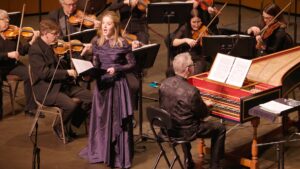
*Note: I understand completely when members of the audience use hearing aids that go through their phone. I had to ask someone the other night to turn her phone face down so I didn’t have to be distracted by the lighted display. This happened after we were specifically told to turn off all light-emitting devices. I waited a generous five minutes before I turned to her and politely asked her…. The response took me by surprise. It wasn’t, “Oh, I’m sorry,” but rather a more aggressive, “Is it bothering you?” I said yes. She did turn her phone over and worked to turn off the screen. I felt that I shouldn’t have to ask….


More Stories
The Generations visit McHenry
Emerging Artist Showcase- Thursday, August 13th Hurry- the house will be sold out before you know it!
Cabaret Calendar