

 **** Love, humor, and Mozart’s music; a good production of Così fan tutte has everything you need for a fun time at the theatre. And the production currently at the Lyric Opera of Chicago, originally directed in 2021 by the late Michael Cavanagh, with revival direction by Roy Rallo and Enrique Mazzola conducting, certainly leans into the laughs. The story of two friends who decide to seduce each other’s fiancés as a bet and catch real feelings, its tone is reminiscent of a good production of a Shakespeare comedy. Set in this production in a blueblood country club in the 1930s, Così fan tutte is a riot during the first act. But if you prefer something a bit more sentimental, in the second act, when we get a happy ending, but not a conventional one.
Ferrando (tenor Anthony León) and Guglielmo (baritone Ian Rucker) are enjoying a week on vacation with their fiancés, Dorabella (mezzo Cecilia Molinari) and Fiordiligi (soprano Jacquelyn Stucker). They are very sickeningly in love, and the club owner, Don Alfonso (baritone Rod Gilfry) won’t stand for that. He tells the young men that, although women think their feelings are real, they are actually shallow and facetious, and that they will commit themselves just as strongly to any man who makes them feel special. Ferrando and Guglielmo deny this and agree to the Don’s wager that, if they pretend to be drafted and return in disguise, each will succeed in flipping the other’s lover within a day. Confident they will win, they treat this prank very lightheartedly.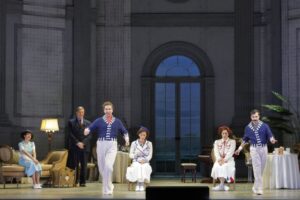
Dorabella and Fiordiligi are quite silly. Their reactions to absolutely everything are over-the-top and performative, and when their boyfriends announce they are getting sent overseas immediately, they accept this unquestioningly because it gives them a chance to dramatically declaim their faithfulness. When Ferrando and Guglielmo sneak back in disguised as virile and mysterious foreigners, the women are initially emphatic in their refusal to be wooed, to the point that Don Alfonso even gets frustrated. However, he enlists the assistance of the servant, Despina (soprano Ana María Martínez), to prod at the younger women and reassure them that switching lovers so quickly is normal and understandable, while also compounding the deception with disguises of her own. To both couples’ dismay, not only does Despina make rapid progress at convincing the women of the merits of a fling, but all four guiltily acknowledge to themselves that they may genuinely prefer the new matchups.
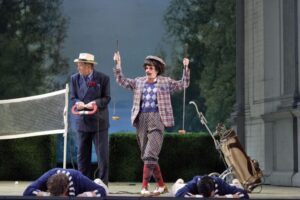
Throughout the first act, the actors are all playing broad comedy, and between their sense of timing and character, Mozart’s cheery music, and the design team’s delight in the aesthetics of old-fashioned physical fitness, the show is, in my opinion, quite funny. Fiordiligi has an aria in Act I, “Come scoglio,” in which she righteously declaims that she will remain faithful, but this is the set-up for her reversal in Act II, in which she struggles with her feelings much more than Don Alfonso expected her to, even though she’s ultimately doing what he predicted. Here, the opera goes from being goofy to being sad and sweet, and the actors are called upon to do both. Their performances in the first act were such extreme caricatures that this didn’t entirely work for me, but Ferrando being the serious guy and Guglielmo being the funny guy did come across clearly enough for the switch in affection to make sense.
Così fan tutte is really more a struggle between generations than the sexes, so it’s a major benefit to this production that Don Alfonso and Despina are able to plausibly play older than the lovers. Erhard Rom’s set and projection design, as well as Constance Hoffman’s costumes, make this country club a bubble for privileged young people who don’t really know themselves at a time when even among the upper class, marriage was becoming more about love than clarifying inheritance. León and Rucker bring a strong sense of innocence to their non-malicious but devastating trolling that matches Stucker and Molinari’s rote but shallow moralizing. Gilfry and Martínez’s Don Alfonso and Despina clearly see themselves as a set of replacement parents whose job is to teach the idealistic and pretentious youth how to actually get along in the world. (Martínez even played Fiordiligi the last time Così fan tutte was at the Lyric.) Recon textualizing Così fan tutte for an environment that’s more recognizable to modern people allows the comedy to shine brighter, and adds a new layer to a show that, historically, took a while to find its audience.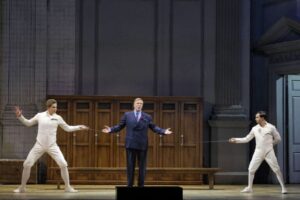
Così fan tutte will continue at the Lyric Opera House, 20 N Upper Wacker Drive, Chicago, thru February 15 with the following showtimes:
 February 7: 7:30 pm
February 10: 7:00 pm
February 13: 7:00 pm
February 15: 2:00 pm
Running time is three hours and thirty minutes with one intermission. There is also a thirty-minute preview talk an hour before the show.
Performances are in Italian with English supertitles.
The Lyric offers parking deals with Poetry Garage at 201 W Madison St. if inquired about in advance. Tickets start at $47; to order, visit LyricOpera.org or call 321-827-5600.
To see what others are saying, visit www.theatreinchicago.com, go to Review Round-Up and click at “Così fan tutte.”





More Stories
“Adolescent Salvation” reviewed by Paul Lisnek (Curtain Call Chicago)
“That’s Weird, Grandma’s 25th Birthday” reviewed by Julia W. Rath
“Vape: the Grease Parody”