
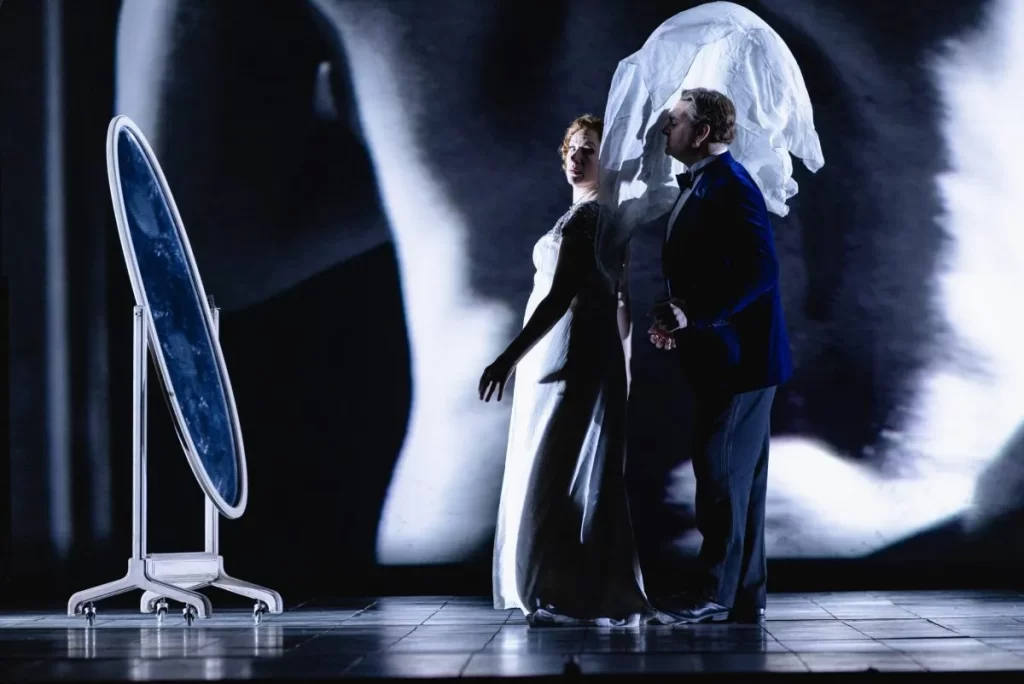
 **** People who know Oscar Wilde for The Importance of Being Earnest may be surprised to encounter Salome, a play finished a few years earlier, in 1892, that is almost the complete opposite in aesthetics and tone. Based on the Biblical account of the death of John the Baptist on the orders of the Judean royal family, it was Wilde’s vehicle for his love of beauty in excess, containing lengthy verbal descriptions of treasures and the sensuality that nineteenth century Europeans projected onto the Orient. The play had a hard time getting produced, as did Richard Strauss’s 1905 opera adaptation, which added a dissonant, often frantic score to the since-disgraced-and-dead Wilde’s edgy subject matter. History would prove that Salome has been more typical of what opera has been after than what came before it, and to give the work new life for contemporary audiences, Sir David McVicar’s production puts special emphasis on the eponymous princess being an abuse victim who is woefully misguided about love and sex. It is that version that is now playing at the Lyric Opera, with revival direction by Julia Burbach, conducted by Tomáš Netopil, and several key cast members all making their Lyric debuts.
The play begins with Salome (soprano Jennifer Holloway) stepping out of the banquet being thrown by her stepfather and uncle, King Herod (tenor Alex Boyer), and mother, Queen Herodias (mezzo Tanja Ariane Baumgartner). She complains that the king has been looking lasciviously at her all night and hides from him in the dungeon, which is currently being occupied by Jochanaan (bass-baritone Nicholas Brownlee.) Or rather, he’s in a pit below the stage, but we still hear his deep voice blaring like a misogynistic foghorn as he rails against the Queen for bedding men of all foreign nationalities and corrupting Judea with her lusts, just as women have always done.
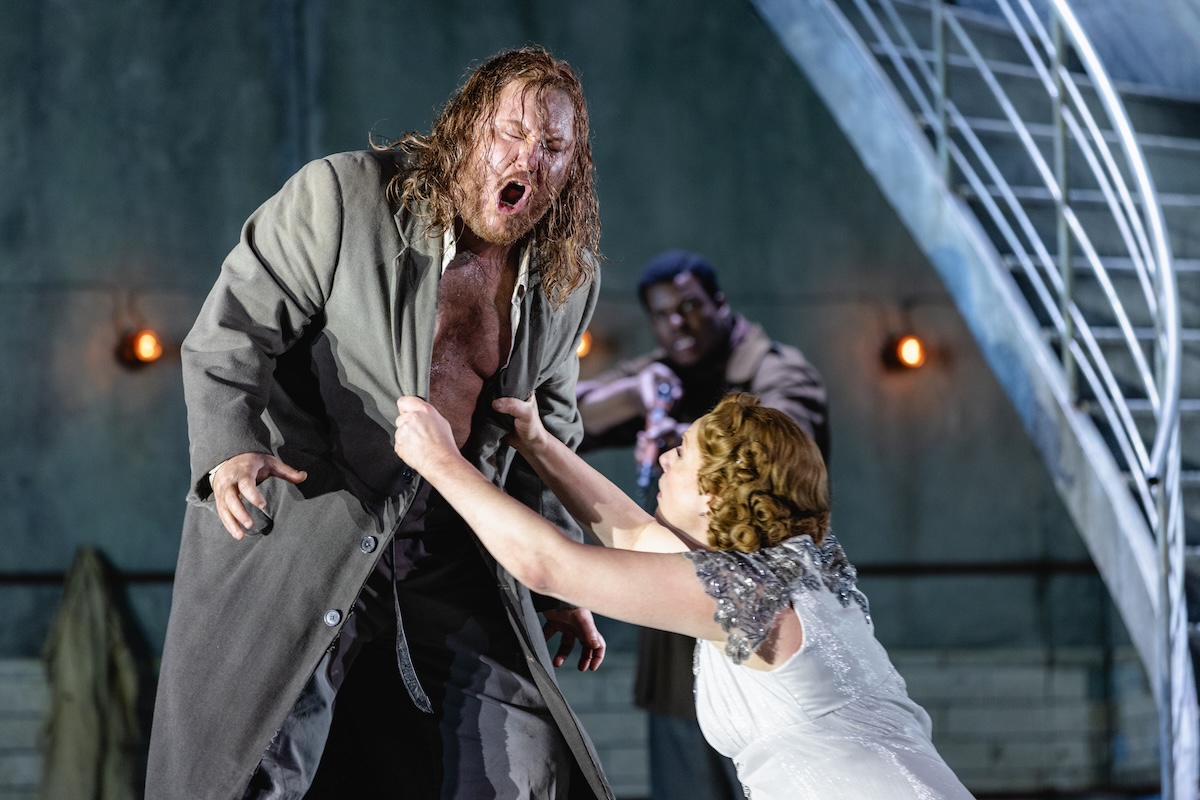
Salome is not used to hearing people say such things out loud, and the guards tell her that Herod fears to execute Jochanaan, who further claims the Messiah has already come and is working miracles. Salome is intrigued by this possible weakness in Herod, and orders Jochanaan to be brought before her. Though he denounces her as retroactively a bastard product of incest, Salome becomes instantly obsessed, fawning over his pale skin and hair that is the “texture of grapes and cedar.” Eventually, Herod moves the party downstairs with Herodias in tow, and Herodias, who has wanted Jochanaan dead for some time, is delighted when Salome proclaims an erotic desire to have him beheaded. It will take all of the princess’s seductive wiles to get her stepfather/uncle to risk angering God, but he has been priming himself for this for most of her life.
Frankly, I had been having a very difficult time accepting the characters in this play as human in any regard until the interactions between Salome and Herod began. Strauss’s music is certainly evocative of tremendous, confusing emotions, but Jochanaan is presented as ridiculous and repellant, and Salome’s description of him has nothing to do with what is actually in front of her. Also, one character randomly killed himself upstage while the audience’s attention was focused elsewhere and his body went unnoticed until Herod pointed it out. However, once the family interactions begin, it becomes much clearer what McVicar’s vision was, and what Strauss found interesting in Salome’s psychology. Alex Boyer was a late replacement as Herod, but he’s excellent. His characterization is that of a put-upon man who initially seems charming in a mildly sleazy way, as is necessary for a client king in a factious nation, but is gradually revealed to be grossly dependent on affection from the girl he raised to be a doll. As for Holloway’s Salome, she’s lonely and desperate for an escape, but cunning and a forceful personality even without fully understanding her own motives. Realizing she has the power to convince Herod to do something he does not want to, she revels in it with her entire being. Baumgartner’s Herodias is heartless and imperious, but her real role in the story is the sense we get of how she has exploited her husband’s fascination with her daughter for a long time.
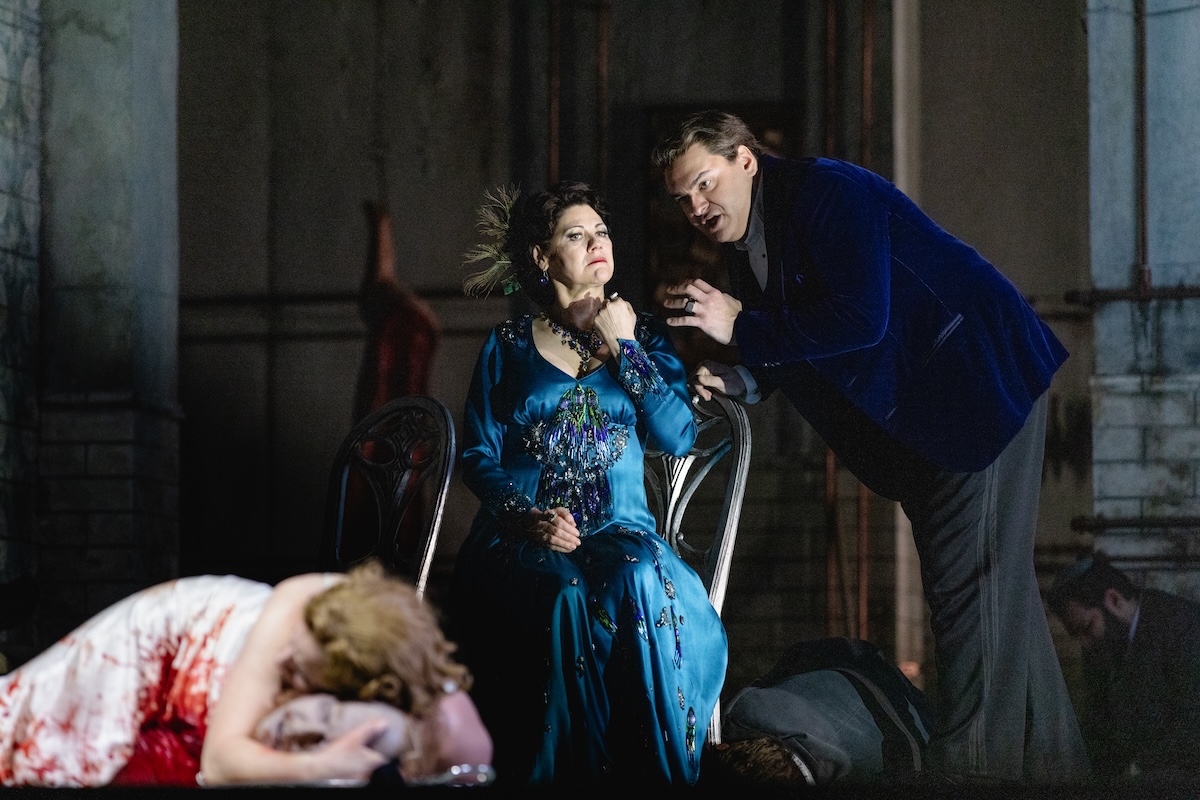
The production’s design, credited to Es Devlin, is reminiscent of the 1930s, and specifically, of fascist Italy. It’s fittingly interesting but gross to look at, with the finery of the royal feast contrasted with the dinge of the dungeon. The long lists of beautiful things the characters describe in the libretto are mostly unseen, although Strauss’s music and the actors’ voices are still rich in detail. (I was surprised to learn Salome’s final aria, “Ah! Du wolltest,” is seventeen minutes long. It hadn’t felt like it.) But perhaps the production’s most distinctive moment is the use of the video designs by 59 Studio during the Dance of the Seven Veils, which convey how suffocating and twisted the Royal Family is, even to its own members. Strauss was at the forefront of opera going from being something fun to listen to for escapist fantasy or as background music to something that is challenging, and often jarring. Though it took me a while to warm up to this production, I do recommend it, both as music and as drama.
Salome will continue at the Lyric Opera House, 20 N Upper Wacker Drive, Chicago, thru February 14 with the following showtimes:
February 3: 7:00 pm
February 6: 7:00 pm
February 11: 2:00 pm
February 14: 2:30 pm
Running time is one hour and forty minutes with no intermission. There is also a thirty-minute preview talk an hour before the show.
Performances are in German with English supertitles.
The Lyric offers parking deals with Poetry Garage at 201 W Madison St. if inquired about in advance. Tickets start at $47; to order, visit LyricOpera.org or call 321-827-5600.
To see what others are saying, visit www.theatreinchicago.com, go to Review Round-Up and click at “Salome.”



More Stories
“Buddy- The Buddy Holly Story”
“Adolescent Salvation” reviewed by Paul Lisnek (Curtain Call Chicago)
“That’s Weird, Grandma’s 25th Birthday” reviewed by Julia W. Rath