
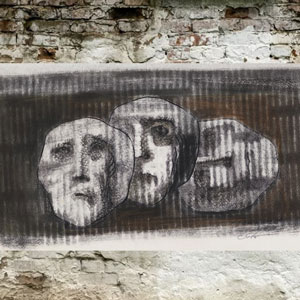
*** “The Unseen” tells the story of two men who undergo tremendous agony as political prisoners. Held in solitary confinement and tortured physically and mentally by a ruthless prison guard, they have only each other for comfort and for some measure of sanity. Originally written by Craig Wright in 2007, the play is timeless in its description of cruelty and depravity and the lengths that people will go to further evil… or keep it from happening to them. While I can appreciate how well constructed this production is, with its fine directing by Steve Needham and its skillful portrayal of violence, it’s nevertheless a disturbing play to watch, because the human suffering within it is so palpable.
The story has to do with two prisoners who live in adjacent cells. Their names are Wallace (Jordan Gleaves) and Valdez (Carlos Andrés Mai), neither of whom has ever set eyes on the other. During much of the performance, the dialogue revolves around the conversations between them, and the opening begins very much like “Waiting for Godot.” Basically, the two men reflect on their circumstances essentially as well as existentially, and this provides some fodder for comedic banter. Wallace starts out as the more practical of the two in how he views the world whereas Valdez is more the dreamer and also the one who dwells on minute odds and life’s quirkiness. But rather than waiting for Godot, they await their guard and torturer nicknamed Smash (Jacob Coggshall), who takes great pride and pleasure in breaking people down. Though Smash is rotten to the core, sometimes his notorious sadism gets to be even too much for him. While I’m not going to get into all of the gruesome details about how the prisoners are being tormented and what subsequently happens to them, I will say that we in the audience cannot help but become privy to their intense pain.
The intrigue in this show is related to a tapping sound of another prisoner on the walls. Apparently, there’s some kind of code that Valdez is the first to notice. But who is this mysterious inmate? Are they male or female? Is their cell located above or below on another floor or behind the next wall? And what is the message that is being tapped out? “You’re a real person; you’re not just the voice inside my head,” says Wallace to Valdez near the end. At least, both of them can converse with each other, whereas the person doing the tapping may not be so lucky. Of course, the play would not be complete without the prisoners seeking some means of escape and a way to put this terrible episode in their lives behind them.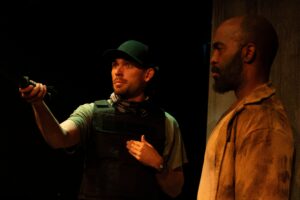
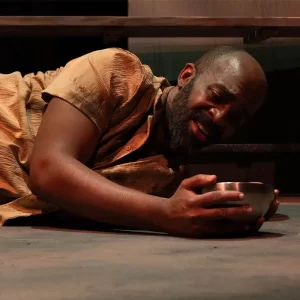
Scenic design by Malia Hunter is minimal but effective. As an audience, we can try to imagine what the prison cells look like and, at the same time, visualize the horrendous living conditions. I liked the props: the wooden slat tables that are supposed to represent prison cots plus the tin dishes and spoons and large garbage pails, which are presumably portable toilets (minus the putrid smell). Via Zach Stinnett’s sound design, we hear the sound of dripping water every so often, consistent with the fact that the men discuss waterboarding (but don’t use that term to describe it). Perhaps the most obvious and obnoxious sound is that of a loud buzzer which continually goes off day and night to keep the prisoners awake and away from thinking their own thoughts. Lighting by Jack Goodman is decent, especially all the flashing red. Costume designer Kasey Wolfgang has created prison garb which includes authentic-looking shoes. And the show would not be complete without the (fake) blood!
Although the horrific physical and mental tortures are described verbally (as opposed to being depicted on stage), their graphic detail might give you nightmares after the fact. All this—in combination with picturing the decay, stench, and unsanitary conditions within the prison walls—made me wonder if the show is one that the general public would necessarily care to watch. That being said, if you’re the sort of person who wants to envision what hell on earth might look like (such as what happens inside that infamous top-security prison in El Salvador), then Tin Drum Theatre Company’s production of “The Unseen” should undoubtably be seen—by you!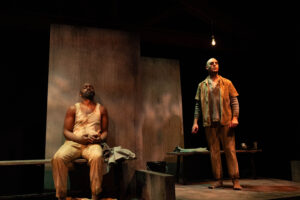
“The Unseen” is playing through November 23, 2025, at Bramble Arts Loft, 5545 N. Clark Street, 2nd Floor, in Chicago, inside their black box theatre.
 Tickets: $15 – $30.
Performance schedule:
Thursdays – Saturdays at 7:30 p.m.
Sundays at 2:30 p.m.
For more information and to purchase tickets, visit: https://tindrumtheatre.com/.
To see what others are saying, visit www.theatreinchicago.com, go to Review Round-Up and click at ” The Unseen”.





More Stories
“Escape to Margaritaville” reviewed by Julia W. Rath
“Instructions for a Seance” (Milwaukee) reviewed by Amy Menzel
“Vladimir” reviewed by Frank Meccia