

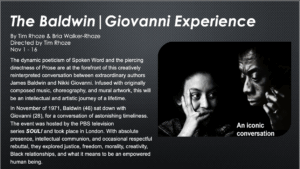
 *** Playwrights and lyricists Tim Rhoze and Bria Walker-Rhoze have written a heartfelt tete-a-tete about the existential condition of African Americans, entitled “The Baldwin | Giovanni Experience.” This world-premiere production reimagines the 1971 televised discussion once held between two eminent writers—James Baldwin (Sean Blake) and Nikki Giovanni (Rachel Blakes)—who take on number of subjects regarding the exploitation and marginalization of black people politically, economically, socially, and culturally, relative to the majority white population. Through the use of poetry and prose plus dance (choreographed by Sean Blake) and music (written by Ethan Korvne), they examine existing (and persisting) grievances that date from the legacy of slavery up through the post-Civil Rights Era. While there’s really no story arc in this play, I especially liked getting to know about Baldwin’s desire to overcome racial discrimination and become a writer of consequence. Among other things, he went to Paris where he learned that Alexander Pushkin was one-eighth black and that Alexandre Dumas was one-half black: details that white America often tried to hide.
The play starts out wonderfully with pianist Isaiah Jones, Jr. accompanying vocalist Mardra Thomas, who sings three songs well-known in the African American community: Stevie Wonder’s “Love’s in Need of Love Today” (1976), Billie Holiday’s “God Bless the Child” (1939), and Roberta Flack’s “Compared to What” (1969). As pleasurable as this is, this segment differs significantly from the rest of the performance and makes the show seem somewhat disjointed. Why was there this introduction in the first place? Was it to draw our attention to a culturally relevant expression of African American music? Or was it to point to the fact that love might be the best way to counteract a divided society’s ills? Perhaps it’s the second, because when the conversation finally turns to Baldwin and Giovanni, Baldwin talks about how the meaning of love would be a substitute for God, and the show ends with Giovanni saying almost the same thing.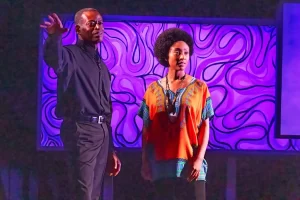
Perhaps more importantly, the question becomes why it is necessary to revive the discussion between these two renown authors in the first place. While there is no doubt that black Americans continue to be discriminated against on account of their race (up to and including today), times have changed significantly during the last half century. On stage, the two of them view race mostly in one dimension, as black versus white, whereas nowadays definitions of race and ethnicity are somewhat more nuanced and are inclusive of other minority groups. People are more likely to identify themselves as being black and brown or as BIPOC (black, indigenous, people of color), plus there are other marginalized populations, which include those in the LGBTQ+ community and those with disabilities. To put this another way, minority status is more fluid and less defined along black/white lines in today’s world, and not necessarily grounded in a legacy of slavery. Shifts in terminology also represent shifts in mindset, away from the narrative in this play, with its emphasis on polarity (e.g., “the white mind” versus “the black mind”), and towards diversity, equity, and inclusion. Dialogue about what was reality then (that is, fighting against Jim Crow) might appear as divisiveness now.
That leads to my point that the script ought to include more than just the repetition of sincere feelings and criticisms from fifty-four years ago. If the point being made implicitly is that times have changed but society still contains structural racism and underlying prejudice, then this idea needs to be brought out more overtly. To accomplish this, there ought to be some interjection of 21st century references to racism, such as black men who were killed by the police, such as George Floyd, Michael Brown, Philando Castile, etc., and black women such as Brionna Taylor and Sonia Massey. Even more immediate is what’s happening right now with ICE raids (like the one on Chicago’s South Side where the residents of an entire apartment building were awakened in the middle of the night, etc.) This would add more relevance to the script and make the point that while times may change, the racial divide and racial attacks persist… and now it’s not just against black people but Hispanics and others who are being targeted.
While the Civil Rights Movement began with African Americans fighting to preserve and protect their human rights, its reach has been expanded over the last sixty years to many other minority groups who have faced bigotry and discrimination. Of course, things may not be as free and equal as they ought to be—and, in fact, it looks like the current state of affairs is regressing in time. That being said, the creative impulse of Baldwin and Giovanni, while radical for their time period, is rather well-known today. Therefore, even though the show is a new creation, it feels more like a historical piece, and it probably would have played much better maybe 30 or 40 years ago before a contemporary audience. Today, a modern audience wasn’t given the space or opportunity to think about how our current circumstances might compare with those of the past and how our sentiments may or may not differ from those of previous generations.
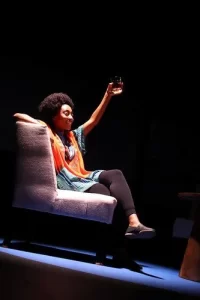
What’s great about this show is that it’s not just talking heads and that there is excellent movement throughout the stage among the main characters. I liked seeing the different personalities of Baldwin and Giovanni, although both don’t necessarily disagree on anything. Whereas he often tears down the fourth wall to address the audience, she does so only once and frequently serves as his foil. All this, plus appealing set design, lovely murals, and the addition of music and dance, makes the production engrossing.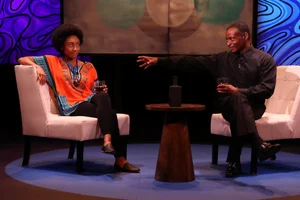
Yet what might have been seen as forward-thinking, if not revolutionary thought, during an earlier time period doesn’t take into account the inclusion of other minorities. Basically, racial polarization has given away to nuances regarding individuals who do not neatly fit into defined racial and ethnic categories, and many people might fall into some combination of majority and minority status. This reality and the growth of the Hispanic population in the United States have somewhat shifted the discussion, such that prejudice and discrimination have become much more multifaceted. Thus, I would have preferred a show that would have focused more on Baldwin’s and Giovanni’s scope of achievements or, better, how the words of these two African American giants might have been applied to what is happening in the United States in the year 2025.
 “The Baldwin | Giovanni Experience” is playing through November 16, 2025, at the Fleetwood-Jourdain Theatre in the Noyes Cultural Arts Center, 927 Noyes Street, Evanston.
Tickets: $32.00
Performance schedule:
Saturdays at 7:00 p.m.
Sundays at 3:00 p.m.
For more information and to purchase tickets, go to www.fjtheatre.com or https://www.cityofevanston.org/about-evanston/arts-and-culture/theatre/fleetwood-jourdain-theatre or phone 847-866-5914.
To see what others are saying, visit www.theatreinchicago.com, go to Review Round-Up and click at “The Baldwin l Giovanni Experience”.




More Stories
“Shane” Reviewed by Julia W. Rath
“Sunday In The Park With George”
“Buddy- The Buddy Holly Story”