

***** Timothy Griffin has created a fascinating tale of murder and mayhem on the high seas entitled “Strange Cargo: The Doom of the Demeter.” Adapted from the seventh chapter of Bram Stoker’s “Dracula”, this horror classic is about a Russian cargo ship and its travels from Transylvania through the Bosporus, past Italy, past the Dover Straits, and into the North Sea—with England being its final destination. But all the while, its crew is being bumped off one by one, and nobody knows what’s happening or who the murderer might be. Over time, as the number of deaths increase and the crew’s paranoia grows, rationality starts to fail and delusions set in. As the story gets eerier, the audience becomes riveted by the intrigue. Considering that the word “doom” is in the title, the question becomes: “To what extent is the ship doomed?” “Can something can be done about it or is this a fait accompli?” A co-production between City Lit Theater and Black Button Eyes Productions, this world premiere presentation, directed by Ed Rutherford, is perfect for the Halloween season!
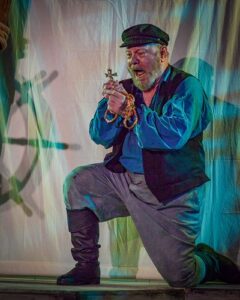
At the Demeter’s helm is Captain Gorodetsky, played to perfection by Brian Parry, with his characteristic charisma and formidable stage presence. Whether reading excerpts from his log or in dialogue with his crew, he not only commands the ship but commands the audience. Alex Albrecht as Chief Basarab, the ship’s first officer, also gives us a remarkably convincing performance with his two-faced demeanor: one when he addresses the captain and crew and the other when he is in contact with Gusa (Jennifer Agather), a sailor whose tongue was once cut out but has now returned as a perfectly articulate entity, real or imagined. Strong performances likewise distinguish Robert Howard, who plays Post, the third in command, as well as Ross Compton, as Bucatar, who insists that he personally must accompany his special cargo on board, consisting of a large wooden box in the shape of a coffin (which the advance piece tells us contains Count Dracula’s personal effects). Additional crew members are played by Riles August Holiday (Olgaren), Andrew Boworth (Abramoff), Cameron Austin Brown (Munir), Nathaniel Kohlmeier (Petrofsky), and Herb Metzler (Yorga).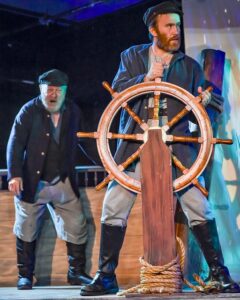
There are lots of nicely conceived and executed surprises throughout the show, some of which have to do with folklore and superstition. Oft-mentioned is the possible existence of mythical beasts and mystical beings which sailors have purportedly encountered in their journeys throughout the centuries. Among the things I learned during the course of the play is what a jonah is. According to the internet, a jonah is an expression for a person who is believed to bring bad luck. The term originates from a sailor’s superstition about the biblical prophet Jonah, whose presence on a ship led to a great storm. Furthermore, just as there is a superstition not to wish actors good luck before a theatrical performance, it’s considered bad luck to whistle on board a ship, for why would someone want to jinx the voyage or bring about misfortune to himself and others?

The lighting and sound by Liz Cooper and Joe Griffin respectively are fantastic, especially the display of disastrous weather! I loved the lighting effects that recreate furious tempests at sea, not to mention the sounds of thunder, pouring rain, and pounding surf. The fog is extremely well done too. It is sufficient to provide a hint of the weather that these sailors experienced, but it’s not overpowering for the actors or the audience. Projection design by DJ Douglass is great. The depiction of waves crashing and splashing onto the ship’s hull could not have been handled any better, not to mention the cursive script noting the time and date for each scene, which extends roughly from the beginning of July to the beginning of August in an unspecified year. The multipurpose set design of a ship’s interior is great, thanks to Ruby Lowe, together with props and puppets by Jeremiah Barr. I liked the prime focus being on the steering wheel (which, theoretically, some crew member is supposed to man at all times). It was also fun to watch the actors on the climbing ropes, which they use to adjust the sails (that exist in our imagination). Then too, there’s the ship’s railing, from which people might be thrown overboard or might hurl themselves overboard. Finally, there is the ship’s bell with its multipurpose uses, ranging from the length of a crew member’s watch and keeping time to warning the captain and crew of the likelihood of fog. Beth Laske-Miller’s costume design could not have been more authentic for the era, and dialect coach Carrie Hardin has done a fine job imparting Eastern European accents to the actors.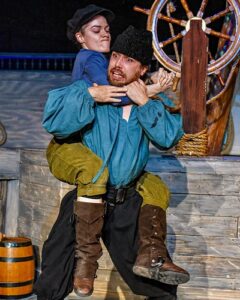
Yet there is one scene which could have been staged a bit differently so as to be less confusing. At one point, we initially think we see resurrected dead people when, in fact, they are supposed to represent English citizens who have gathered on shore to witness a ship having been blown off course. But suddenly, they turn into dead people with a need to explain themselves.
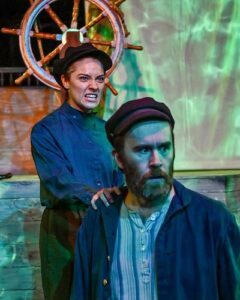
Throughout this murder-mystery, you can try to figure out who the killer might be and if and when he might strike next—or you can suspend your judgment and let the story flow over you. That being said, some of the best parts of the script occur when people turn on each other and come up with all sorts of speculations of who might be motivated to kill, as well as rationalizations for their own behavior. Yet while most aspects of the tale are neatly tied up in a bow, I wasn’t entirely sure that I gathered the full import or reach of the “whodunnit” or that I “liked” the way things came down at the end. Perhaps it has to do with my own thoughts about predestination and free will. I have a feeling that your impressions of the play’s resolution may be somewhat different than mine. But that can only add to the interesting conversations you might have with others who’ve seen the same show.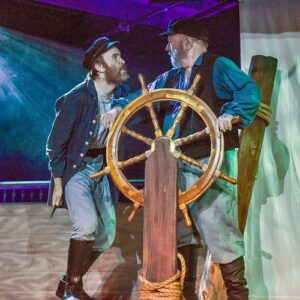
“Strange Cargo: The Doom of Demeter” is playing through November 23, 2025, at City Lit Theater, 1020 W. Bryn Mawr Avenue, in Chicago, located on the second floor of the Edgewater Presbyterian Church. (accessible via elevator).
 Single tickets are $38.
Senior prices are $33.
Students and military are $15.
 Performance schedule:
Fridays and Saturdays at 7:30 p.m.
Sundays at 3:00 p.m.
Mondays, November 10 and 17 only at 7:30 p.m.
For more information and to purchase tickets, please visit https://www.citylit.org/ or phone 773-293-3682.
To see what others are saying, visit www.theatreinchicago.com, go to Review Round-Up and click at “Strange Cargo: The Doom of the Demeter”.




More Stories
“Buddy- The Buddy Holly Story”
“Adolescent Salvation” reviewed by Paul Lisnek (Curtain Call Chicago)
“That’s Weird, Grandma’s 25th Birthday” reviewed by Julia W. Rath