
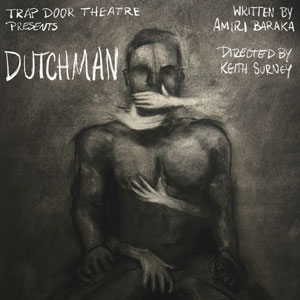
** “I don’t envy your task, writing this up,” said one of the audience members to me when “Dutchman” ended. I rarely, if ever, tell people whom I don’t already know that I’m a theatre reviewer. If anything, I say very little and listen to the audience’s reaction when the show is over. But this time was different: I had a burning question in mind. I engaged two young (African American) women in conversation, who were ahead of me in line at the exit.
“Excuse me,” I asked. “Do you think that the play was racist?”
After some initial hesitation, both said yes. Then they commented on the discomfort that this show made them feel, and we talked about it. “It was written by an African American man,” one woman said. “And black people hold a lot of trauma. What was on stage was heartfelt.” We agreed that this was a hard show to watch but, as she put it, “The actors were true to their intentions.”
The story starts out reasonably well. Written by Amiri Baraka, the play focuses on a young man named Clay (a marvelous acting performance by director Keith Surney), who wears a tie and suit jacket and is commuting from his home in New Jersey to his job in New York City. One day, he meets a sensual and sexually provocative woman named Lula (Carolyn Benjamin), who is white and who later says that she scouted him out on the train. Although the two have never met before, she knows his likes and dislikes and the people whom he hangs out with and seems to understand him almost better than he does. “I know other people like you,” she says. She clearly wants sexual favors from him, but he tries to ignore her and continue reading his book.
Yet Lula wears him down. She cuts into his defenses regarding his concept of self by exploiting the stereotype that black men are endowed with great sexual prowess, which later evolves into Clay’s search for an authentic African American identity. But how does he define this? Is it built upon the legacy of slavery or does it go further back in time to a history of black people in Africa? Or is his identity a reaction to the prejudices that whites have often held about black people? Clay’s belief that he is being persecuted in today’s society lies just beneath the surface: the product of real or imagined racial discrimination plus historical taboos regarding sexual relations between black men and white women. The gist of the story, however, is that no matter how well assimilated a black man might be in American society, he holds an underlying feeling that he never really fits in and believes that is constantly looked upon with suspicion.
While the narrative brings up interesting questions regarding Clay’s sense of self and his relationship to the (white) world, the playwright unfortunately undercuts his own narrative when the tale descends into misogyny and absurdity.
Initially, Lula’s insatiable sexual desire seems so ridiculous that it is funny. We see it when she first calls herself “Lena, the hyena.” Then Lula acts the part with leering eyes and an uncanny laugh and a sense of raw energy. During the quirky yet clever beginning, we watch how she beguiles Clay while eating an apple and making sounds as if she were having an orgasm. She then offers Clay an apple, presumably as a turn on, and he eventually accepts it. This modern rendition of the story of Adam and Eve is fun to watch, and an opening night audience liked the chemistry between the two characters. But over time, Lula becomes more obnoxious and offensive, especially with the introduction of a second Lula (Genevieve Corkery) and later a third Lula (Ali Foley), all of whom are supposed to be one and the same person. Racially-charged insults then escalate; and it is notable that right after the first Lula leaves the stage to be replaced by the second, this is the moment when the play loses its audience.
This scenario begs the question of why it is necessary to have three Lulas in the first place. Why couldn’t the same actor who played the original Lula continue in this role, at least for the sake of continuity? This has to do with the way that director Surney has chosen to characterize women in this play. Having one female character as Lula would have been sufficient to push the point that it is the white woman, above all others, who is ultimately out to emasculate and destroy the black man. However, when the three Lulas (sequentially and then jointly) gang up on Clay and cause his rage come to the fore, it becomes evident that they have been transformed into the Harpies, a group of female mythological creatures who are rapacious monsters. Here the three Lulas are not just scolding, bad-tempered women but sex objects and soulless creatures who first attack verbally and then with physical violence. While the advance piece states (among other things) that the show has to do with sexual politics, I would argue, “No, it doesn’t!” Rather, this play has its basis in misogyny, and through the actions of these female monsters, the playwright brings out their racism by propagating unflattering stereotypes about black men that are not only demeaning but untrue.
It’s one thing to question whether the world at-large can or will accept a black man in any credible position in society, no matter how well he is dressed or how well he seems to be assimilated. But do we have to witness the intensity of Clay’s self-flagellation? Why must every negative stereotype about black people have to be bandied about? Is this any way to showcase any one group of people to others? Why must there also be hints of anti-Semitism in the performance?
Viscaya Wilson’s minimal set design works well considering that the audience never knows exactly where the characters are supposed to be located in time and space. When we first walk into the theatre, we see the floor to ceiling poles as props for three pole dancers, who perform before the show starts. These poles eventually morph into those characteristic of the interior of a subway car, and thanks to lighting design by Gary Damico, we get the feel of flickering lights through the row of car windows. Yet at first, we think we are seeing a man outdoors reading with a woman wanting to share a green bench with him. Later, after we have to imagine the bench as being a large seat on the subway, it becomes doubtful whether Lula would want to climb all over Clay so publicly in order to have him succumb to her sexual advances. Then there are other moments when the audience has to imagine that the setting is a disco nightclub plus other settings mostly in Clay’s imagination. These existential shifts take place constantly and are hard to follow.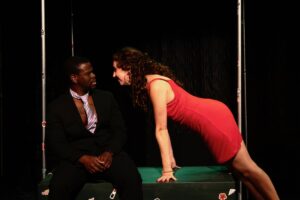
I’m presuming that the play is called “Dutchman”, because the Dutch were the first colonial power to bring enslaved Africans to the New World. This story shows us how a black man (and a descendant of these people) goes through the motions of trying to be white and act white. While the questions that Baraka raises are interesting, the presentation is chaotic and confusing. There is no need to introduce the Harpies as a means to put forward the blatant racism inherent in the dialogue. Rather than starting a good conversation that is uncomfortably relevant, the use of misogyny shifts our attention away from exploring true questions of African American identity and more towards watching monsters and their brutality. As the story becomes less grounded in reality and more improbable, this takes away from the overall message.
“Dutchman” is playing through October 25, 2025, at Trap Door Theatre, 1655 W. Cortland Street, in Chicago.
General Admission Tickets: $22.00 plus a $1.44 service fee
 Performance schedule:
Thursdays, Fridays, and Saturdays at 8:00 p.m.
For more information about this show, see: https://trapdoortheatre.com/trap-open-dutchman/.
To purchase tickets, visit: https://www.ticketleap.events/tickets/trapdoor/dutchman.
For general information and to learn about Trap Door Theatre’s other offerings, go to: https://www.trapdoortheatre.com.
Accessibility: Trap Door Theatre is wheelchair accessible.
The Trap Door Theatre, NFP is a 501(c)3 non-profit corporation
To see what others are saying, visit www.theatreinchicago.com, go to Review Round-Up and click at “Dutchman”.



More Stories
“Buddy- The Buddy Holly Story”
“Adolescent Salvation” reviewed by Paul Lisnek (Curtain Call Chicago)
“That’s Weird, Grandma’s 25th Birthday” reviewed by Julia W. Rath