
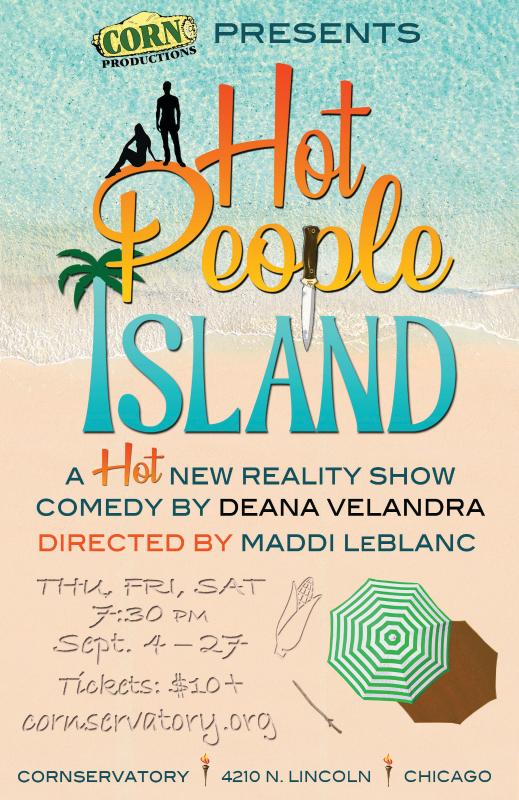
 *** “Hot People Island”, written by Deana Velandra and directed by Maddi LeBlanc, is a spoof on TV reality shows that exploit people and create genuine emotional distress and psychological harm for the sake of gaining viewership. A mashup of “Survivor”, “Love Island”, “Traitors”, “The Bachelor”, and “The Newlywed Game”, “Hot People Island” deliberately escalates the drama among eight competitors who want to do anything to win a $1 million prize.
The comedy begins with the premise that this hot TV reality show is in its 100th season. Basically, the show’s producers choose contestants in their twenties who must live on an isolated island and must couple up for dating purposes—but also for friendship and survival. Aimed at pitting participants against each other, the producers want the group to constantly vote their least favored individual off the island so that they can be the last person left standing and win the coveted prize. During the entire time, the contestants are under video surveillance, so that a TV audience can be privy to the strategic alliances among them, plus given a glimpse into the contestants’ dating behaviors and whatever humiliating material which the producers choose to broadcast.
The story begins when the show’s (queer) host/M.C. (Jonathan Castillo) introduces “Hot People Island” by means of an opening teaser, where he displays the possibility of all sorts of emotions among the participants, ranging from jealousy to pettiness to self-promotion and the like. He explains that this season is meant to be the most dramatic of all of the years that the program has been on the air. He constantly listens to a voice in his earpiece (from his producer) about what the next contest among the competitors will be. Now that he has nicely hooked the viewers, we are introduced to the eight (sexually) hot people, who will live together for the duration of the program. They are made up of four men and four women: George (Max Valdes—who sometimes wears sunglasses to look cool and wears a huge raven tattoo), Freddy (Jake Gartung—with the British accent), Craig (Tyler Harrell), Jackson (Jake Rhodes), Rylie (Sarah Seidler), Bridget (Triniti Cruz), Sandy (Trisha Stigge), and Madison (Vanessa Dalpiaz, with a Southern accent and pleasant singing voice). At the beginning, Tom (Tom Cannan) and Jam (Jamie Link) are groupies who watch the program from home and comment about it during the commercial breaks (when they mute their TV set). But later on, Tom becomes the show’s producer and Jam, his assistant. And note that theatregoers are stand-ins for a remote viewing audience.
Once the presumption of heterosexuality among the couples is squashed, the story crosses lines that would not normally be seen on television. This part of the show is clever, playful, and very funny. The second half, however, starts to descend into darkness when a relatively simple sexually tinged comedy plummets into a murder mystery, creating a certain amount of horror and edginess, both to engage and thrill a TV audience. The uses of sex and violence provide juicy moments and points of contention throughout, especially when the host prods contestants into emotional struggles fueled by jealousy, gossip, one-upmanship, trickery, and even hunger with the intent of having the program obtain higher ratings.
This is an entertaining show, not meant to be high art and where queerness is heartily embraced. It’s most likely targeted to the 21-35-year-old demographic, not to mention a drinking crowd, considering that there are many opportunities when audience members are encouraged to take a swig from our chosen BYOB beverage whenever the DRINK sign lights up. That being said, while there are moments in “Hot People Island” that are somewhat too silly or goofy for my personal taste (especially if you are sober), the audience ate it all up, especially this one man in the first row on opening night, who kept commenting aloud about the action to those seated on either side of him.
Set design by Michael Brooks is simple, if not outright corny with its simplistic cartoon-like paintings on long vinyl curtains, one of which has a green background with palm trees and another with a blue sky and white clouds. (What else can you expect from a venue called the Cornservatory Theatre?) Prop design by Anthony Sanberg is unusual, with tree trunks consisting of brown paper bags. Lighting is generally flat although there are some sparkles on occasion, thanks to Justin Oliver Lance’s design, and sound design by Deanna DeMay is appropriate. Dialect coaching by Lindsay Bartlett also needs to be recognized. Costumes by Martina Logan are modern and consist of swimwear and clothes suitable for being on an island that is hot in more ways than one. My favorite outfits, however, are those being worn by the host.
What I found so interesting about this play is that “Hot People Island” questions the norms of reality TV and makes us think about what it means to toy with other people’s emotions. Do any of the content creators realize what can happen to a person when they choose to exploit their vulnerabilities? Considering that the show glamorizes conflict, aggression, and materialism, this begs the issue of where one draws the line between ethical and unethical behavior on the part of the TV producers, the host, and the contestants themselves. How far is too far when producers allow morally questionable and dehumanizing activities to become accepted practice? When is some amount of mean-spiritedness considered acceptable, and where exactly is the tipping point when this devolves into an excessive and unacceptable amount of cruelty? Moreover, why should participants have to suffer in the first place for public amusement in order to gain a financial reward? One need only look at the possibility of an extreme case: What if satisfying the demands of a bloodthirsty audience can ensure higher ratings? What are the demands of shock value?
The horror sets in when we are faced with our own complicity as a TV viewer in being fixated when people are being treated as objects for our own entertainment. This is not just limited to who should be sent home packing but also who is forced to be eliminated from the competition (with the key word being “eliminated”). Thus, a major point that the show makes is this: When we confuse reality with reality TV, this can become a recipe for disaster—and it becomes harder and harder to become instinctively appalled when we watch certain attitudes, behaviors, and activities on television—and in real life—that cross the line. But again, where is that line and who determines it? And when is it the right moment for me, as a viewer, to simply turn off the TV set—or not turn on the program in the first place?
There are several spots in the play when unexpected twists and turns glue us to the edge of our seats or make us feel uncomfortable. When the intrigue draws us in more tightly, we are caught up in the web of manipulation. This 95-minute performance is never dull and accomplishes what it has set out to do.
“Hot People Island” is playing through September 27, 2025, at the Cornservatory, 4210 N. Lincoln
Avenue, in Chicago.
Tickets range from $10-20.
 Performance schedule:
Thursdays, Fridays, Saturdays at 7:30 p.m.
For more information and to purchase tickets, visit: https://www.cornservatory.org/.
To see what others are saying, visit www.theatreinchicago.com, go to Review Round-Up and click at “Hot People Island”




More Stories
“Escape to Margaritaville” reviewed by Julia W. Rath
“Instructions for a Seance” (Milwaukee) reviewed by Amy Menzel
“Vladimir” reviewed by Frank Meccia