
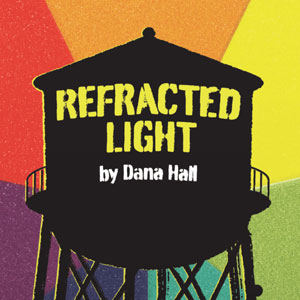
** The world premiere of “Refracted Light” by Eclectic Full Contact Theatre tells a true-to-life tale about a dysfunctional family. In this coming-of-age story, 18-year-old Penny (Jamie Lee) plans to go away to college. Although she already knows that she is a good writer, she has no idea what the next chapter of her life might bring. For now, Penny wants to be treated as an adult and feels the need to break away from her parents and do her own thing, while her high-strung mother Lucy (Jessica Lauren Fisher) wants to prolong treating her as a child—and continue always getting her own way. What’s good about this story is that it is realistic: We see how both main characters learn how to change and grow. However, the situation in the Harris family is compounded by the fact that Penny is part of an alcoholic family structure, which has been passed down from one generation to the next. Although the family dynamics are interesting to watch and the exploration of alcoholism, drug dependency, and mood disorders is done very well, the overall plot could be made a lot more compelling and effective than it is. The stakes need to be much higher than the emphasis on Penny’s graduation from high school and the party that will follow.
First, let’s start with the underpinnings of the story. For those unfamiliar with the alcoholic family structure, this is a situation where addiction affects family dynamics in different ways. While certain family members enable the alcoholic(s) among them, coping strategies often lead to the abuse of others or their emotional neglect. When excuses are made for bad behavior, the blame becomes widespread among the circle. In this case, Penny, being a child and a grandchild within an alcoholic family, has suffered from an unpredictable home life to say the least. This is alluded to by her mother who mentions early on to Penny’s father Ted (Zach Kunde) that her younger sister, Becky (Kim Wilson Buck) previously went through a somewhat similar experience as Penny is undergoing now, that is, when both sisters grew up in their own dysfunctional family with an alcoholic mother. Soon we find out that Penny was hospitalized at a young age for a mood disorder and has been on medication ever since. This, we learn, is similar to Becky’s situation where she was (improperly) diagnosed with depression as a child and placed on drugs. Because of the perceived similarities between Penny’s situation and Becky’s, Lucy allows “the cool aunt” to step in and become Penny’s informal counselor with regard to her home life and whatever troubles she may be experiencing. Deep conversations between aunt and niece—such as atop a water tower—contrast with the professional guidance provided by Penny’s psychotherapist Dr. David Daker (Charles Schoenherr). Like Penny’s aunt, Dr. Daker is well-aware of Penny’s personal challenges. Whenever the young woman doesn’t know how to handle her emotions or is confused about how to run her life, she gravitates between the two of them, who offer very different advice while offering a sense of comfort and connection.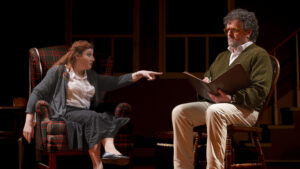
Playwright Dana Hall ought to be commended for many nicely written portions of her script. Penny, Lucy, and Becky are especially well-developed characters. The prose is beautiful when Penny reads some of her own writings aloud and when Dr. Daker provides his words of wisdom. There are certain confidential dialogues that are beautifully done. We get the point quickly that the beginning of college is a time when parents and their adult children need to renegotiate their relationships with each other and reestablish boundaries. However, at 2-hours and 15 minutes (with a fifteen-minute intermission), the story drags in spots with too much verbiage. The script needs to get to the point sooner. The alcohol scene with Lucy lasts much too long, even though it’s fascinating to see how much Lucy is enamored of her handbags. The portion of the show with Ted and squirrel in the tree unnecessary to tell this tale, despite the fact it’s good for a laugh or two. And yes, the show does have its laughs, not to mention its bright spots. One of its best moments has to do with Becky and Penny both wanting to see the world with its vivid colors but not being able to do so “properly” because being on meds dulls the senses. But as Becky says, you still see the colors and their gradations, even if they aren’t bright. All that being said, a 90-minute show with no intermission would work much better for this script, especially considering that the end of Act I and the beginning of Act II take place during the exact same evening and there is not enough “suspense” at this point in the drama for a break between acts.
Direction by Natividad Salgado is respectable. Cassie McKnight’s set design is fine when it comes to the action inside the house with its lovely blue walls, dark blue curtains, and red rose stained glass. Tricia Carver-Horner’s props design is nicely suited, such as the furniture in the living room and dining room. However, the audience has to largely imagine the scene in the doctor’s office, and I would have appreciated seeing something more than just the two chairs. I especially would have liked more fanciful lighting and projections at the time when Penny and Becky decide to sit outdoors on top of a water tower. Since Penny says how beautiful the view is, maybe there ought to have been some type of LED rotating motion star projector, so that the audience would be privy to the night sky, or possibly we could observe the glow of skyscrapers in the distance. Furthermore, it would have been great to see a projection of a water tower that mimics the cover of our program. Costume design by Alex Kingsley is contemporary, and sound design by Kate Schnetzer works well for this space.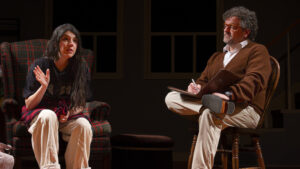
When you’re 18, being expected to do something you don’t want to do may seem like the end of the world. But since Penny is going off to college soon and able to do what she wants without parental supervision, then spending several hours at a family party that she doesn’t really want to attend is not so horrible. It’s not that big of a chunk out of her life. And sometimes you just have to humor other family members… and suck it up. Nevertheless, I get it: For whatever reason, Penny doesn’t want a big fuss being made over her. But equally valid is that her parents feel that this is a special occasion. I would argue that it is a sign of maturity to figure out your priorities and which parts of life are more or less important in the scheme of things—and when it’s important to be true to yourself and your own feelings and sometimes not so much. The key is to understand where the boundary line exists between how far other people can push you and when you should push back.
More precisely, the prospect of attending a graduation party is not a strong enough plot point to revolve this story around. Going to this event (or not) won’t make much of a difference in the scheme of things during the rest of Penny’s life. To make this story more compelling (while keeping issues regarding emotional trauma intact), the young woman ought to be involved in a decision that has far more consequences regarding her future life chances. For example, maybe her parents didn’t want her to go away to college in the first place and now insist that she attend college while continuing to live at home. Alternatively, she could resist her parents’ desires for her to immediately take a job rather than obtain a higher education. The possibilities are endless. Basically, the play would be more noteworthy if there were a cultural or generational divide between the parents and their daughter in addition to all of Penny’s angst about her existential condition and the fact that she’s on medication. Should there be a greater amount of conflict between what Penny’s family wants her to do with her life versus what she wants to do, then the potential uncertainties and outcomes would be more interesting to follow.
“Refracted Light” is playing through September 27, 2025, at The Edge Theatre, 5451 N. Broadway, in Chicago.
Tickets are $30.
Performance schedule:
Thursdays, Fridays, and Saturdays – 7:30 p.m.
Sundays – 3:00 p.m.
For further information and to purchase tickets, please visit: https://www.onthestage.tickets/show/eclectic-full-contact/6852d0fa009fe80fb633dd8b.
To see what others are saying, visit www.theatreinchicago.com, go to Review Round-Up and click at “Refracted Light”.



More Stories
“Buddy- The Buddy Holly Story”
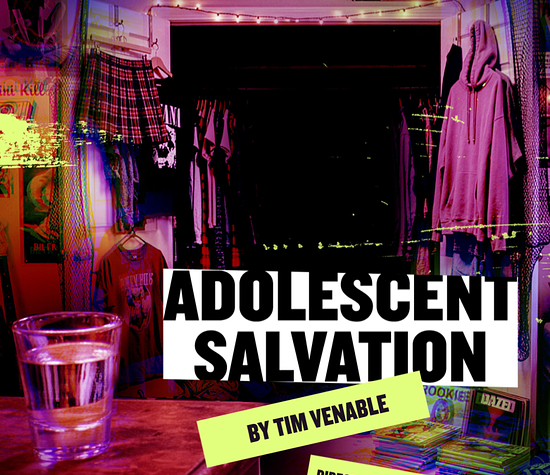
“Adolescent Salvation” reviewed by Paul Lisnek (Curtain Call Chicago)
“That’s Weird, Grandma’s 25th Birthday” reviewed by Julia W. Rath