

***** “Dear Jack, Dear Louise” is a sweet romantic comedy set against the backdrop of America’s entry into the Second World War. Brilliantly directed by Mandy Modic, the play features a nicely drawn chemistry between David Moreland as Jack Ludwig and Isabelle Muthiah as Louise Rabiner, whose snail mail letters over two years’ time draw them closer together. Jack is a medical doctor, who is also a U.S. army captain and originally from Coatesville, Pennsylvania, while Louise is a dancer and an aspiring Broadway actress from Brooklyn. Since Louise’s father and Jacob’s father previously knew each other, they suggested that their twenty-something-year-old children become pen pals—now that Jack has been stationed in Oregon and Louise has made the move to New York City.
The first act of this epistolary play begins in July 1942, and if anything, it’s more about the couple’s growing romance from a distance. “It’s good” and “It’s really cute” were the comments I heard during intermission. The second act begins in August 1943, and to my mind, this part of the story is what makes the show. Things are not so free and easy as tension builds up and doubt starts to creep in about whatever connection that Louise and Jack might have established through their letters. This reality becomes all the more poignant after we see Jack leave his stateside position as a doctor to go overseas and arrive in France in the third wave on D-Day. Not only was this a time when there was moral clarity regarding the enemy, but the performance also tells us what it means to be a medical doctor who treats both American and German casualties. The show also portrays the establishment of a second front against the Germans with exact locations being kept secret. All the while, Jack retains his composure and fortitude, because he has some type of anchor at home—whether it’s his parents, his best friend Greg, or his distant girlfriend—who, through their letters, clearly provide him with some grounding in life back in the U.S.A. At the same time, Louise continues to audition for acting roles on stage, and she writes about her latest developments in advancing her career. What Jack’s and Louise’s handwritten notes reveal is a sense of shared values and shared ties to family relationships—all the while the world-at-large impinges on their lives and potentially affects whether they succeed in accomplishing their dreams, ambitions, and goals.
Bob Silton’s scenic and props design could not have been any better! Two gigantic postage stamps grace the stage’s backdrop: The one on stage right is engraved in red, features a biplane, is focused on the Army and Navy, while the one on stage right is engraved in blue and is focused on Industry and Agriculture, that is, the domestic scene. Underneath the Army/Navy stamp is a door that one might see in an office building and a straight-line rectangular desk where Jack does his writing. This is contrasted with the residential door, overstuffed sofa, and curvaceous and highly polished walnut desk with spindly legs where Louise pens her letters from home. The proscenium arch is made to look like the outline of a traditional airmail envelope, with its alternating red, white, and blue diagonal markings, plus the canopy of letters strung together and hung on the ceiling over the stage and a portion of the audience captures a sense of whimsy. I loved this combination with the authentic 1940s furniture.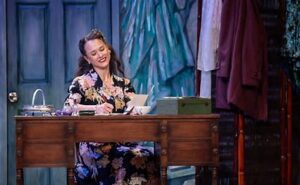
Lighting by Alexa Wiljanen is usually lighthearted, (such as in illuminating the canopy) but it becomes more dramatic as the show proceeds, for example, the judicious use of spotlights to illustrate emotion—and using strobe lights to depict battle scenes. Sarah Ramos’s sound effects, such as gunshots from small arms fire and bombs going off, only add to the drama.
I absolutely adored the costume design by Rachel Sypniewski! Of course, Jack is attired in World War II-era military apparel, such as his combat uniform, his dress uniform, his helmet, and all his associated gear. Most of the time, he wears an armband with a red cross on it to indicate that he is a medical doctor. But, for me, the most fascinating and thoughtful apparel is worn by Louise. All the dresses she wears are cut along the same early 1940s pattern, each sporting a V-neck, buttons in front, defined waist, hem below the knee, and side zipper. The dress worn at the beginning is navy blue with a huge floral print, as if she were about to kick up her heels during a (virtual) summertime fling. Later in the first act, she changes to a darker navy blue dress with off-white flowers that are somewhat smaller, yet form a pretty pattern. There is less gaiety in the second dress, but it’s still quite cheerful, especially when she changes to her off-white shoes. In the second act, however, Louise is clothed in a staid dress in navy blue with very tiny flowers which resemble polka dots from afar. Basically, as Louise’s and Jack’s letters progress from mere curiosity about each other to the prospect of a serious and committed relationship—and as her career starts to take off—her dresses change too: The flowers become smaller and less noticeable, and the dresses shift from symbolizing playful romance to embodying intense concern. Or alternatively this change in fabric represents Louise’s fear of desertion or loneliness, since the flowers in the last dress are placed farther apart from each other, while still forming a regular pattern.
In all, this play is largely an old-fashioned love story that neatly transports us to an age much different from our own. We observe how it becomes more challenging over time for both Jack and Louise to tightly focus on their budding relationship, which is continually threatened by outside forces. In addition to the narrative including particular experiences from the World War II era, it features nostalgic references to movie stars and Broadway shows from eighty years ago. Of course, I won’t ruin the ending for you. But is it any surprise that the script was written by Ken Ludwig… and this is the story about how his parents met?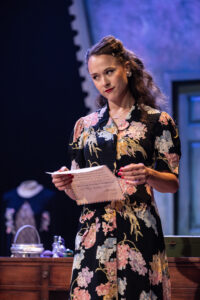
Yet what makes this tale so relevant (and riveting) is that with the advent of social media and the prevalence of texting, using the written word to connect with strangers has made somewhat of a comeback. In other words, the fashion of writing messages to a person whom one has never previously seen or met might once again be appealing today. The advantage of this sort of casual correspondence is that this can allow you to explore interests and commonalities before meeting up in person. It can afford you the luxury of having people introduce themselves from a distance and for you to learn something about their character, lifestyle, prospects, and opinions before any chemistry might get in the way. And by and large, that’s what this show is all about.
Please see this production soon, because there’s only one weekend left to go!
“Dear Jack, Dear Louise” is playing through August 3, 2025 at the Metropolis Performing Arts Centre,
111 West Campbell Street, in Arlington Heights.
Tickets range from $20-$49.
 Performance schedule:
Sat, July 26: 2:00 p.m. and 7:30 p.m.
Sun, July 27: 2:00 p.m.
Wed, July 30: 2:00 p.m.
Thu, July 31: 7:30 p.m.
Fri, August 1: 7:30 p.m.
Sat, August 2: 7:30 p.m.
Sun, August 3: 2:00 p.m.
For more information and to purchase tickets, visit https://www.metropolisarts.com/ or call the box office at 847-577-2121.
To see what others are saying, visit www.theatreinchicago.com, go to Review Round-Up and click at “Dear Jack, Dear Louise”.





More Stories
“Escape to Margaritaville” reviewed by Julia W. Rath
“Instructions for a Seance” (Milwaukee) reviewed by Amy Menzel
“Vladimir” reviewed by Frank Meccia