

 **** Billed as a provocative riff on “Waiting for Godot” and “The Book of Exodus”, Antoinette Chinonye Nwandu’s play “Pass Over” takes a deep dive into the topic of racism with the utmost of seriousness plus piques of humor. The play demonstrates the futility of life in Englewood, a rundown and segregated inner-city neighborhood on Chicago’s South Side. Directed by Tim Rhoze, this illuminating and powerful story about the lives and dreams of two black men is both profound and enlightening.
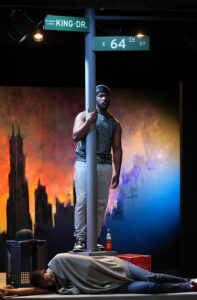
One of the first things the audience observes when walking into the theatre is the set design (also thanks to Rhoze plus muralist Sarah Kaiser). We see a painting of Chicago’s downtown skyscrapers in the distance, and in the foreground, a signpost marks the intersection of 64th Street and Dr. Martin Luther King Jr. Drive. Hanging out and jiving on this street corner are two black men: Moses (Tyshaun Meekie) and Kitch (Ty Norwood). Much like Estragon and Vladimir in “Waiting for Godot”, they are alternatively comedians, absurdists, and nihilists. But most of the time, they reflect on the human condition, on the meaning of suffering, and on an existential situation that is very tangible for both of them. As these two friends trash talk to pass the time, they describe what it means to be trapped in an impoverished area of the city and constantly live in a culture of fear, where the police routinely harass them and their “brothers” and treat them like criminals. In the course of revealing painful truths, they occasionally drop to the ground in response to the sound of gunshots: a reality that is both exhausting and soul-crushing. But what is free is their mindset and their willingness to laugh and to share their dreams.
Moses is the visionary. He aspires for things to be better than they are, and he preaches the prospect of seeing the world as it could be or should be—rather than settling for what is. As in the story of Exodus, it is Moses who sees beyond Egypt to the Promised Land and wants to take his community with him. He constantly uses the term “pass over” in every single nuance imaginable. Of course, the prime meaning of “pass over” is a reference to the Prophet Moses leading the Jews out of Egypt and out of slavery to something new and different and beautiful and perhaps unimaginable. Yet Kitch rebukes his friend for being foolish. He finds it ridiculous that Moses aspires to the culture of the wealthy white man with his champagne, caviar, and fancy hotel suites. And of course, how could there ever be the reality of a quiet and safe neighborhood in which to live? Rather, Kitch metaphorically wants to stay in Egypt, that is, remain in the ’hood. His dream of abundance largely has to do with himself: He wants to show off his jewelry, his fancy car, his house, and all of his acquired riches to his buddies. He also wants to retain his culture, including the constant use of the “n-word” (which Moses, at some level, is willing to give up). It is interesting how Kitch has chosen a mundane name for himself, as compared to his given name of Percy, which is more elitist-sounding and not in keeping with his self-image: of wanting to act more authentically “Black”, because that’s his identity and his concept of self in his own mind.
As in “Waiting for Godot”, there is a third character in the show. Here it’s a white man (Tiemen Godwaldt) who plays two different roles. When we first see him, the disoriented man is apparently lost in Englewood. Carrying a picnic basket, he wants to have lunch with his mother and constantly refers to himself as his “mother’s only son.” This is clearly a reference to Jesus Christ: in this case, to a white Jesus, who calls himself Master. His seeming generosity is a paternalism with strings attached, presumably having to do with submission to the dreadful way that things currently are. Godwaldt also plays a corrupt and brutal police officer (Osifer) who routinely harasses Moses and Kitch and others in the neighborhood. The implication here (and I hope I’m not putting words in the mouth of the playwright) is that both the white liberal do-gooder and the corrupt white enforcement officer are equally prejudiced against black people and together serve to keep them down. We in the audience come to understand how constant humiliations and a series of dashed expectations combined with personal pain can result in bitterness (if not rage) and a loss of hope in one’s future.
Over time, as things for Moses and Kitch go from bad to worse, their visions begin to merge as they realize that there may not be any earthly riches for either one of them. The bottom line is that it doesn’t seem to matter whether an African-American man can see past his neighborhood or seek to overcome—or “pass over” (that is, using one iteration of the term). It doesn’t matter whether a black man uses the “n-word” (or not) in referring to his peers or whether he has visions of the Promised Land or has to content himself with things remaining largely as they are: Both share the same culture and heritage and live in the same doomed locale. As harsh external forces are drawn inside of themselves, both individuals question who and what they are and why they are here, and soon it becomes an illusion to think otherwise. In this case, death (a very different definition of “pass over”) might become the escape. Death may be empowering, but only if it’s on your terms and not that of white man.
Now for a bit of my own biography: Being Jewish, I really wanted to see “Pass Over.” There is the common thread of slavery and discrimination that is shared by both blacks and Jews, together with some amount of racial prejudice that exists in almost every generation. Every year at Passover, we read from the Hagaddah about the Ten Plagues and the miracle of Moses’ parting of the Red Sea and leading his followers to freedom. The question on the table is: “Are there or are there not any miracles that can change such dire circumstances?” “Is God there but is not listening?” This play is saturated with futility and fatalism—and that’s a lot of the power of the story. However, there is something to be said about working to get the metaphorical Egypt out of you and not forgetting that you are destined for better things.
“Pass Over” is playing through August 10, 2025, at the Fleetwood-Jourdain Theatre in the Noyes Cultural Arts Center, 927 Noyes Street, Evanston.
General Admission Tickets: $32
Students: $10
Performance schedule:
Saturdays at 7:00 p.m.
Sundays at 3:00 p.m.
For more information about this and other shows, visit https://www.cityofevanston.org/about-evanston/arts-and-culture/theatre/fleetwood-jourdain-theatre or call 847-866-5914.
To purchase tickets for “Pass Over”, go to: https://apps.cityofevanston.org/webtrac/wbwsc/webtrac.wsc/search.html?module=PST&keyword=FJT.
To see what others are saying, visit www.theatreinchicago.com, go to Review Round-Up and click at “Pass Over”.





More Stories
“Shane” Reviewed by Julia W. Rath
“Sunday In The Park With George”
“Buddy- The Buddy Holly Story”