

 *** Griffin Theatre Company’s production of “Girls & Boys”, written by Dennis Kelly and directed by Robin Witt, is a dramatic one-hander that stars Cynthia Marker in the role of Woman. In This Midwest premiere, Marker commands the stage as she recites her insightful monologue about a British woman’s life and presents a gut-wrenching set of circumstances that range from the mundane to the devastatingly traumatic. What an incredibly thoughtful and intense performance! And Kelly should be commended for the grace by which this biographical tale eases into a disturbing piece of theatre that introduces us to the term “family genocide.” No, we don’t bear witness to the violence; we are only told about it. “It’s not happening here; it’s not happening now,” says Woman at one point to the audience. So we are spared the grisliness of it all. Yet the question I found myself asking as a reviewer was this: How do you write about a profound tragedy without giving the story away?
Woman is originally from Southampton, England, and in her youth has interests in sex and parties and in gaining some measure of fulfillment in life in both career and family (although she has no clue what this might entail). On a lark, she travels to Italy for what seems to be an extremely low-level position in the documentary film industry which, for some unknown reason, has captured her interest and tickled her fancy. Once she gets this relatively obscure but apparently important job, she meets Jason, who has made a name for himself in creating documentary film. He eventually becomes her husband, and together they raise two children: LeeAnn and Danny. Every so often, there is an interruption in Woman’s stream of consciousness when we see snippets of her playing with LeeAnn at the age of seven and Danny at the age of five. After a short domestic scene, it’s back again to the personal reflections.
In all, this is a story about Woman’s struggles and how she thinks about them. Apparently, she not only takes care of the children but simultaneously advances in her career: so much so that her husband eventually sees her as being some kind of threat to his masculinity. Woman is baffled by his sudden distance: Why does Jason no longer care for her or care about her? She could understand his having an affair as being the reason for their marriage falling apart, but she could never (in her wildest dreams) have imagined that he would feel threatened by a wife who honestly might be more talented than he is.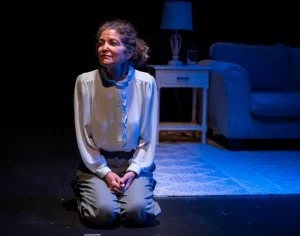
For me, the title “Girls & Boys” is somewhat of a misnomer—although by the end, girls and boys really are the priority. It’s the title’s seeming innocence which draws you in without beating you over the head that you’re going to be told an innately distressing story. You are also drawn in by the weird humor at the beginning, not to mention the foul language and sexual references. Yet there’s a fallow period in the middle of the play when things move just a bit too slowly. Perhaps ten minutes could be cut without ruining its impact. And then we could get to the point faster.
The scenic design by Sotirios Livaditis and prop design by Paloma Locsin are cleverly coordinated with the lighting design by Brandon Wardell. The part of the set on the stage is all in off-white: the couch, the lampshades, the rug, etc. This coordinated with the off-white lights (flat and spotlight) which illumine Woman throughout the bulk of the performance as she talks about herself and her life. However, one of the first things I noticed upon entering the theatre was similar upside-down furniture hanging on the ceiling, all in dark teal. Among other things, we see an upside-down bear sitting on the couch and what seems to be children’s toys. Later we notice that this part of the set is intentionally lit, akin to the moments when the blue light predominates: The blue shines whenever we see Woman caring for her children and running after them. If there is meant to be any foreshadowing, it is this: The set portends a world that has been turned upside-down, at least for Woman. But I also felt that the blue meant that these scenes of domestic “tranquility” were not exactly what Woman bargained for when she decided to work and raise a family at the same time. She becomes blue in the face when shouting at her children and participating in their silly games, and one could surmise that this type of scene provided her with less satisfaction as compared to her job. The story ultimately is about getting one’s priorities straight: where everything thought to be upside-down is really right-side up and vice versa…. But how would we know this? For Woman, it’s the love of family that ultimately takes precedence over the love of a job or how well she can do it. And she comes to the realization that it is impossible to go back in time to recreate or relive a family situation that may or may not have been satisfying. Time is something you can never get back, while mournfulness can continually return.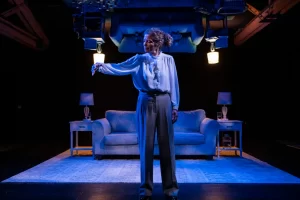
Thomas Dixon’s sound effects are imaginative. I noticed that these strange and baffling sounds would tend to follow the scenes envisioning the children: whenever the blue lighting ended and the off-white lighting returned. But my guest felt that they sounded like water and took them more literally than I did. He thought the sounds were supposed to portend something, while I thought that they demarcated scenes and shifts in perspective, although they were too loud relative to the monologue. Speaking of portents, I liked the photo on the cover of the program, which does allude to the underlying creepiness and horror of the tale.
Woman wanted to share her world with today’s audience. But could she ever put the pieces of her life back together again? Of course, one has to ask: Is it ever possible to get past any horrible tragedy? To my mind, seeing this show can offer a sense of catharsis or closure to the families who have been shaken by this kind of horrendous crime and might make them more inclined to reach out to a network for social support. In other words, survivors might desire to connect with others who have gone through same or similar hardships, or they may choose to offer healing to those attempting to recover from such a terrible event or make sense of it. Perhaps the point of creating this show was not just to acquaint the audience with the topic of family genocide but to urge individuals to learn more about what can happen so that they might better recognize its warning signs.
Marker definitely makes a connection with the audience through her super-convincing acting as Woman. The night I saw the show, she received a standing ovation from everyone! Her practically nonstop monologue in a 100-minute performance is remarkable. What is exemplary, however, is that she has to say the same words every night on such a gruesome theme. Be prepared to be ill at ease with the subject matter. The show will unquestionably open your eyes and definitely is worth seeing.
“Girls & Boys” is playing through August 16, 2025 at Bramble Arts Loft, 5545 N Clark Street, in Chicago.
Tickets range from $30- $43.
Performance Schedule:
 Thursdays, Fridays, and Saturdays – 7:30 p.m.
Sundays – 3:00 p.m.
For more information about this show and to learn about their other offerings, visit https://www.griffintheatre.com/.
To purchase tickets for “Girls & Boys”, go to https://ci.ovationtix.com/34563/production/1240744
Approximate runtime: 90 minutes with no intermission.
To see what others are saying, visit www.theatreinchicago.com, go to Review Round-Up and click at “Girls & Boys”.





More Stories
“Escape to Margaritaville” reviewed by Julia W. Rath
“Instructions for a Seance” (Milwaukee) reviewed by Amy Menzel
“Vladimir” reviewed by Frank Meccia