

***** When is the right time to leave a country that you and your ancestors have known and loved… and where your ancestors have lived for centuries? This is the underlying theme behind “Prayer for the French Republic”, a co-production between Northlight Theatre and Theater Wit and a play that is “spot-on” for these uncertain times. Jeremy Wechsler’s splendid direction neatly captures a story that is sad yet funny and smart; he strikes just the right balance in creating a believable family situation that neatly combines personal history with current events together with a compelling presentation of historical events as they affect French Jewry.
Written by Joshua Harmon, the play is focused around the Salomon family and consists of two threads. The first takes place in 2016-17 and is a story about a family of Jews living in France just after the Charlie Hebdo killings: a time when far right extremist Marine Le Pen ran for president as a member of the National Front Party and who attracted quite a following of Nazi sympathizers. The second thread takes place during the 1940s: a time when French Jews were so well assimilated that they remained in the country until it became much too late to escape the clutches of the Vichy regime. As a consequence, most were deported to concentration camps. With this collective memory constantly haunting French Jews in the present day, the question becomes: What do you do if you’re Jewish and when Jews are (once again) being singled out for threats, intimidation, and physical harm? Do you hide your true identity? Do you put aside your religion and remain in France? Or do you plan to escape to another country—and then ask yourself if this is the right moment to leave or not?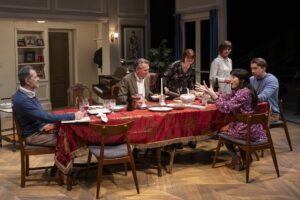
Specifically, this tale is narrated to a greater or lesser extent by Patrick Salomon (Lawrence Grimm). At the onset, he explains a bit about his family history and the importance of the Salomons’ crafting and selling pianos for well over several generations. The play then draws in an American audience via the character of 20-year-old Molly (Maya Lou Hlava), who is originally from New York and is doing a study abroad year in France. She has come to visit her distant cousins the Benhamous family on the weekends. The father Charles Benhamous (Rom Barkhordar) is a doctor by profession and an Algerian Jew, whose family immigrated in the 1960s. The mother Marcelle (an absolutely brilliant performance by Janet Ulrich Brooks) is Patrick’s sister and a psychiatrist by profession. She is Molly’s relative by blood on her father’s side of the family. Marcelle and Charles have two children: Elodie (Rae Gray), who is 28 and manic-depressive with a brilliant sense of history and a biting and humorous sense of irony, and Daniel (Max Stewart), who is 26 and overtly more religious than either of his parents, such that he wears a kippah (yarmulke).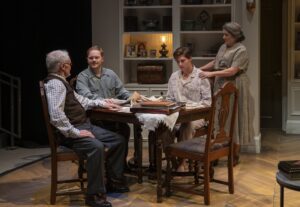
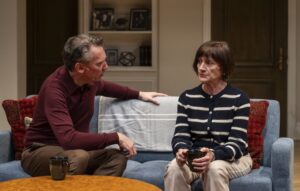
At the same time, we learn about Patrick’s and Marcelle’s great-grandparents Adolphe Salomon (Torrey Hanson) and his wife Irma (Kathy Scambiatterra), who miraculously avoided deportation from France during the Holocaust and survived undetected during their elderly years. The audience witnesses what it was like when their son Lucien (Alex Weisman) and their grandson Pierre (Nathan Becker) returned to their family home from a concentration camp in Poland after World War II ended. In fact, Pierre (Patrick’s and Marcelle’s father) is the only character who ages in this story, such that we later get a perspective on life from him as an elderly man (Henson Keys) during the third act. In fact, it is the third act which makes the show. It is riveting and very real and pulls together lots of initially disparate elements. I especially loved watching the arguments around the dining table and seeing the characters’ strong differences of opinion when it comes to figuring out what next to do with their lives: how they each have a different vision of what their future might be and how they might choose to care for their papa, the aging Pierre.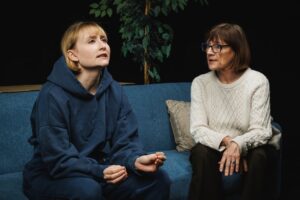
Three hours with two intermissions goes by quickly. I learned a lot about French Jewry and its history while watching this show, not to mention witnessing this family’s struggles with their Jewish and French identities. What is best, however, is its honest dialogue. While the topic of antisemitism is jarring and scary, the uses of humor and swear words add liveliness and some measure of everyday reality to the story. While sometimes pedantic with voluminous amounts of historical detail, the narrative can still be followed nicely without reference to any of this, even if you are unfamiliar with the Jewish religion and traditions or even with Jewish history as it relates to World War II and the Holocaust. Basically, you need to take in everything on an emotional level and examine what each character is going through at any given moment as they struggle with the threat of antisemitic violence in their own way. Do they see it? Do they deny it? When do they see it? And what do they choose to do about it? Emotions in this play range from fear to anxiety to anger to hope. For example, it is the injured Daniel who wants to weather out the storm and not be captive to fear, while his father Charles goes to synagogue and prays for the French Republic in the hope that things will become better—and truer to the ideals of French democracy, that is, the virtues of liberty, equality, and fraternity. Thus, it should be no surprise that the production opened on Passover week 2025, having to do with the holiday retelling of the Exodus story, which is associated with freedom, the primacy of the rule of law (as with the Ten Commandments), and the ability to practice one’s religious faith without obstacle.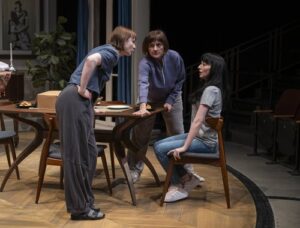
The set design by Joe Schermoly works very well, such that we see a living room/dining room area with the three doors on the back wall of the stage, together with the railing above that allows us to imagine a bridge outdoors. Nicholas Bartleson’s prop design, with the more contemporary dining room table in front and the older dining room table towards the back, allows us to differentiate between the two different time periods. I liked the lighting design by JR Lederle, which features the Eiffel Tower at one point as well as synagogue lights. Costumes by Mara Blumenfeld are authentic for both time periods. Sound design by Joseph Cerque works well for this show.
There is a saying in Hebrew: “L’dor v’dor”, which means from one generation to the next. We can see the angst of the present generation grappling with similar issues and prejudices from the past and having similar discussions as their ancestors. This idea is especially important to a story that spans five generations of the Salomon family. And in every generation, there has been some measure of antisemitism, even when certain times and places seem to be better for the Jews.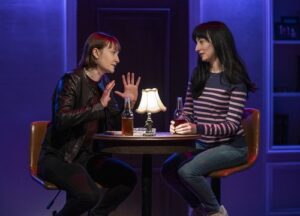
So while the underlying tale is about the Jews in French history, the show is nevertheless meant to tell us something about America and Jewish-Americans too: Since the deportations and killings of Jews never took place on American soil, the United States has been largely isolated from a specific type of hatred that permeated Europe across the generations. This explains why so many Jews were so anxious to emigrate to the United States: to put the killings and violent attacks behind them. Moreover, American Jewry has tended to be more isolated against random attacks against individuals as compared to French Jewry, because of a somewhat different history in relation to the State of Israel and the policies of Netanyahu’s government. But times have changed since this play was written in 2022 and especially since October 7, 2023. Considering that the parallels between antisemitism in France and the United States are slowly becoming all too true, this well-crafted and intricate play may resonate more with an American audience today than when Harmon first wrote it.
“Prayer for the French Republic” is playing through May 18, 2025, at the North Shore Center for the Performing Arts, 9501 Skokie Blvd, in Skokie.
Tickets range to $91 on Ticketmaster, depending on the time and date of the performance and location within the theatre.
Student tickets are $15, but you must call 847-673-6300.
Group tickets are available for 10 or more people. For rates, email groupsales@northlight.org .
Performance schedule:
 Wednesdays – 1:00 p.m. and 7:30 p.m.
Thursdays and Fridays – 7:30 p.m.
Saturdays – 2:30 p.m. and 7:30 p.m.
Sundays – 2:30 p.m.
For more information and to purchase tickets, visit: https://www.theaterwit.org/tickets/productions/536/performances, which will take you to Ticketmaster.
You may also phone the Theater Wit box office at 773-975-8150 or the North Shore Center box office at 847-673-6300.
For more information about Northlight Theatre and their offerings, please visit https://northlight.org/.
For more information about Theater Wit and their offerings, see https://www.theaterwit.org/.
To see what others are saying, visit www.theatreinchicago.com, go to Review Round-Up and click at “Prayer for the French Republic”.
 Paul Lisnek, WGN+, WGNRadio.com
****/4
——————-
Riveting, Gripping and Compelling.
Prayer for the French Republic may be set a continent away, but the message strikes at home all to strongly…in fact, too close for comfort. In fact, the title could accurately be called prayer for America and the world. It hits home that hard.
It’s story that ultimately has a Jewish Family asking: “Why Do they hate us?“ Can anyone really answer that question with certainty? We see the fear, the danger, the uncertainty of safety and just living your life without an intent to bother anyone else….indeed, what are you so afraid of when it come to the Jewish people? A question that has been pondered for thousands of years and most answers to that question are based on false narratives and ideas. This three-act play is set in 1944-46 and 2016-2017, decades apart but with a history of discrimination which, if it has not be repeating, certainly has been rhyming.
But this is also a story of family…of the challenges and struggles that certainly every family faces, but here, we are made to wonder whether life’s questions can be pegged to the history of the Jewish people.
The cast, simply put, is stellar. Janet Ulrich Brooks (as Marcelle) is one of Chicago’s premiere talents and she shines here with strength and dominance; a tour de force. Rom Barkhordar (as her husband Charles, who has also made a mark in many Chicago-based shows including the classic A Band’s Visit at Writers) and Rae Gray and Max Stewart as their 20-something children provide the other two corners of this family square dynamic. There is something great to be said about every performer in this production which is one more reason this show is not to be missed!
Prayer for the French Republic is a co-production of Northlight Theatre and Theater Wit and runs through May 18th at Northlight Theater in Skokie. Tickets can be purchased at: www.northlight.org
Paul M. Lisnek, J.D., Ph.D.

More Stories
“Shane” Reviewed by Julia W. Rath
“Sunday In The Park With George”
“Buddy- The Buddy Holly Story”